How I Made $1M Trading Forex After a Losing Streak
TL;DR
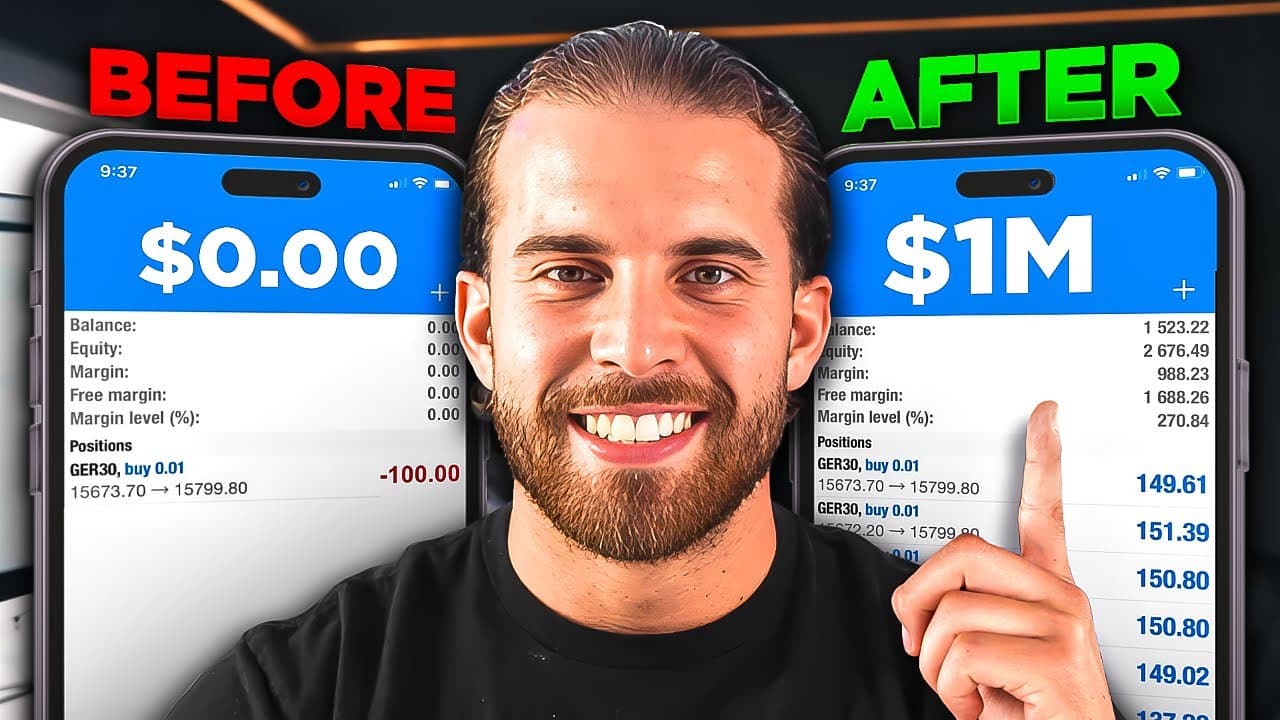
Recovering from a six-figure losing streak came down to abandoning a partnership, trading solo, and following a fixed plan to the letter. The core method: a strict 1:2 to 1:3 risk-to-reward on every trade, risking $200,000-$300,000 to target $400,000-$600,000, live-streamed three times a week until the account grew by over a million dollars.
Transcript
I was on a losing streak at the beginning of this year. I lost a little bit over six figures. So, I decided to take things serious and I locked myself in a room until I made a little bit over a million dollars. This is exactly how it went out. So, to start off, how did I lose multiple six figures in the market? Well, I decided to have a bright idea... Read More
Key Insights
- The losing streak of over six figures early in the year traced to three causes: Trump entering the markets and shifting conditions, a failed partnership with a trader named Sensei, and the pressure of 100,000+ people watching every trade.
- Risk-to-reward stays constant regardless of position size. Risking $2,000 to make $4,000 is the same 1:2 ratio as risking $200,000 to make $400,000, so the dollar amount is irrelevant to the strategy itself.
- The account balance is deliberately hidden because it is irrelevant to any trade's outcome. How deep the pockets go does not change whether a trade hits stop-loss or take-profit, so focus belongs on the trade setup, not the money.
- Biden-era markets were slow, predictable, and easy to trade for four years, which meant strategies were not adapted when Trump entered and reversed market behavior across the board, catching the traders by surprise.
- A counter-trend trade only makes sense when a repeating reversal pattern appears at a historic extreme. GBPCHF was bought against a bearish weekly, daily, and 4-hour trend only because it sat at its lowest point ever and had bounced four times before.
- Sticking to a trading plan means accepting a break-even exit even after a trade was up $400,000. The plan mattered more than the unrealized profit, and honoring it set up winning the same GBPCHF entry back later.
- A stop-loss is placed slightly above entry to cover swap fees, commissions, and spread, so a 'break even' trade actually closed at $10,000 profit rather than truly flat.
- Greed nearly cost a completed win. Holding a 1:2 trade for a larger 1:4 target without adding a position meant the market retraced and took the trade out at break even instead of locking the $400,000 gain.
Install to Summarize YouTube Videos and Get Transcripts
Explore YouTube Video Summarizer or Get YouTube Transcript Extractor
Questions & Answers
Q: Why did the trader lose over six figures at the start of the year?
The losses came from three combined factors. First, Trump entered the markets and shifted conditions across the board, while the strategy had been tuned to the slow, predictable Biden-era markets of the prior four years. Second, a partnership giving free signals with a trader named Sensei fell apart because they never saw eye to eye. Third, the pressure of over 100,000 people watching and 150,000 copying every trade led to poor decisions.
Q: What risk-to-reward ratio does the trader use?
Every trade uses a risk-to-reward of 1:2 to 1:3. On the challenge he risks anywhere from $200,000 to around $300,000 and targets $400,000 to $600,000. He stresses the ratio stays identical regardless of position size: risking $2,000 to gain $4,000 is the same 1:2 as risking $200,000 to gain $400,000. Only the dollar amount scales, not the underlying risk management, which he has applied for seven years.
Q: Why does the trader refuse to show his account balance?
He says the account size is irrelevant to any trade's outcome. How deep his pockets go will not change whether a trade goes to stop-loss or take-profit, so viewers should focus on the trades he predicts rather than his money. He compares disclosing it to showing his bank balance, calling it unnecessary. He notes he once showed a $2 million account earlier in the year but chose to keep balances private afterward because some viewers doubted it was real.
Q: How did the trader plan to make a million dollars?
He built a strategic plan before starting rather than improvising. The foundation was a powerful risk-management strategy: risking $200,000-$300,000 per trade to target $400,000-$600,000 at a 1:2 to 1:3 risk-to-reward. He traded solo, sent every trade in his Telegram, and hosted live streams three times a week, Monday, Wednesday, and Friday, breaking down each trade in detail until the account grew by over a million dollars.
Q: Why did the trader take a counter-trend trade on GBPCHF?
Normally he would never buy a market that is bearish on the weekly, daily, and 4-hour timeframes, as it goes against his strategy. The exception is when a pattern repeats itself. GBPCHF sat at the lowest point it had ever reached in history, and every prior time it got there it had a major retracement upward. The same double bearish weekly setup, a bullish consolidation candle followed by a bullish engulfing, had produced a bounce four times before.
Q: Why did a trade that was up $400,000 end at break even?
The GBPCHF trade hit his 1:2 risk-to-reward, putting him up $400,000 after risking $200,000. Instead of closing, he held for a potential 1:4 target because the setup looked capable of a larger retracement, and he wanted his community to win more without adding risk. He admits he got blinded since it was his first free live-stream trade. The market retraced and took him out at break even rather than locking the gain.
Q: How can a break-even trade still be profitable?
He always places his break-even stop a little above his actual entry to cover swap fees, commissions, and spread, ensuring a true break even or even slight profit. On the GBPCHF trade this meant the break-even exit actually closed at $10,000 in profit. Viewers messaged him in disbelief that he called a $10,000 gain a break-even day, since that was what some of them aimed to make in a whole month.
Q: How did the partnership with Sensei affect the trader's results?
The two profitable traders combined to run a free daily signals community, with him giving swing and day trades and Sensei giving scalp trades. The problem was they never saw eye to eye and parted ways. He felt he had to pick up Sensei's slack because Sensei did not really want to do it. That friction, combined with the market pressure and the Trump-driven shift, contributed to the early losing streak before he decided to trade alone.
Summary & Key Takeaways
-
After losing over six figures early in the year, the trader blamed a failed free-signals partnership with Sensei, the added pressure of 150,000 people copying trades, and Trump entering the markets and disrupting the predictable Biden-era conditions the strategy relied on.
-
The recovery plan was to trade solo, live-stream every trade on Telegram three times a week (Monday, Wednesday, Friday), and rely on strict risk management, risking $200,000-$300,000 per trade to target $400,000-$600,000 at a 1:2 to 1:3 risk-to-reward ratio.
-
The first trade, a counter-trend GBPCHF buy taken only because a historic reversal pattern repeated at the market's lowest point ever, reached 1:2 but was held for more profit, retraced, and closed at break even, which was still $10,000 in actual profit.
Read in Other Languages (beta)
Share This Summary 📚
Summarize YouTube Videos and Get Video Transcripts with 1-Click
Try YouTube Summary with ChatGPT & Claude or YouTube Transcript Generator
Explore More Summaries from fxalexg 📚


Summarize YouTube Videos and Get Video Transcripts with 1-Click
Try YouTube Summary with ChatGPT & Claude or YouTube Transcript Generator