Why Did the $100 to $1,000,000 Challenge Fail?

TL;DR
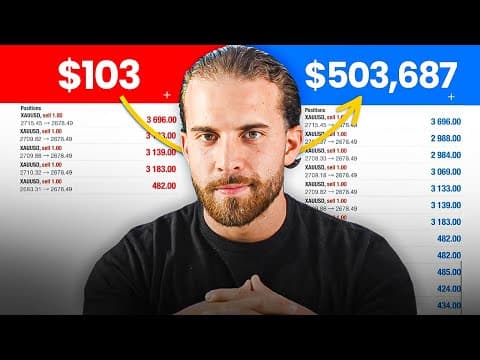
The $100 to $1,000,000 challenge failed because the trader abandoned his trading plan, traded through an NFP event he had overlooked, and struggled under mounting pressure. After turning $100 into $10,000 and later losing $300,000 in one week, he identified poor life balance, limited sleep, and a need to prove himself as deeper causes. Read on for his account of the collapse and the lessons he drew from it.
Transcript
yes you did it you turned the 100 into the M everything was going perfect now I'm at the point where I'm very confident in my strategy like the hate doesn't get to me anymore I feel like I already went through the hardest part now we're going to try and take these 130,000 into $260,000 officially the trade that we caught last night has given us 100... Read More
Key Insights
- The account was blown after multiple stop losses during NFP, which occurs on the first Friday of the month according to the trader’s account. He admitted that he had no idea the event was happening and said the news move completely caught him.
- The challenge progressed from $100 to $10,000 before eventually reaching roughly $300,000. The trader considered the early percentage growth the hardest phase, yet he failed when he believed only two successful account flips remained between approximately $300,000 and $1 million.
- The trader accepts full responsibility for the failure. Although he mentions technical reasons, he rejects excuses and says his behavior had broken from the trading plan during the final two or three weeks of the challenge.
- The central mistake was a lack of balance across trading and everyday life. The challenge disrupted his sleep, diet, gym routine, friendships, basketball activities, business operations, and ability to maintain the analytical standards he normally applied to trades.
- Sleep deprivation weakened the trader’s judgment and consistency. He reports sleeping an average of roughly two to four hours daily while monitoring London and New York sessions, managing large account fluctuations, and trying to preserve a normal life after trading.
- The pursuit of public proof increased the psychological pressure of the challenge. The trader wanted to demonstrate that he could become the best trader in the world, test his abilities publicly, and fulfill expectations created among community members who viewed him as a trading example.
- The excitement of winning became a repeated source of dopamine. Profitable trades, public posts, direct messages, and reports that community members had taken the same trades encouraged him to chase the next success even as exhaustion and declining discipline became apparent.
- The social-media break created space for reflection after approximately three years of continuous community activity. During about two weeks in Puerto Rico, the trader reviewed videos from weeks one through eleven and reconsidered the challenge, his strategy, Swing Trading Lab, and his community.
Install to Summarize YouTube Videos and Get Transcripts
Explore YouTube Video Summarizer or Get YouTube Transcript Extractor
Questions & Answers
Q: Why did the $100 to $1 million challenge fail?
The trader says he increasingly broke his trading plan during the final two or three weeks of the challenge. The immediate collapse came when multiple trades approached or hit their stop losses during NFP, an event he admitted he had not anticipated. He ultimately blamed himself, along with mounting stress, weakened discipline, and pressure to complete the challenge.
Q: How far did the trader progress in the $100 to $1 million challenge?
He says he completed what he considered the hardest stage by turning $100 into $10,000. Later, he planned to grow $130,000 into $260,000 and reported $100,000 in floating profit on a trade. Despite that progress, he eventually lost $300,000 in a single week and blew the account.
Q: What role did NFP play in blowing the trading account?
NFP was the immediate event surrounding the account’s final collapse. The trader says it occurred on the first Friday of the month and that he had absolutely no idea it was happening. One trade hit its stop loss, two others neared their stops, the account dropped below six figures, and it was ultimately wiped out.
Q: When did the trader stop following his trading plan?
He says he had been completely breaking his trading plan during the final two or three weeks. By that point, the three-month challenge had become highly stressful, and he acknowledged that everything had gone down the drain. He accepted that he had been unable to cope with the challenge.
Q: How did the goal of becoming the best trader affect the challenge?
The trader wanted the challenge to demonstrate his skills publicly and test whether he could become the best trader in the world. He says that ambition placed enormous and unnecessary weight on him. Although the winning mindset initially helped him pursue profitability, he concluded that it worked against him near the challenge’s end.
Q: Why did sharing trades publicly increase the pressure?
The trader says many community members followed and profited from the same trades, which filled him with excitement. He estimated that as many as 80% of his audience were catching those trades alongside him. Publicly demonstrating his skills and helping others grow made the challenge more emotionally significant.
Q: Why did the trader leave social media after blowing the account?
He entered what he called “dark mode” because the three-month challenge had become stressful and he needed to accept the failure. He stopped posting on YouTube, Instagram, Telegram, and Discord and paused trade ideas and free trades. The break gave him time to reflect on the challenge, his strategy, Swing Trading Lab, and his community.
Q: What did the trader do during his social-media break?
He spent about two weeks on a small island in Puerto Rico reflecting on his mistakes and broader trading activities. He says he went roughly a week or 10 days without posting, his first such break in three years. During that time, he reconsidered the challenge, his strategy, his community, and the future of his work.
Summary & Key Takeaways
-
The trader began with $100 and successfully reached $10,000, later reporting balances near $300,000 and a floating profit of $100,000. His attempt collapsed after several stop losses and an NFP move he had not anticipated, ultimately erasing three months of effort and producing a $300,000 weekly loss.
-
After blowing the account, he withdrew from YouTube, Instagram, Telegram, Discord, trade ideas, and free trades. He spent about two weeks in a Puerto Rico villa reflecting on the challenge, his strategy, his community, and his businesses. It was his first social-media break in approximately three years.
-
His review identified a lack of life balance as the central problem. Trading disrupted sleep, nutrition, exercise, friendships, basketball, business operations, and analytical discipline. Averaging roughly two to four hours of sleep left him drained, while public expectations and the dopamine of shared wins encouraged increasingly poor decisions near the challenge’s end.
Read in Other Languages (beta)
Share This Summary 📚
Summarize YouTube Videos and Get Video Transcripts with 1-Click
Try YouTube Summary with ChatGPT & Claude or YouTube Transcript Generator
Explore More Summaries from fxalexg 📚



Summarize YouTube Videos and Get Video Transcripts with 1-Click
Try YouTube Summary with ChatGPT & Claude or YouTube Transcript Generator