How Does a Forex Trader Compound a Small Account?

TL;DR
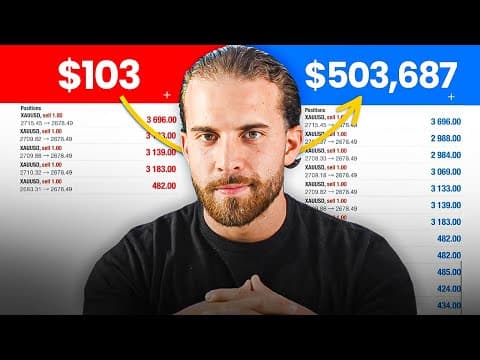
A forex trader documents a public challenge to grow a tiny starting stake into a life-changing sum by doubling the account week over week. The strategy relies on multi-timeframe analysis: only trading when weekly, daily, and four-hour charts align, waiting for price to break and retest key areas of interest before entering.
Transcript
so we're a week of the moon what nobody has ever done before and that's turn one of these hundred dollars into a million dollars absolutely everything has been documented here to China we're already eight weeks into the series where I'm documenting it on my YouTube Instagram telegram Discord so not only do you guys learn from my mistakes but can al... Read More
Key Insights
- Multi-timeframe alignment is the core filter for entries, where the trader only commits when the majority of timeframes point the same direction and refuses to let a single opposing timeframe outweigh the others.
- The break-and-retest method drives every setup, meaning the trader waits for price to break an area of interest, pull back to retest it, and only then enters in the direction of the break.
- Areas of interest define the bias with a simple rule: whenever price is below the zone the trader is selling, and whenever price is above it the trader is buying.
- Head-and-shoulders structure signals reversals, and the trader looks for a left head and right shoulder forming at a strong area of interest to confirm a directional move.
- Confirmation candlesticks reduce risk, as the trader waits for signals like a bearish engulfing candle or an evening star formation on lower timeframes before pulling the trigger.
- Position sizing scales up as the account compounds, and the trader deliberately starts the week with lower risk before adding to a position once price breaks and retests a new zone.
- Session timing matters, because the trader avoids entering until the right session such as London is active, since sessions can move sharply for or against the position.
- Consistency is presented as the decisive factor for results, with the creators emphasizing showing up daily and documenting trades publicly even on days without a trade.
Install to Summarize YouTube Videos and Get Transcripts
Explore YouTube Video Summarizer or Get YouTube Transcript Extractor
Questions & Answers
Q: What is the goal of this forex trading series?
The goal is to publicly document an attempt to grow a very small starting amount of money into a life-changing sum by roughly doubling the account week over week. The trader records every step across YouTube, Instagram, Telegram, and Discord so followers can learn from the mistakes, see the exact strategy, and copy the trades being taken in real time as the challenge progresses over several weeks.
Q: How does the trader decide which direction to trade a currency pair?
The trader uses multi-timeframe analysis, checking the weekly, daily, and four-hour charts to see which way the majority of timeframes are pointing. When two timeframes point down and one points up, the single opposing timeframe is not treated as enough to outweigh the others, so the logical move is to follow the dominant direction. When all three timeframes align, the trader considers it a higher-probability setup.
Q: What is the break-and-retest strategy explained in the video?
Break-and-retest means waiting for price to break through a defined area of interest, then pull back to retest that same zone before committing to a trade. If price breaks below a zone and retests it from underneath, the trader sells; if it breaks above and retests from above, the trader buys. This approach keeps entries simple and lets the trader avoid getting stuck inside a long accumulation range.
Q: How does the trader use areas of interest to place trades?
Areas of interest act as decision lines on the chart. The rule is straightforward: whenever price is trading below the zone, the trader is looking to sell, and whenever price is above it, the trader is looking to buy. The trader draws these zones at strong, respected levels where price has rejected multiple times, then waits for price to interact with them before entering in the corresponding direction.
Q: What chart patterns does the trader look for?
The trader looks for head-and-shoulders and inverted head-and-shoulders formations at strong areas of interest. A clean left head and right shoulder forming at a key level signals a potential reversal, and the trader watches for price to build the right shoulder and break the neckline. Confirmation on lower timeframes, such as a bearish engulfing candle or an evening star, is used to time the actual entry.
Q: How does the trader manage risk and position sizing?
The trader scales position sizes up as the account grows, noting that compounding the balance requires larger lot sizes over time. Despite this, the trader deliberately starts the week with lower risk rather than going too aggressive early, then plans to add to a winning position only after price breaks and retests a new zone in the trade's favor, layering exposure as confirmation builds.
Q: Why does the trader wait for a specific trading session before entering?
The trader emphasizes that session timing affects how price moves, waiting for an active session like London before entering because sessions can produce sharp moves either for or against the position. Even when a valid retest setup appears, the trader may hold off on adding an entry if the market is not in the right session, preferring to enter when volatility and momentum are more likely to support the trade.
Q: What do the creators say is the most important factor for trading success?
Consistency is presented as the single most important factor. The creators stress showing up every single day, documenting trades publicly even on days when no trade is taken, and maintaining discipline through both good and difficult periods. They frame long winning streaks and progress as the result of steady, repeated effort rather than any single lucky trade, encouraging viewers to stay consistent especially during tough spots.
Summary & Key Takeaways
-
The video is part of an ongoing public series where the trader documents attempts to grow a small starting stake into a far larger sum, sharing every trade across YouTube, Instagram, Telegram, and Discord so viewers can learn from mistakes and copy the trades in real time.
-
The trader walks through the week's watchlist of currency pairs, explaining the bias for each using weekly, daily, and four-hour timeframes, and identifies areas of interest, head-and-shoulders patterns, and break-and-retest zones that would justify buying or selling.
-
After entering a sell on the top pair at a retested area of interest with confirming candlestick signals, the trader shows the position moving into profit, discusses adding to it on a further retest, and stresses patience, session timing, and consistency as keys to results.
Read in Other Languages (beta)
Share This Summary 📚
Summarize YouTube Videos and Get Video Transcripts with 1-Click
Try YouTube Summary with ChatGPT & Claude or YouTube Transcript Generator
Explore More Summaries from fxalexg 📚





Summarize YouTube Videos and Get Video Transcripts with 1-Click
Try YouTube Summary with ChatGPT & Claude or YouTube Transcript Generator