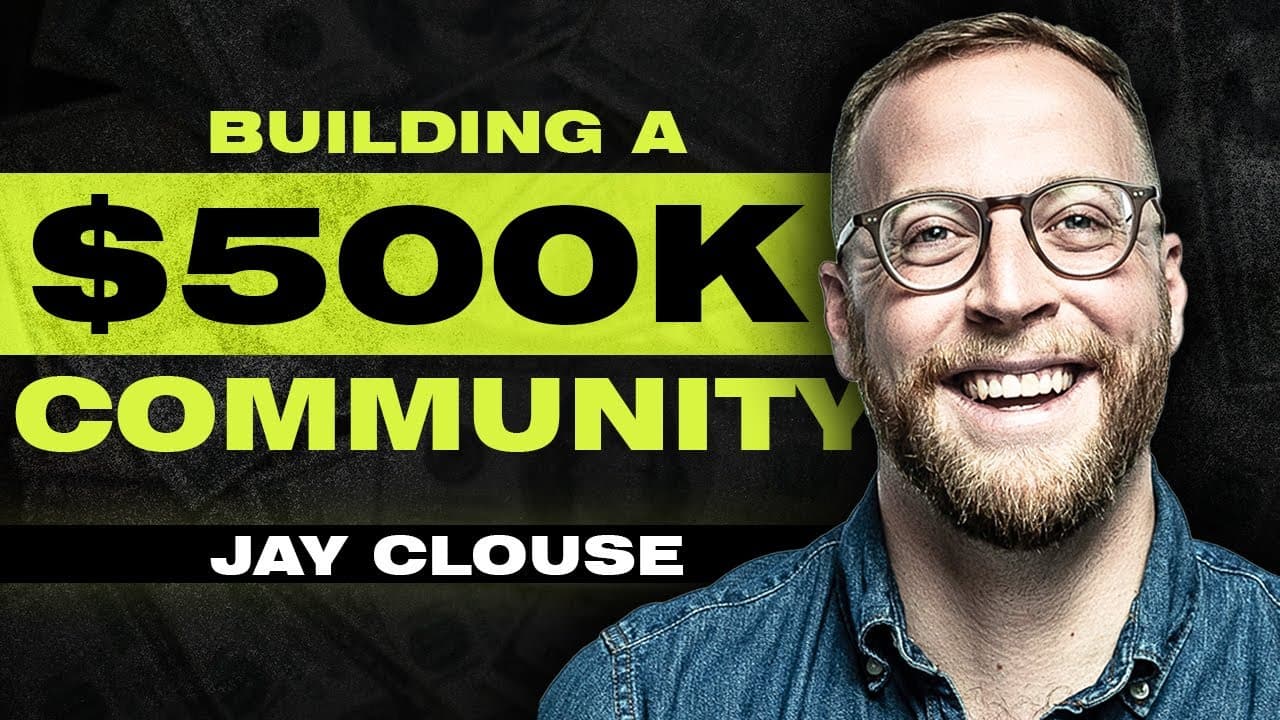
How Did Jay Clouse Build a $500,000 ARR Community in Less Than 2 Years?
TL;DR
Jay Clouse builds a high-retention creator community by offering direct customer value and treating retention as the central measure of success. His membership, The Lab, lets creators learn how to build communities while observing his operating model, and the episode description attributes a 95% retention rate to his strategies. Read on to see how cohort courses, reusable frameworks, and recurring memberships support this approach.
Transcript
ironically what I still see as the biggest issue for most creators who enter my world it's not creating good work and it's often not even just getting attention to their work a lot of them don't know how to turn that attention into a business they have like a really I guess immature view as in like it hasn't been fleshed out of what like a revenue ... Read More
Key Insights
- Many educational creators lack a developed revenue model even when they produce strong work and attract attention. They often assume attention must be sold to advertisers, overlooking direct customer products such as cohort-based courses and paid membership communities.
- Cohort-based courses are effective testing grounds for educational products because creators can charge more, collect immediate feedback, address problems as they occur, and improve early student outcomes before converting the material into a self-paced format.
- Live programs create a forcing function through scheduled sessions and deadlines. Creators must organize their knowledge, deliver on time, and transform loosely held experience into structured lessons, models, and frameworks that other people can understand and apply.
- Frameworks are valuable intellectual property because they package experience into memorable, referable ideas. When a framework includes strong language and a clear concept, audiences can share it independently, spreading the creator's thinking without requiring constant content production.
- A distinctive premise gives creators shared vocabulary for diagnosing a problem and communicating a solution. The phrase "spiky point of view" is presented as an example of language that people can reference, explain to others, and connect back to its original source.
- Professional creator work requires entrepreneurship because producing respected ideas is only part of the job. Creators must also build systems that reward their work financially, and Clouse prefers helping people who have already chosen that demanding path rather than persuading reluctant participants.
- Membership communities create a direct relationship between creators and paying customers. Clouse describes The Lab as his strongest product because members receive instruction about building communities while simultaneously observing the real operating choices inside his own membership.
- Retention is the central metric for a membership community because recurring revenue depends on customers continuing to receive value. The episode description attributes a 95% retention rate to Clouse's strategies and identifies retention as the golden metric for this business model.
Install to Summarize YouTube Videos and Get Transcripts
Explore YouTube Video Summarizer or Get YouTube Transcript Extractor
Questions & Answers
Q: How did Jay Clouse build a high-retention creator community?
Clouse built The Lab around a direct relationship with paying customers and made retention the central metric. Members learn how to build communities while also observing the operating choices inside his own membership, and the episode description attributes a 95% retention rate to his strategies.
Q: How can creators turn audience attention into revenue?
Creators can develop a clear revenue model instead of assuming attention can only be sold to advertisers. The discussion highlights direct customer products such as cohort-based courses and paid membership communities as ways to receive financial value from the people benefiting from the work.
Q: Why should creators start with a cohort-based course?
A cohort-based course lets a creator test an educational product before making it self-paced. Live delivery can support a higher price, produce faster feedback, reveal problems as they occur, and improve early student outcomes.
Q: How do live course deadlines improve a creator's work?
Scheduled sessions create a forcing function because the creator must organize ideas, prepare material, and deliver on time. During a six-week accelerator, one speaker distilled his knowledge about community-powered businesses into about 20 frameworks and models.
Q: Why are frameworks valuable for creator businesses?
Frameworks package experience into ideas that are easier to understand, remember, and reference. When a framework is strong and clearly named, other people can spread it on the creator's behalf, and it can support courses, writing, communities, and other products.
Q: What is a spiky point of view for creators?
A spiky point of view is a distinctive perspective or unique premise that gives a creator's audience shared vocabulary. The discussion cites Maven co-founder Wes Kao's blog post as an example of a named concept that people can reference, explain, and connect back to its source.
Q: How can a membership community reduce repeated launches?
A membership creates an ongoing paid relationship with customers and can provide recurring revenue. Brian Withers's team used a private membership to move beyond a cycle centered on repeated cohort-based course launches.
Q: Why is retention important for a creator membership?
Retention shows whether members continue receiving enough value to stay. Because membership revenue recurs only while customers remain, the episode identifies retention as the golden metric and associates Clouse's strategies with a 95% retention rate.
Summary & Key Takeaways
-
Jay Clouse focuses on educational creators who already want an entrepreneurial career but need help converting useful content and audience attention into revenue. He argues that many capable creators understand content production yet lack a developed business model, often assuming that advertising is the only practical way to monetize their work.
-
Cohort-based courses can validate an educational product before it becomes self-paced. Their live schedules create deadlines, support higher pricing, expose problems quickly, and produce direct student feedback. The process also forces creators to organize experience into reusable frameworks, methodologies, and intellectual property that can support courses, communities, writing, and other products.
-
Clouse presents membership communities as a direct and valuable relationship between creators and customers. His community, The Lab, teaches members how to build memberships while letting them observe his operating model. Examples include Miles McNair's multi-five-figure membership launch and Brian Withers's team using membership to reduce dependence on repeated cohort launches.
Read in Other Languages (beta)
Share This Summary 📚
Summarize YouTube Videos and Get Video Transcripts with 1-Click
Try YouTube Summary with ChatGPT & Claude or YouTube Transcript Generator
Explore More Summaries from Greg Isenberg 📚





Summarize YouTube Videos and Get Video Transcripts with 1-Click
Try YouTube Summary with ChatGPT & Claude or YouTube Transcript Generator