How will AI hardware and agents evolve, says Jeff Dean

TL;DR
Specialized hardware and scalable training will continue to enable larger models with better performance. Multimodal and agent-based systems will expand capabilities, while a few leading general-purpose models coexist with lighter weight successors. AI will influence science by using AI to accelerate discovery and approximate complex simulators.
Transcript
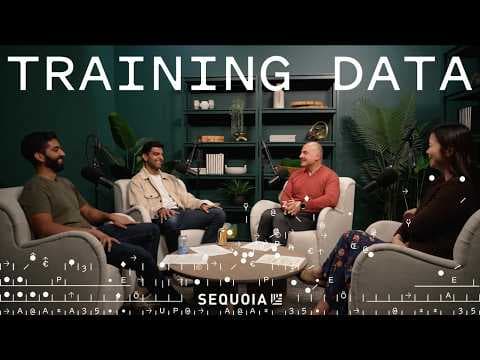
we have Jeff Dean and if you read Jeff's bio he's run everything at some point in Google uh including overseeing the genesis of this industry and the BERT paper that kind of sparked things so many years ago And um and we're very fortunate at Sequoia to have our partner Bill Korn who spent about a decade before Sequoia running most of engineering at... Read More
Key Insights
- Scaling up models and data has consistently improved results, and this trend is expected to continue with better algorithms and hardware.
- Specialized hardware accelerators, like TPUs, are crucial for training and inference at scale and must be connected with high-speed networks to maximize efficiency.
- Multimodality enables AI to handle audio, video, images, text, and code, expanding the scope of what models can output and understand.
- Agents hold promise for complex tasks in virtual environments and in physical robotics, but require ongoing training and early product implementations to prove value.
- There will be a mix of open source and closed models, with a small number of leading general-purpose models
- Hardware strategy will involve both dedicated chips and scalable, fast networking to spread computation efficiently across devices.
- Analog inference hardware is a possible future path, offering potential power efficiency advantages alongside digital approaches.
- AI is influencing multiple scientific domains by learning from data and using surrogates for expensive simulators to enable faster discoveries.
Install to Summarize YouTube Videos and Get Transcripts
Explore YouTube Video Summarizer or Get YouTube Transcript Extractor
Questions & Answers
Q: A real search query question about the video (e.g. 'How to...', 'What is...', 'Why does...', 'When should...'). Question 1
Jeff Dean explains that the industry is moving toward larger models trained on bigger data, supported by improved algorithms and scalable hardware. He notes that this scaling has driven much of the progress in the last decade and will continue to do so as computational resources and data availability grow, enabling more capable AI systems.
Q: Question 2
Dean discusses the role of specialized hardware, particularly accelerators like TPUs, in both training and inference at scale. He emphasizes the importance of continued hardware improvements, high bandwidth networking, and the ability to distribute model computation across many devices to achieve efficient large-scale AI workloads.
Q: Question 3
The conversation covers multimodality, where inputs like audio, video, images, text, and code can be processed together and output in multiple forms. This capability expands the usefulness of AI systems across tasks and indicates a trend toward more integrated models that operate across different data types.
Q: Question 4
Regarding agents, Dean acknowledges their promise to perform many tasks in virtual environments and eventually in physical robotics, but notes that current capabilities are limited and require continued training and early products to demonstrate value. The path involves more reinforcement learning and experiential learning.
Q: Question 5
The landscape of large language models will likely include a few leading general-purpose models, with many lighter-weight models derived through techniques like distillation. This suggests a tiered ecosystem where elite models drive most capabilities while smaller models adapt for specific applications or environments.
Q: Question 6
Dean mentions that AI is influencing science by enabling faster discoveries and by using AI to approximate expensive simulators. This allows researchers to screen vast possibilities, such as molecules, more quickly, accelerating progress across disciplines and changing how scientific inquiry is conducted.
Q: Question 7
The discussion notes Nobel prize-worthy AI contributions in chemistry and biology, highlighting how AI assistants and advanced models enable breakthroughs by learning from data and assisting in complex tasks. This underscores AI’s growing impact beyond pure engineering, extending into fundamental scientific progress.
Q: Question 8
On the future of inference hardware, Dean touches on the possibility of analog computing as a power-efficient option, while acknowledging digital approaches remain central. The choice will depend on trade-offs between efficiency, precision, and practicality for real-world AI workloads.
Summary & Key Takeaways
-
AI hardware and scaling are central to improving model performance, with emphasis on bigger models and more data, aided by improved algorithms and specialized accelerators.
-
Multimodality and reinforcement learning play a key role in extending model capabilities to process diverse inputs and tasks across modalities.
-
AI is already transforming science by enabling faster exploration and approximation of expensive simulations, accelerating discoveries across fields.
Read in Other Languages (beta)
Share This Summary 📚
Summarize YouTube Videos and Get Video Transcripts with 1-Click
Try YouTube Summary with ChatGPT & Claude or YouTube Transcript Generator
Explore More Summaries from Sequoia Capital 📚




Summarize YouTube Videos and Get Video Transcripts with 1-Click
Try YouTube Summary with ChatGPT & Claude or YouTube Transcript Generator