How to Become an AI Engineer: Beginner Roadmap
TL;DR
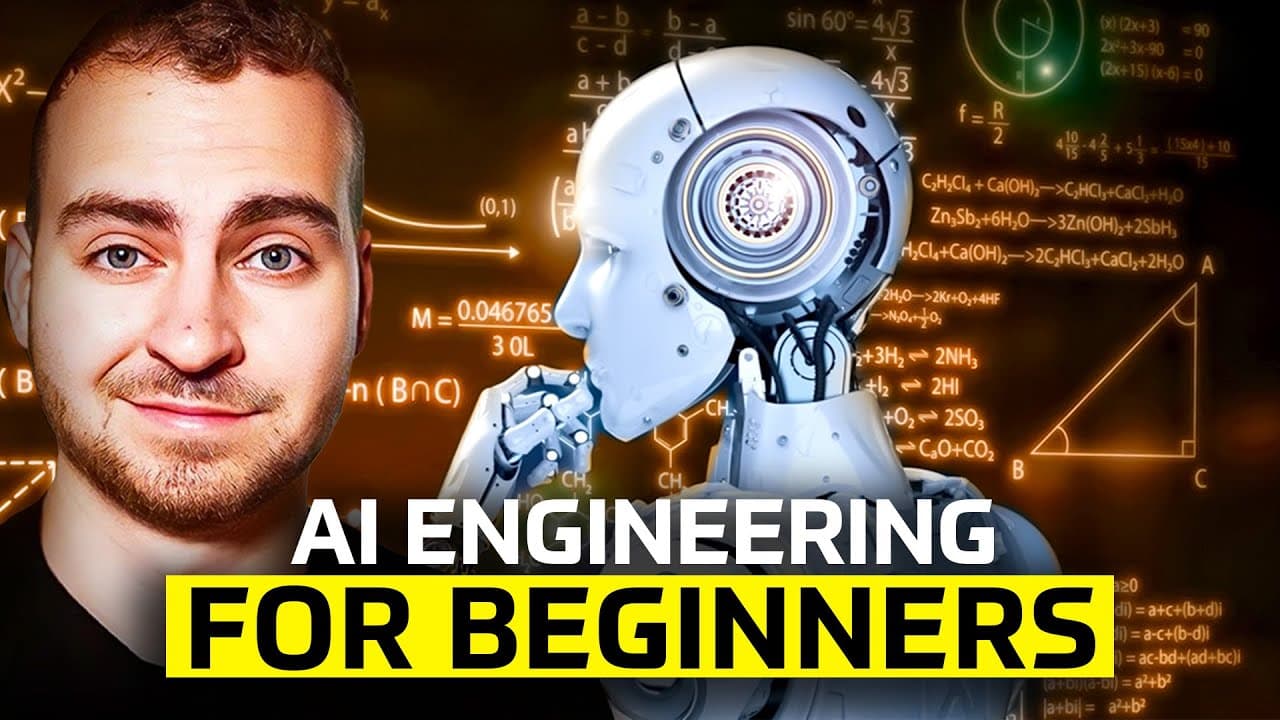
To become an AI engineer, build a strong Python foundation, learn essential software-development tools, understand LLMs and their APIs, and then create applications with AI frameworks. The roadmap recommends spending at least two months on Python before progressing to Git, virtual environments, Jupyter notebooks, Ollama, Docker model runner, LangChain, LangGraph, and Hugging Face Transformers. Read on for the skills and sequence recommended at each stage.
Transcript
If you're interested in becoming an AI engineer, then watch this video. I'm going to give you a complete roadmap, a step by step guide on how to break into this field for beginners. I'm going to try not to use a ton of fancy terms. I'm going to make this very clear and easy to understand, and I'm going to explain practically how you actually could ... Read More
Key Insights
- A practical AI engineer is responsible for implementing AI into software systems using existing models and base LLMs, rather than building or training a model from scratch like GPT-5, which is reserved for machine learning researchers.
- Python is the number one language for machine learning and AI because it is easy to learn and all the main frameworks are written in it, so a strong Python foundation is the required starting point.
- A solid Python foundation includes loops, variables, functions, and more advanced features like decorators, generators, and metaclasses, plus packages and modules, and typically takes at least two months to build.
- Core developer tools an AI engineer needs are Git and GitHub for version control, IDEs like PyCharm, Cursor, or VSCode, basic bash and terminal commands, virtual environments for isolating dependencies, and Jupyter notebooks.
- A math background or computer science degree is helpful but not a requirement, since most AI engineering roles use existing models and build systems around them rather than developing the models with advanced mathematics.
- Learning LLMs means understanding their architecture and how they turn input into output, knowing which lab to use when, and interacting with them through APIs like the OpenAI, DeepSeek, or Claude API.
- Tools like Ollama and Docker model runner let you run LLMs locally on your own computer, which is an important skill in the LLM section of the roadmap.
- The core AI frameworks are LangChain for easily building AI applications and agents, LangGraph for orchestrating AI agents through a controllable graph or flow, and Transformers with Hugging Face for using open-source models.
Install to Summarize YouTube Videos and Get Transcripts
Explore YouTube Video Summarizer or Get YouTube Transcript Extractor
Questions & Answers
Q: What is the beginner roadmap for becoming an AI engineer?
Start by spending at least two months building a strong foundation in Python and general programming. Next, learn Git and GitHub, an IDE or editor, terminal commands, virtual environments, and Jupyter notebooks. Then study LLM architecture, model selection, APIs, local model tools, and frameworks such as LangChain, LangGraph, and Hugging Face Transformers.
Q: What does a practical AI engineer do?
A practical AI engineer implements AI in software systems using existing models and base LLMs. The work can include fine-tuning, prompt engineering, API integration, and selecting the right model for a task. Much of the role is core software engineering centered on AI.
Q: Do AI engineers need to train models from scratch?
No, the practical AI engineering path described here focuses on using existing models rather than training systems such as GPT-5 from scratch. Building foundational models belongs more to machine learning and AI research, while AI engineers generally build or enhance software systems around available models.
Q: Why should beginners learn Python first for AI engineering?
Python is presented as the leading language for machine learning and AI because it is easy to learn, widely used in the field, and supports the main frameworks. Beginners should understand variables, loops, functions, decorators, generators, metaclasses, packages, and modules before moving into AI and machine learning.
Q: Which software-development tools should an aspiring AI engineer learn?
The roadmap includes Git and GitHub for version control, plus editors or IDEs such as PyCharm, Cursor, and VSCode. It also recommends basic bash or terminal commands, virtual environments for isolating project dependencies, and Jupyter notebooks for running and experimenting with Python code.
Q: Do you need advanced math or a computer science degree for AI engineering?
A math background or computer science degree can be helpful, but the roadmap does not treat either as a requirement. Many practical AI engineering roles use existing models and build systems around them, so they do not require the advanced mathematics involved in developing models from scratch.
Q: What should beginners learn about LLMs and their APIs?
Beginners should understand what an LLM is, its architecture, and how it turns input into output. They should also learn when to use different models, including Gemini, GPT-5, Claude, and reasoning models. The next step is interacting with models through APIs such as the OpenAI, DeepSeek, and Claude APIs.
Q: Which AI frameworks and local model tools are included in the roadmap?
The roadmap recommends Ollama and Docker model runner for running LLMs locally. It presents LangChain as a starting point for building AI applications and agents, followed by LangGraph for more controlled agent orchestration. Hugging Face Transformers is also recommended for working with open-source models, alongside numpy and pandas.
Summary & Key Takeaways
-
The video defines a practical AI engineer as someone who implements AI into software systems using existing tools and base LLMs, doing work like fine-tuning, prompt engineering, and API integration. This differs from machine learning research, which involves training models from scratch and requires far more advanced academic backgrounds and mathematics.
-
The roadmap begins with a strong Python foundation covering loops, variables, functions, decorators, generators, and packages, expected to take at least two months. It then adds core developer tools: Git and GitHub, IDEs like PyCharm or VSCode, bash commands, virtual environments for dependency isolation, and Jupyter notebooks for experimentation.
-
Next comes understanding LLMs, their architecture, when to use each lab, and how to call their APIs, plus running models locally with Ollama or Docker. Finally, learners study AI frameworks like LangChain, LangGraph, and Hugging Face Transformers, along with numpy and pandas, before moving on to building projects.
Read in Other Languages (beta)
Share This Summary 📚
Summarize YouTube Videos and Get Video Transcripts with 1-Click
Try YouTube Summary with ChatGPT & Claude or YouTube Transcript Generator
Explore More Summaries from Tech With Tim 📚
Summarize YouTube Videos and Get Video Transcripts with 1-Click
Try YouTube Summary with ChatGPT & Claude or YouTube Transcript Generator