How Did Queen Victoria Rise, Rule, and Find Love?
TL;DR
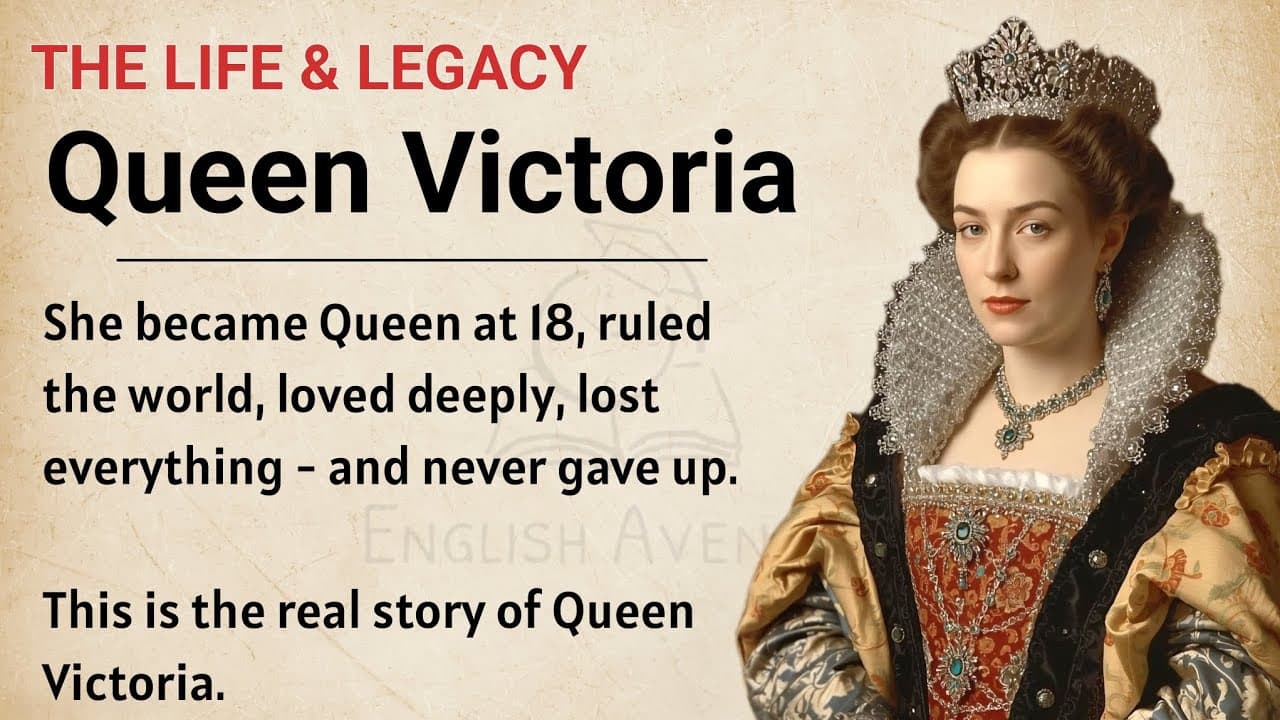
Queen Victoria became monarch at 18 after an isolated childhood shaped by the controlling Kensington system. She asserted her independence, married Prince Albert, raised nine children, and relied on their close partnership while governing the British Empire. Albert also supported education, science, technology, worker conditions, housing, art, culture, and the Great Exhibition of 1851 before suffering a serious illness in 1861.
Transcript
Welcome everyone. Today you are about to hear the real and powerful life story of Queen Victoria. The woman who became queen at just 18, ruled the biggest empire in the world, fell in deep love, lost everything, and still stayed strong. This story is perfect for English learners. It's easy to understand, full of emotion, and filled with history, lo... Read More
Key Insights
- Queen Victoria was born Alexandrina Victoria on May 24, 1819, at Kensington Palace in London. She began life fifth in line to the throne, but deaths and the absence of children among those ahead of her eventually placed her in line to become queen.
- The Kensington system was a collection of harsh rules created by Victoria's mother and Sir John Conroy. It restricted her movement, relationships, play, and privacy to keep her isolated, dependent, and easier to control throughout much of her childhood and teenage years.
- Victoria's education was a source of resilience during her isolated childhood. She read avidly, kept a private diary, studied art and music, learned French, German, and Italian, and practiced drawing, writing, and painting while preparing herself for her future responsibilities.
- Victoria became queen at 18 when her uncle, King William IV, died in June 1837. She responded confidently before powerful older men, moved from Kensington Palace to Buckingham Palace, and removed Sir John Conroy from her life as an early assertion of independence.
- Victoria's relationship with Prince Albert developed from an early meeting when she was 16. After he returned to London on October 10, 1839, she recognized her love for him and proposed because, as queen, she was the person who could formally initiate the marriage.
- Victoria and Albert married on February 10, 1840, in a ceremony where she wore a white gown. Their relationship became both an emotional bond and a working partnership, with Albert helping her examine documents, understand politics, manage pressure, and approach royal responsibilities calmly.
- Victoria and Albert had nine children during the following 17 years. Their home at Osborne House combined royal discipline with books, toys, affection, and family life, although Victoria also recorded post-birth depression, loneliness during childbirth, and the difficulties she experienced as a mother.
- Albert's public contribution included support for education, science, technology, worker conditions, public housing, art, and culture. He also helped organize the Great Exhibition of 1851, which presented Britain as a leader in innovation, while his demanding workload gradually weakened his health.
Install to Summarize YouTube Videos and Get Transcripts
Explore YouTube Video Summarizer or Get YouTube Transcript Extractor
Questions & Answers
Q: How did Queen Victoria become queen at 18?
Victoria was fifth in line to the throne when she was born, so nobody initially expected her to rule. Over time, the people ahead of her either died or had no children. When her uncle, King William IV, died in June 1837, she inherited the crown at 18 and entered government without extensive experience or a trusted family support system.
Q: What was the Kensington system in Queen Victoria's childhood?
The Kensington system was a strict collection of rules created by Victoria's mother and her adviser, Sir John Conroy. It was designed to isolate Victoria and keep her dependent. She could not walk alone, choose her dining companions, or play freely, and she shared her mother's room. Constant supervision made palace life feel like a cage rather than a home.
Q: How did Queen Victoria prepare herself to rule?
Victoria prepared through disciplined private learning despite her controlled upbringing. She became an enthusiastic reader, studied art and music, maintained a secret diary, and learned French, German, and Italian. She also enjoyed drawing, painting, and writing. After realizing at eight that she might become queen, she privately promised to be good and developed a commitment to kindness, dignity, and discipline.
Q: What did Queen Victoria do after gaining independence?
Victoria asserted her independence immediately after becoming queen. She faced a room of powerful older men with calm confidence, moved out of Kensington Palace and into Buckingham Palace, and removed Sir John Conroy from her life. These decisions ended much of the control imposed during childhood, although she still had to learn government quickly and resist people who wanted to manipulate her.
Q: How did Queen Victoria and Prince Albert fall in love?
Victoria first met her German cousin Prince Albert when she was 16 and remembered his kind, intelligent, and thoughtful manner. He returned to Buckingham Palace on October 10, 1839, following encouragement from their uncle Leopold, King of Belgium. Victoria felt an immediate emotional connection and proposed to Albert herself because her position as queen required her to initiate the marriage proposal.
Q: How did Prince Albert support Queen Victoria's rule?
Albert had no official authority as king, but he became Victoria's closest adviser and emotional support. He read documents with her, helped her understand political matters, offered calm guidance during periods of pressure, and worked without trying to overshadow her. Their partnership joined Victoria's public role with Albert's quieter contribution to government, family life, social improvement, culture, and innovation.
Q: How many children did Queen Victoria and Prince Albert have?
Victoria and Albert had nine children during the 17 years following their marriage: Victoria, Albert Edward, Alice, Alfred, Helena, Louise, Arthur, Liupold, and Beatatrice. Their family life at Osborne House included laughter, books, toys, discipline, and affection. Victoria also wrote about post-birth depression, loneliness during childbirth, and the emotional struggles she experienced while raising a large royal family.
Q: What happened to Prince Albert's health in 1861?
Albert's health had weakened after years of heavy work, long nights, stress, missed meals, and limited sleep. In 1861, at age 42, he developed what first appeared to be a cold, but his condition worsened. He experienced chills, fever, body pain, paleness, cold hands, and declining energy, despite Victoria's repeated requests that he rest and reduce his workload.
Summary & Key Takeaways
-
Victoria was born Alexandrina Victoria at Kensington Palace on May 24, 1819. Although fifth in line to the throne, she gradually became the expected heir. Her mother and Sir John Conroy imposed the isolating Kensington system, but reading, languages, art, music, painting, writing, and a private diary helped strengthen her independent character.
-
Victoria became queen at 18 after King William IV died in June 1837. She moved into Buckingham Palace, removed Sir John Conroy from her life, and faced powerful men who expected to control her. Despite limited governmental experience and persistent isolation, she resolved to rule with strength, wisdom, fairness, discipline, and dignity.
-
Victoria proposed to Prince Albert after his 1839 return to London, and they married on February 10, 1840. Their marriage combined affection with practical cooperation. They had nine children, while Albert became her trusted adviser and promoted modernization. His worsening health in 1861 threatened the partnership that had anchored Victoria personally and politically.
Read in Other Languages (beta)
Share This Summary 📚
Summarize YouTube Videos and Get Video Transcripts with 1-Click
Try YouTube Summary with ChatGPT & Claude or YouTube Transcript Generator
Explore More Summaries from English Avenue 📚
Summarize YouTube Videos and Get Video Transcripts with 1-Click
Try YouTube Summary with ChatGPT & Claude or YouTube Transcript Generator