When Should You Use an AI API Instead of Chat?
TL;DR
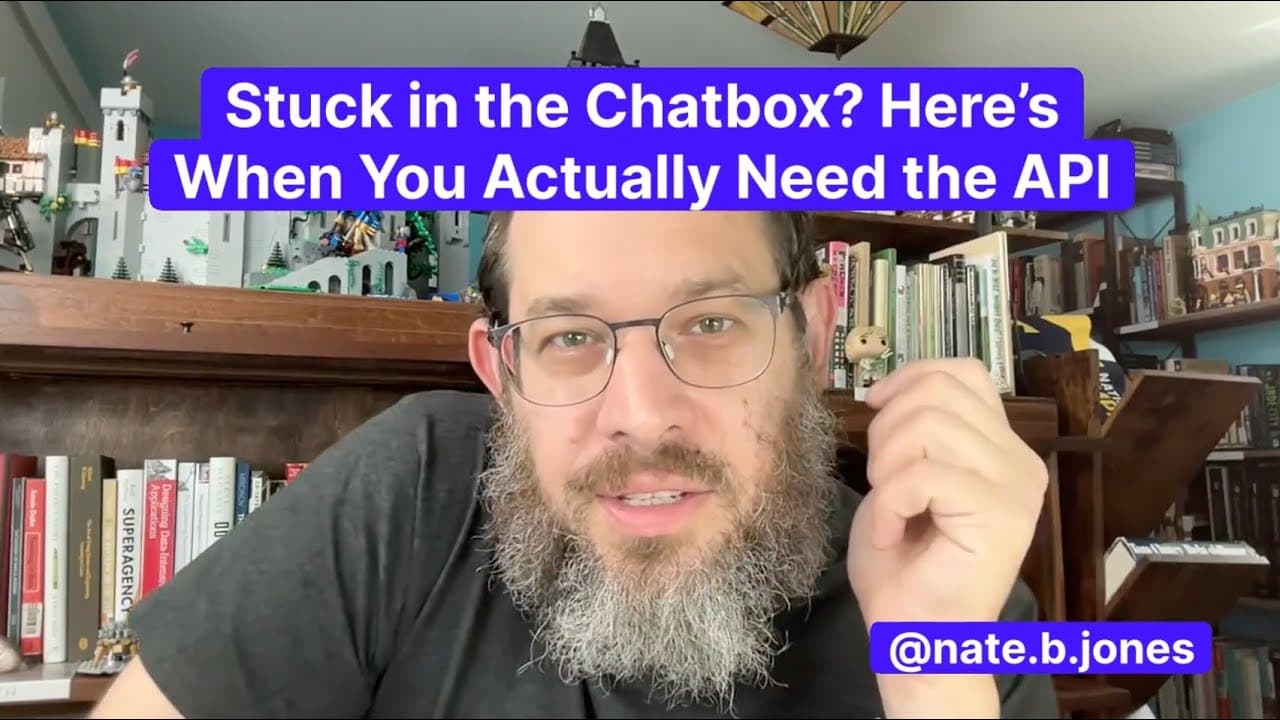
Use an AI API when a chatbot cannot provide enough control over reasoning, tone, context, output format, or workflow integrations. APIs expose capabilities such as custom system prompts, function calling, structured outputs, streaming responses, and metered pricing, but a chatbot remains sufficient for casual questions, brainstorming, web searches, and conversational back-and-forth.
Transcript
Today we're going to address something that I have never seen addressed anywhere on the web and I cannot figure out why. We have a dime a dozen guides for using AI APIs. We have dime a dozen guides for using the chatbot. And you know what I cannot find anywhere? I cannot find a guide that helps you if you are a chatbot user and you are wondering wh... Read More
Key Insights
- A chatbot is an intentionally limited interface that exposes selected presets rather than every available model control. An API offers a broader palette, including configurable reasoning effort, temperature, context handling, and system instructions that cannot be adjusted as precisely through the standard web interface.
- API pricing is metered according to usage rather than charged only through a flat monthly subscription. For workflows that avoid expensive reasoning models, especially those using smaller models or Gemini, the transcript argues that usage can cost less than a monthly chatbot plan.
- Extended context is more practical through an API because users can load and control larger bodies of information directly. This matters for long documents, million-token context workflows with Claude, and other substantial tasks that become difficult to manage inside a chatbot interface.
- Function calling allows an AI model to trigger actions instead of merely producing text. This capability supports integrations that move information between tools, place model intelligence inside applications, and reduce the repetitive copying and pasting associated with isolated chatbot conversations.
- Structured outputs make response formats more dependable by requiring the model to return JSON, tables, or another specified structure consistently. This is valuable when model responses feed applications or repeatable workflows that cannot rely on loosely formatted conversational text.
- API system prompts provide stronger control over model behavior than web-interface instructions. The transcript characterizes chatbot system prompts as suggestions and API system prompts as closer to rules, giving users more authority over tone, processing, and the intended role of the model.
- The need for an API becomes clear when repeated chatbot attempts fail because reasoning is insufficient, tone remains wrong, or a large context cannot be loaded effectively. These moments of persistent friction are practical signals that additional controls may solve the problem.
- Chatbots remain appropriate for brainstorming, casual questions, web searches, and users who prefer conversational back-and-forth. API adoption is optional, and its value depends on whether someone needs automation, integrations, precise configuration, or repeatable work rather than simple conversation.
Install to Summarize YouTube Videos and Get Transcripts
Explore YouTube Video Summarizer or Get YouTube Transcript Extractor
Questions & Answers
Q: When should I use an AI API instead of a chatbot?
Use an AI API when repeated attempts in a chatbot fail because you need more control over reasoning power, tone, context, system instructions, or output structure. It is also appropriate when the model must trigger actions, connect with other tools, stream responses, or return dependable formats such as JSON. Casual questions and brainstorming generally remain well suited to chatbots.
Q: What extra controls does an AI API provide?
An AI API can provide configurable reasoning effort, temperature, context management, custom system prompts, function calling, structured outputs, and streaming responses. These controls offer more flexibility than the fixed presets selected for a public chatbot interface. They let users shape how a model behaves, what information it receives, how it responds, and where its output goes.
Q: Can using an AI API cost less than a chatbot subscription?
API use can cost less than a monthly chatbot subscription when a workflow does not require an expensive reasoning model or very heavy usage. Instead of paying a flat price, the user pays according to metered consumption. The transcript specifically notes that smaller GPT-5 models and Gemini can be inexpensive, while also emphasizing that the actual comparison depends on individual needs.
Q: Why are large-context tasks better suited to an API?
Large-context tasks are better suited to an API because users can more precisely control what information enters the prompt and take advantage of extended context windows. The transcript gives Claude's million-token context window as an example. This approach is useful for long documents and substantial bodies of work that may be difficult to load or manage reliably in a chatbot.
Q: What is function calling in an AI API?
Function calling is an API capability that allows an AI model to trigger actions rather than only generate text. It can support workflows that take data from one place and send it to another, connect models with tools, or add AI capabilities inside an application. This makes the model part of an operational process instead of an isolated question-and-answer interface.
Q: How do structured outputs improve AI workflows?
Structured outputs require an AI model to return information in a specified format, such as JSON or a table, consistently. Dependable formatting matters when responses will be processed by software, stored in another system, or reused in a repeatable workflow. It reduces the uncertainty created when a conversational model changes the organization or presentation of its answer between requests.
Q: How should a chatbot user start moving to an API?
Start after identifying a specific chatbot limitation, then use the API offered by the same model provider you already know. The transcript recommends using the ChatGPT API if you currently use ChatGPT, or the Claude API if you currently use Claude, instead of changing models simultaneously. Modern language models and readable documentation can guide beginners through setup and coding step by step.
Q: When is an AI API unnecessary?
An AI API is usually unnecessary when AI use is limited to casual questions, brainstorming, basic web searches, or conversational back-and-forth. In those cases, a chatbot already provides a convenient interface and the additional configuration may offer little practical value. The decision should be based on real workflow friction, not an assumption that every serious user must adopt an API.
Summary & Key Takeaways
-
Chatbots and APIs provide different ways to access AI models. Chatbots offer convenient, generally configured experiences, while APIs expose more controls over reasoning effort, temperature, system instructions, context, and response behavior. The API becomes useful when fixed chatbot presets prevent a user from completing larger, more specialized, or repeatable work.
-
API access supports function calling, structured outputs, streaming responses, larger context workflows, and connections to external tools. These capabilities shift AI use from isolated conversations toward designed workflows with defined inputs, processing, outputs, and integrations. Users can place model intelligence directly inside applications, notes, agents, and other parts of their work.
-
A transition to the API should begin when repeated chatbot attempts fail because of insufficient reasoning, incorrect tone, limited context handling, or poor workflow integration. Users can stay with the same model provider to reduce complexity. Casual brainstorming and conversational questions usually do not justify switching, so adoption should follow practical friction rather than pressure.
Read in Other Languages (beta)
Share This Summary 📚
Summarize YouTube Videos and Get Video Transcripts with 1-Click
Try YouTube Summary with ChatGPT & Claude or YouTube Transcript Generator
Explore More Summaries from AI News & Strategy Daily | Nate B Jones 📚






Summarize YouTube Videos and Get Video Transcripts with 1-Click
Try YouTube Summary with ChatGPT & Claude or YouTube Transcript Generator