What Could Alien Life Look Like on Other Planets?
TL;DR
Alien life could take on unimaginable forms depending on a planet's environment. For example, on the tidally locked planet Ipa, organisms thrive in darkness and communicate through sound, while Nimbus hosts cloud-dwelling creatures, and Monnier features life using magnetic fields to navigate. Understanding these possibilities helps expand our imagination of extraterrestrial ecosystems.
Transcript
What do real aliens look like? We know that life on Earth is incredibly diverse and exists in the strangest and most extreme places. From blue dragon sea slugs to aye-ayes, or Chrysomallon snails with shells of iron. Or whatever this is supposed to be. Let's use our imagination and real science to travel to three possible worlds, each more alien th... Read More
Key Insights
- The video explores three hypothetical alien worlds, each with unique environmental conditions and potential life forms, showcasing the diversity of possible extraterrestrial ecosystems.
- On the planet Ipa, life thrives in a tidally locked environment with a stable underwater ecosystem, where plants are black to absorb dim light and creatures rely on sound for interaction.
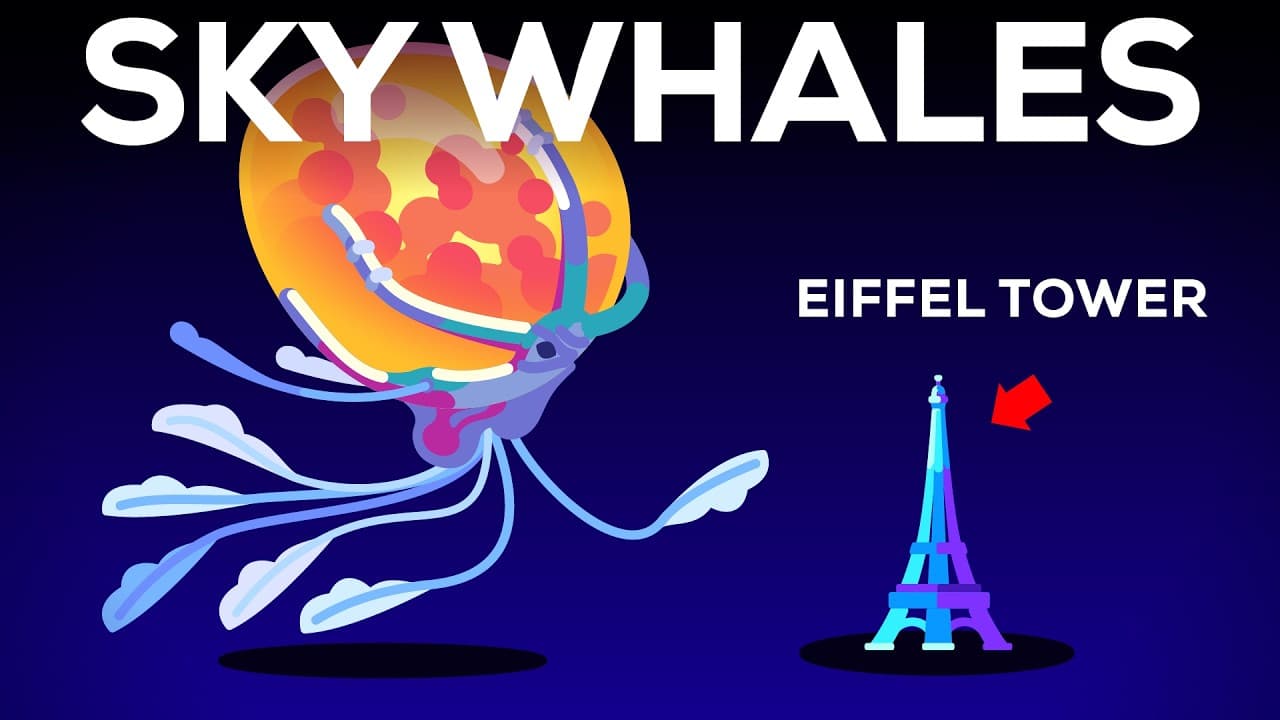
- Nimbus, a gas giant, hosts life forms that have adapted to living in cloud layers, including plankton-like creatures and massive Sky Whales that float using heated gases.
- Life on Nimbus is transient due to its host star's short lifespan, highlighting the fragile nature of ecosystems dependent on specific stellar conditions.
- Monnier, a moon of a brown dwarf, features life forms that utilize magnetic fields and low gravity to move and survive, with plants that levitate and critters that skate on magnetic kites.
- The video emphasizes the importance of scientific speculation in understanding potential alien life, encouraging viewers to imagine diverse biological adaptations beyond Earth.
- Kurzgesagt collaborates with Brilliant to offer educational content that enhances scientific understanding and problem-solving skills, bridging the gap between imagination and real-world science.
- The video concludes with a call to appreciate the possibility of discovering alien life and the role of scientific inquiry in expanding human knowledge of the universe.
Install to Summarize YouTube Videos and Get Transcripts
Explore YouTube Video Summarizer or Get YouTube Transcript Extractor
Questions & Answers
Q: What is the significance of the planet Ipa's ecosystem?
The planet Ipa's ecosystem is significant because it represents a stable underwater environment where life has adapted to a tidally locked world. In this ecosystem, plants are black to absorb the dim light from the star Oculus, and creatures rely on sound for communication and hunting, showcasing the potential diversity of alien life forms.
Q: How do life forms on Nimbus adapt to their environment?
Life forms on Nimbus adapt to their environment by living in the planet's cloud layers. The cloud plankton are small, spider-like creatures that use electrostatic threads for lift, while Sky Whales float using heated gases. These adaptations allow them to thrive in a gas giant's atmosphere, highlighting the innovative ways life might evolve in different conditions.
Q: What challenges do life forms on Nimbus face?
Life forms on Nimbus face the challenge of their host star's short lifespan, as B-type stars like Caeruleus live only a few hundred million years. This means that the ecosystem on Nimbus is transient, with life having only a limited time to exist before the star's end, emphasizing the fragile nature of such environments.
Q: How do creatures on Monnier utilize magnetic fields?
Creatures on Monnier utilize magnetic fields by incorporating magnetized minerals into their biology. The Skaters, for example, use magnetic kites to move across the moon's surface, while plants levitate using the extreme magnetism and low gravity. These adaptations allow them to navigate and survive in Monnier's unique environment.
Q: What role does scientific speculation play in the video?
Scientific speculation plays a crucial role in the video by encouraging viewers to imagine diverse biological adaptations beyond Earth. It highlights the importance of creative thinking in understanding potential alien life forms and emphasizes that speculation can lead to valuable insights into what scientists should look for when searching for extraterrestrial life.
Q: How does the video conclude regarding the search for alien life?
The video concludes by encouraging viewers to appreciate the possibility of discovering alien life and the role of scientific inquiry in expanding human knowledge. It suggests that future generations may explore exotic ecosystems and potentially communicate with other intelligent beings, emphasizing the excitement and importance of the search for extraterrestrial life.
Q: What educational content does Kurzgesagt offer in collaboration with Brilliant?
Kurzgesagt collaborates with Brilliant to offer educational content that enhances scientific understanding and problem-solving skills. This includes hands-on, bite-sized lessons on various topics like physics, AI, and mathematics, allowing learners to explore scientific concepts in depth and apply them to real-world situations, bridging the gap between imagination and science.
Q: What is the purpose of the Kurzgesagt Lab experiment featured in the video?
The Kurzgesagt Lab experiment featured in the video serves to illustrate astrophysical processes, such as the formation of a blue giant star and a supernova. It demonstrates the scientific accuracy and creativity involved in Kurzgesagt's content, while also promoting their shop products, which directly support the creation of more educational videos.
Summary & Key Takeaways
-
The video imagines what alien life might look like on three different worlds, each with unique environmental conditions. It explores how life could adapt to these environments, emphasizing the diversity of potential extraterrestrial ecosystems and the role of scientific speculation in understanding alien life.
-
On the planet Ipa, a tidally locked world with a stable underwater ecosystem, life forms have evolved to thrive in dim light and communicate through sound. Nimbus, a gas giant, hosts cloud-dwelling creatures, while Monnier, a moon of a brown dwarf, features life forms that use magnetic fields to move.
-
Kurzgesagt collaborates with Brilliant to offer educational content that enhances scientific understanding. The video concludes by encouraging viewers to imagine diverse biological adaptations beyond Earth and appreciate the potential for discovering alien life through scientific inquiry and exploration.
Read in Other Languages (beta)
Share This Summary 📚
Summarize YouTube Videos and Get Video Transcripts with 1-Click
Try YouTube Summary with ChatGPT & Claude or YouTube Transcript Generator
Explore More Summaries from Kurzgesagt – In a Nutshell 📚




Summarize YouTube Videos and Get Video Transcripts with 1-Click
Try YouTube Summary with ChatGPT & Claude or YouTube Transcript Generator