Is Time Travel Possible? Forward and Backward Explained
TL;DR
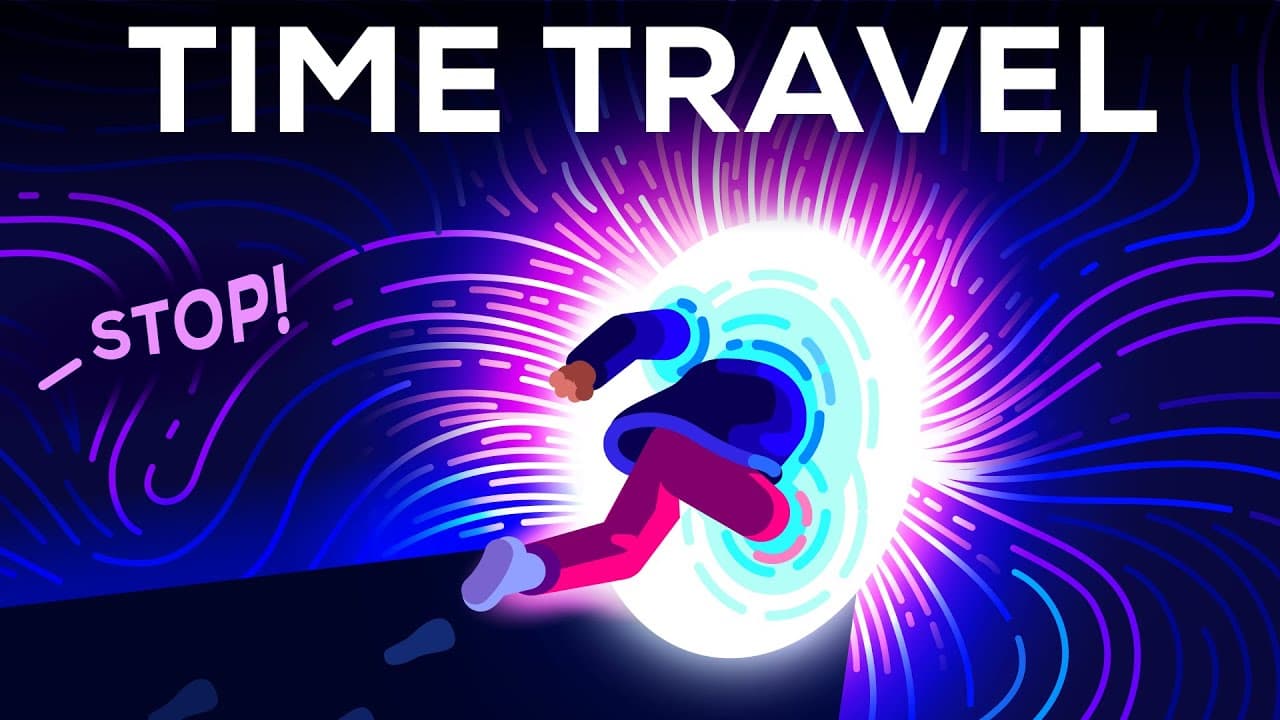
You already travel forward through time one second every second, but you can go faster by moving quickly through space or sitting near a black hole, where time slows. Backward time travel would require faster-than-light tachyons, which relativity effectively rules out because reaching light speed needs infinite energy. The past stays locked away.
Transcript
You’re going forward through time one second every second. Congratulations, you’re a time traveler! A bit lame, but let's start here to get to the fun, real time travel to ride on dinosaurs and high five Einstein. Time isn’t really a thing that passes but a dimension, a direction you can move in. We think our universe is four dimensional, with... Read More
Key Insights
- Time is a dimension rather than a thing that passes, and what you experience as living is you moving through the time direction of a four-dimensional spacetime made of three spatial dimensions and one time dimension.
- Everything in the universe moves at the speed of light through spacetime, with that fixed speed split between motion through space and motion through time, so moving faster through space means moving slower through time.
- Photons move at light speed through space and therefore experience zero time, meaning from a photon's perspective it leaves the sun's surface and hits your eye with nothing happening in between.
- Time dilation lets a fast-moving object age slower relative to a slower one, illustrated by the twin paradox where a twin sent on a fast rocket returns younger than the twin who stayed on Earth.
- Massive objects bend spacetime and slow time nearby, so Earth's gravity makes time pass 0.00000007% slower than in deep space, and time slows dramatically near a black hole's event horizon.
- Backward time travel would require moving faster than light, which forces negative speed through the time dimension, sending you into the past relative to the rest of the universe.
- Tachyons are hypothesized superluminal particles that would travel backward in time and get faster as they lose energy, but there is no evidence they exist and most scientists think they are not real.
- Relativity forbids anything slower than light from ever reaching light speed because that acceleration requires infinite energy, so even all the energy in the universe could not accelerate a grain of sand to light speed.
Install to Summarize YouTube Videos and Get Transcripts
Explore YouTube Video Summarizer or Get YouTube Transcript Extractor
Questions & Answers
Q: Is time travel actually possible?
Forward time travel is real and you do it constantly, moving one second every second into the future. You can travel forward faster by moving very quickly through space or by staying near a strong gravitational field like a black hole, which slows time for you. Backward time travel, however, appears strictly impossible because it would require faster-than-light motion, which relativity forbids since reaching light speed needs infinite energy.
Q: Why does moving faster through space slow down time?
Everything in the universe moves at the speed of light through four-dimensional spacetime, and that fixed total speed is split between your motion through space and your motion through time. When you move faster through the space dimensions, less of your speed remains for the time dimension, so you move slower through time. Move slower through space and you move faster through time, always summing to light speed overall.
Q: What is the twin paradox?
The twin paradox is a story where one twin is put into a rocket and shot through space very fast while the other stays on Earth moving slowly. Because the traveling twin moves fast through space, they move slower through time, so when the rocket returns the twins are no longer the same age. The space twin is younger, demonstrating time dilation, the fact that your position in time is subjective and true only for yourself.
Q: How does gravity affect the passage of time?
Massive objects bend spacetime, which causes time to pass more slowly near them. On Earth the effect is tiny, with our planet's gravity making time pass 0.00000007% slower than in deep space far from gravitational fields. Near a very strong field like a black hole, the closer you get to the event horizon the slower time passes for you, though your own watch still ticks normally while outside observers see you nearly frozen.
Q: What are tachyons and could they enable backward time travel?
Tachyons are the name scientists gave to hypothetical superluminal particles that move faster than light. If they exist they would have wild properties, including getting faster as they lose energy and traveling backward in time. Some observers could in theory see tachyons moving into the past, potentially allowing messages to be sent to your past self. However, there is no evidence tachyons exist and most scientists think they are not real.
Q: Why can't you travel faster than the speed of light?
Moving faster through space requires energy, and the energy needed for something slower than light to reach the speed of light is literally infinite. Even gathering all the energy of the universe could not accelerate a grain of sand to light speed. You can get as close as you like but never reach it. This is why relativity forbids anything starting below light speed from ever crossing that boundary into superluminal, backward-time-traveling motion.
Q: Do photons experience time?
Photons, or light particles, move at the speed of light through space, which means their speed through the time dimension is zero, so they are frozen in place in time and experience no time passing. From a photon's own perspective, light seen on Earth was just on the surface of the sun and then suddenly crashed into your eye with nothing happening in between. In reality defining a reference frame for photons this way is not truly possible.
Q: Why is the past impossible to reach while the future is easy?
Reaching the future just means moving forward through time, which everyone already does, and you can speed it up by moving fast or using gravity. Reaching the past would require superluminal motion, which relativity forbids because reaching light speed demands infinite energy, and the tachyons that might allow it show no evidence of existing. So the past is a faraway land that can be seen only in pictures, movies, and memories, locked away forever outside our reach.
Summary & Key Takeaways
-
Time is not something that flows but a dimension you move through, part of a four-dimensional spacetime combining three spatial dimensions with one time dimension. What feels like time passing is actually your motion forward through the time direction, which normally only allows movement in one direction.
-
Everything moves at the speed of light through spacetime, splitting that speed between space and time. Moving faster through space slows your passage through time, producing effects like the twin paradox and letting fast rockets or strong gravity carry you into the future.
-
Backward time travel would need faster-than-light motion, giving negative speed through time via hypothetical tachyons. But relativity forbids reaching light speed because it demands infinite energy, and no evidence for tachyons exists, so traveling into the past appears strictly impossible.
Read in Other Languages (beta)
Share This Summary 📚
Summarize YouTube Videos and Get Video Transcripts with 1-Click
Try YouTube Summary with ChatGPT & Claude or YouTube Transcript Generator
Explore More Summaries from Kurzgesagt – In a Nutshell 📚




Summarize YouTube Videos and Get Video Transcripts with 1-Click
Try YouTube Summary with ChatGPT & Claude or YouTube Transcript Generator