Let's discuss about Peltier coolers #2 - Performance chart
TL;DR
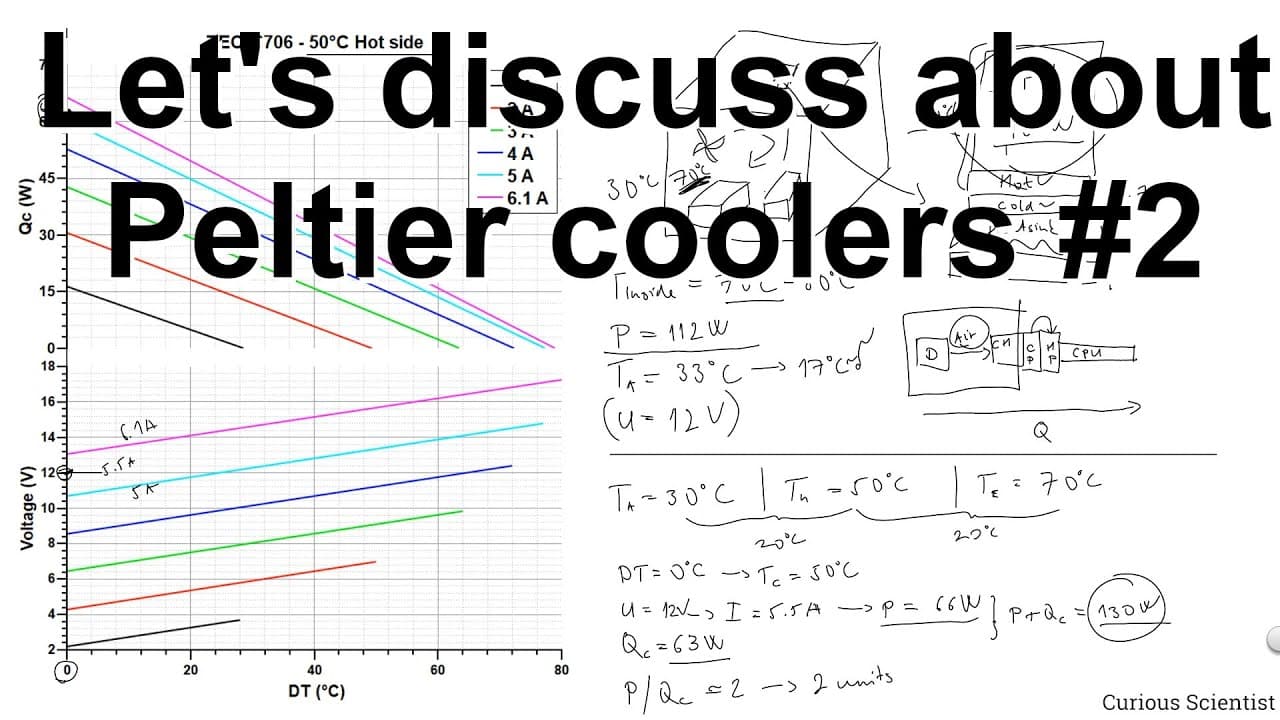
This video explains how to analyze Peltier cooler performance using a practical example.
Transcript
welcome everyone in this video I will show you how to read the performance chart of the Tai Chi colors and how to apply them on a real-life example so I got an example in one of the comments in the comment section of one of my videos and I thought that that's quite fun to discuss and quite interesting so I would like to use that example in this vid... Read More
Key Insights
- 😒 Peltier coolers use electrical energy to create a temperature differential, allowing for targeted cooling in various applications.
- 😚 Effective air circulation and heat transfer are essential for the functionality of cooling systems, especially in closed enclosures.
- 😅 Maintaining the hot side near ambient temperatures is critical for optimizing the cooling capabilities of the device.
- 🥵 The relationship between current, voltage, and the heat generated dictates the overall efficiency of the cooling process.
- 😎 Users must consider the thermal load generated by electronic components to understand the proper configuration of a cooling system.
- 🥵 Achieving low cooling temperatures often requires managing the heat effectively on the hot side of the cooler.
- 😎 Misconceptions about cooling capabilities can lead to inefficient designs and operational failures in Peltier applications.
Install to Summarize YouTube Videos and Get Transcripts
Explore YouTube Video Summarizer or Get YouTube Transcript Extractor
Questions & Answers
Q: What is a Peltier cooler, and how does it work?
A Peltier cooler, or thermoelectric cooler, functions based on the Peltier effect, where using electrical current creates a temperature difference across two sides of the device. This allows one side to absorb heat while the other dissipates it, making it useful for cooling applications when designed and implemented properly.
Q: Why is it important to maintain good thermal contact in this system?
Maintaining good thermal contact between the devices generating heat and the cooling system is crucial because it maximizes heat transfer efficiency. Poor thermal contact can lead to heat accumulation within the enclosure, reducing the effectiveness of cooling and potentially damaging the electronic components inside.
Q: What were the key temperature values discussed in the example?
The discussion centers around an enclosure with an internal temperature of approximately 70 degrees Celsius and an external ambient temperature of around 30 degrees Celsius. The aim is to reduce the internal temperature to about 50 degrees Celsius using a Peltier cooler and associated heating elements.
Q: What happens if the Peltier cooler is not adequately cooled on its hot side?
If the hot side of the Peltier cooler is not effectively cooled, the accumulated heat can create a thermal imbalance, leading to decreased cooling performance on the cold side. Eventually, this can result in overheating, reduced lifespan of the components, or complete failure of the cooling system.
Q: How does the current supplied to the cooler affect its performance?
The current influences the cooling power and temperature difference (DT) the Peltier cooler can achieve. Higher currents typically increase the cooling power but also generate more heat on the hot side, necessitating effective heat dissipation to maintain operational efficiency.
Q: What is the significance of the performance chart mentioned in the video?
The performance chart provides critical data that enables users to understand the cooling potential of a Peltier cooler at various voltage and current settings. By interpreting this chart, users can determine the optimal operating conditions to achieve effective cooling for their applications.
Summary & Key Takeaways
-
The video demonstrates how to read performance charts for Peltier coolers, focusing on a real-life example involving an electronic enclosure generating heat.
-
It explains the importance of maintaining a proper thermal contact and air circulation for effective heat transfer in a closed system.
-
By analyzing different current values and their impact on cooling power, the video emphasizes the balance between temperature differences and cooling efficiency.
Read in Other Languages (beta)
Share This Summary 📚
Summarize YouTube Videos and Get Video Transcripts with 1-Click
Try YouTube Summary with ChatGPT & Claude or YouTube Transcript Generator
Explore More Summaries from Curious Scientist 📚



![Building a Peltier cooler-based cooling box - First iteration, improvements [Part 2/6] thumbnail](/_next/image?url=https%3A%2F%2Fi.ytimg.com%2Fvi%2F0YlNw0EGnzI%2Fhqdefault.jpg&w=750&q=75)


Summarize YouTube Videos and Get Video Transcripts with 1-Click
Try YouTube Summary with ChatGPT & Claude or YouTube Transcript Generator