How OpenAI's Core AI Subscription Will Transform Your Life
TL;DR
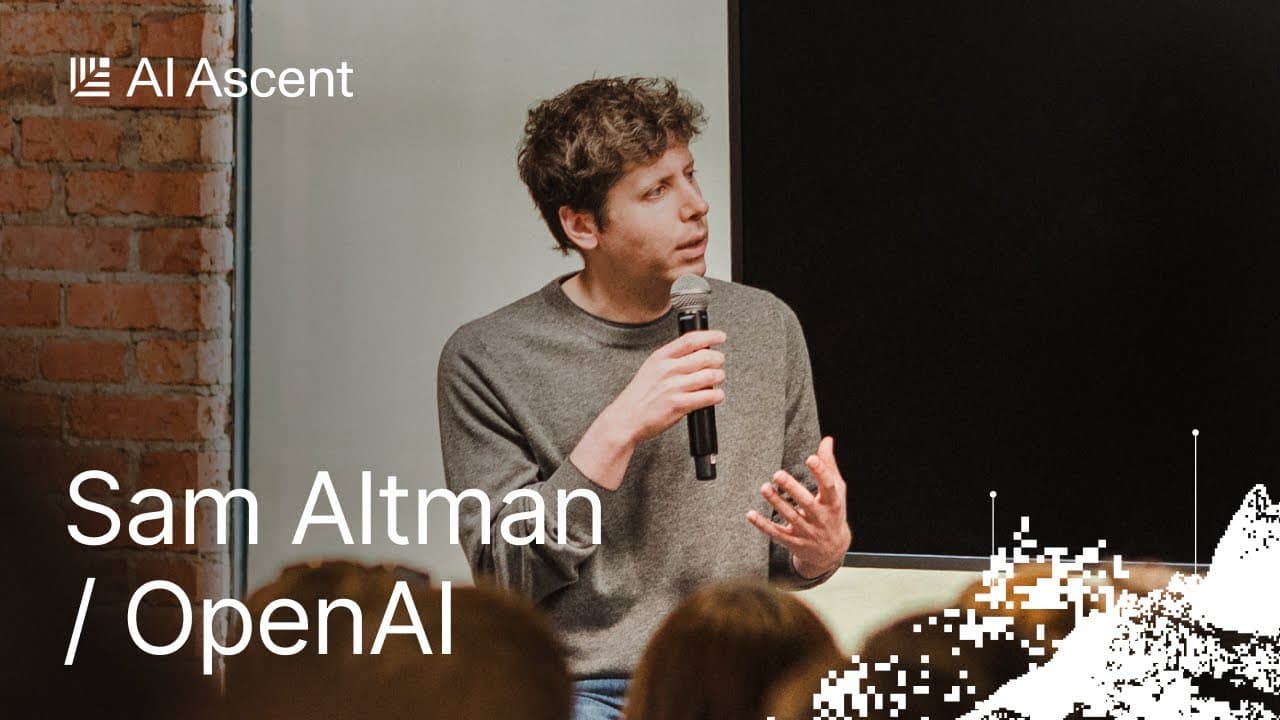
OpenAI aims to create a core AI subscription service that seamlessly integrates into users' lives, offering personalized experiences across platforms. Sam Altman emphasizes high product velocity, the importance of voice interaction, and the potential of federated AI protocols to enhance daily interactions with technology.
Transcript
our next guest needs no introduction so I'm not going to bother introducing him Sam Alman I will just say Sam is now three for three and joining us to share his thoughts at the three AI events that we've had which we really appreciate So I just want to say thank you for being here This was our first office That's right Oh that's right Say that agai... Read More
Key Insights
- Sam Altman reflects on OpenAI's evolution from a small research lab to a leading AI platform, highlighting the journey and challenges faced.
- OpenAI's vision is to create a core AI subscription that integrates seamlessly into users' lives, providing personalized AI experiences.
- ChatGPT's development was influenced by users' desire to interact with AI conversationally, despite initial challenges in creating a chat-friendly model.
- OpenAI aims to maintain high product velocity by keeping teams small and focused, avoiding the pitfalls of large, bureaucratic organizations.
- Altman emphasizes the importance of building smarter models and infrastructure to support the growing demand for AI capabilities.
- Young users treat AI as an operating system, integrating it deeply into their daily lives, which influences OpenAI's development focus.
- OpenAI plans to develop a federated protocol for AI interactions, allowing seamless integration and communication between different AI tools and services.
- Voice interaction is seen as a critical area for development, with potential to enable new device classes and enhance user experiences.
- More videos with Sam Altman:
Install to Summarize YouTube Videos and Get Transcripts
Explore YouTube Video Summarizer or Get YouTube Transcript Extractor
Questions & Answers
Q: What is OpenAI's vision for its AI products?
OpenAI envisions creating a core AI subscription service that integrates deeply into users' lives, providing personalized AI experiences across various platforms and services. The goal is to develop a single, efficient model capable of reasoning across a user's entire history, fundamentally changing how we interact with technology.
Q: How does Sam Altman view the role of voice interaction in AI?
Sam Altman sees voice interaction as a critical area for development within OpenAI. He believes that once a truly human-level voice interaction is achieved, it will enable new classes of devices and greatly enhance user experiences. OpenAI aims to crack the code for a great voice product, integrating it with graphical interfaces for seamless interaction.
Q: What challenges did OpenAI face in developing ChatGPT?
OpenAI faced challenges in making their models chat-friendly, as initial versions were not optimized for conversational interaction. Despite these difficulties, the demand for conversational AI led to the development of ChatGPT. The process involved refining models and incorporating user feedback to create a product that people enjoy interacting with.
Q: How does OpenAI maintain high product velocity?
OpenAI maintains high product velocity by keeping teams small and focused, ensuring that everyone is busy with meaningful tasks. This approach avoids the bureaucratic pitfalls of large organizations and encourages innovation. Altman believes that researchers, engineers, and product people should drive value and be given significant responsibility.
Q: What does Sam Altman think about AI's integration into daily life?
Sam Altman believes that AI will become deeply integrated into daily life, with younger users already treating it as an operating system rather than just a search tool. OpenAI aims to develop AI models that can reason across a person's entire life context, transforming how technology is used in everyday activities and decisions.
Q: What is OpenAI's approach to AI customization and personalization?
OpenAI aims to achieve a state where a tiny reasoning model with extensive context can provide personalized AI experiences without retraining. While current capabilities fall short of this ideal, OpenAI views customization and personalization as compromises towards achieving a model that can efficiently reason across a user's entire life context.
Q: What is the future direction for AI according to Sam Altman?
Sam Altman envisions a future where AI models become smarter, infrastructure is expanded, and AI is integrated into society through new protocols and platforms. He predicts significant advancements in AI's ability to perform tasks, make scientific discoveries, and eventually impact the physical world through robotics and other applications.
Q: How does OpenAI plan to support external developers and companies?
OpenAI plans to develop a federated protocol that allows seamless integration and communication between different AI tools and services. This approach aims to enable external developers and companies to build on OpenAI's platform, fostering innovation and wealth creation while maintaining the core AI subscription service as a central offering.
Summary & Key Takeaways
-
Sam Altman discusses OpenAI's evolution from a small research lab to a leading AI platform, emphasizing the importance of maintaining high product velocity and innovation.
-
OpenAI aims to create a core AI subscription service, integrating AI deeply into users' lives and providing personalized experiences across various platforms and services.
-
Altman highlights the potential of voice interaction and federated AI protocols, aiming to enhance user experiences and enable new classes of devices.
Read in Other Languages (beta)
Share This Summary 📚
Summarize YouTube Videos and Get Video Transcripts with 1-Click
Try YouTube Summary with ChatGPT & Claude or YouTube Transcript Generator
Explore More Summaries from Sequoia Capital 📚
Summarize YouTube Videos and Get Video Transcripts with 1-Click
Try YouTube Summary with ChatGPT & Claude or YouTube Transcript Generator