How Does Project Astra Assist in the Real World?
TL;DR
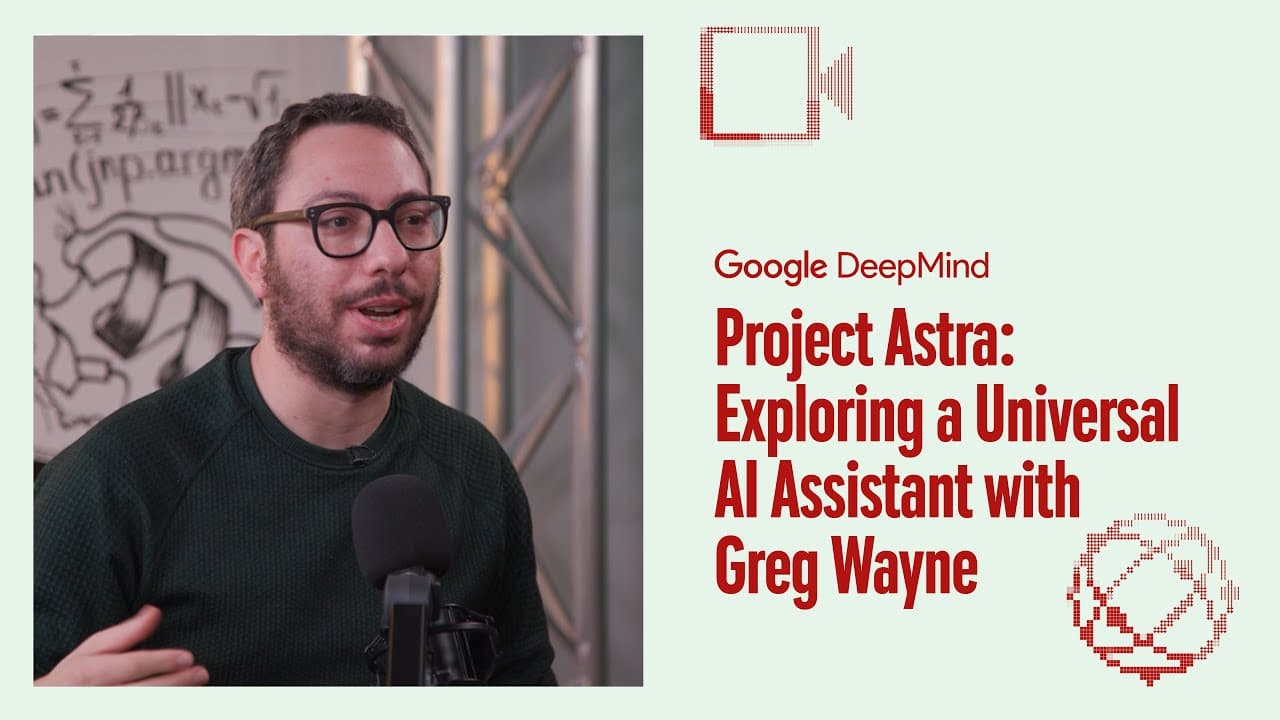
Project Astra combines vision, hearing, voice, memory, context, reasoning, and real-time interaction to act as an AI assistant that shares a user’s perspective. The research prototype can discuss visible surroundings, remember recent and previous interactions, and potentially support accessibility, learning, reminders, and everyday decisions across phones, computers, smart glasses, and VR headsets.
Transcript
[MUSIC PLAYING] HANNAH FRY: Welcome to "Google DeepMind-- The Podcast" with me, your host, Professor Hannah Fry. Now, 2025 is coming and so is the era of agentic AI, although, of course, you'll have known about that months ago if you've been listening to us. So now listen in carefully as we tell you about the next thing. It's called Project Astra, ... Read More
Key Insights
- Project Astra is a research prototype designed as a co-present AI assistant with eyes, ears, and a voice. It can accompany users through smart glasses, phones, computers, or VR headsets, observe what they are doing, and hold conversations about their surroundings.
- Gemini is part of the intelligence underlying Project Astra, alongside other systems. Astra complements Gemini by combining its capabilities with real-time perception, contextual conversation, memory, and device-based interaction, while development of Astra and Gemini can influence each other.
- Visual understanding is demonstrated through Astra’s ability to recognize a studio setup, identify artwork, distinguish the left hemisphere of a brain model, and describe drawings on a whiteboard. Its incorrect book-title guess also shows that confident visual interpretation can still produce errors.
- Public testing is intended to make Astra’s development a co-creation process. Google DeepMind is giving the prototype to trusted testers so people outside the laboratory can use it in everyday situations, describe how it feels, and provide feedback about whether it is genuinely helpful.
- Smart glasses can provide Astra’s most intimate experience because the assistant shares the wearer’s perspective and can converse about what the wearer sees. The underlying software is not limited to glasses, however, and can be specialized for phones, computers, or VR headsets.
- Accessibility is a major potential application because Astra can act as another seeing and hearing intelligence alongside a user. Greg Wayne suggests that such assistance could help people with vision impairment navigate and understand the world, although the technology remains under development.
- Patient, repeatable coaching is a potential strength of Astra. Unlike a person who may tire of repeated practice, the assistant could continuously help someone distinguish difficult pronunciations, provide feedback during training, or support practice in interpreting faces and emotions.
- Memory and proactiveness could let Astra provide assistance without waiting for an explicit command. It has photographic memory for the previous 10 minutes while the camera is running, can remember earlier conversations, and may eventually surface context-based reminders such as replacing something that ran out.
Install to Summarize YouTube Videos and Get Transcripts
Explore YouTube Video Summarizer or Get YouTube Transcript Extractor
Questions & Answers
Q: What is Project Astra and how does it work?
Project Astra is a Google DeepMind team, project, and research prototype seeking to build a universal AI assistant with eyes, ears, and a voice. It uses Gemini together with other systems to perceive a user’s surroundings, converse about visible events and objects, remember relevant context, and interact in real time across devices such as phones, computers, smart glasses, and VR headsets.
Q: How is Project Astra different from an older Google Assistant?
An older Google Assistant is described as primarily a command-and-control system for accessing information or controlling services, such as requesting a song. Project Astra is designed to talk about the physical world shared with the user. It can see what the user is doing, interpret surroundings, maintain context, and discuss objects or situations rather than merely execute isolated commands.
Q: What can Project Astra recognize through its camera?
Project Astra can analyze objects and environments visible through a connected camera. In the demonstration, it inferred that a studio setup was being used for a recording, recognized an MC Escher motif, identified a model as the brain’s left hemisphere, and described drawings on a whiteboard. It also guessed a book title incorrectly, demonstrating that its interpretations are not always reliable.
Q: Why is Google DeepMind testing Project Astra before release?
Google DeepMind is demonstrating and testing Astra so the public can follow its development and selected users can contribute feedback. Trusted testers are using the research prototype in everyday settings, including asking it for fashion advice. Greg Wayne describes this as co-creation, where experiences and reactions from people outside Google help shape whether the assistant becomes useful and helpful.
Q: Which devices could support Project Astra?
Project Astra is intended to work across multiple types of hardware rather than remain attached to one screen or keyboard. Smart glasses can create an especially intimate experience because the assistant shares the wearer’s visual perspective. However, the software stack is broadly device-agnostic, with specializations for different platforms, and can also operate through phones, computers, or VR headsets.
Q: How could Project Astra help people with vision impairment?
Project Astra could provide another seeing and hearing intelligence that shares the user’s perspective. For someone who cannot see, or who can see something without understanding it, the assistant could describe and interpret the surrounding world. Greg Wayne compares the desired support with having another person nearby, while emphasizing that these accessibility applications are still part of ongoing research and development.
Q: How does memory work in Project Astra?
Project Astra has what Greg Wayne calls perfect in-session memory. While the camera is running, it remembers the previous 10 minutes photographically. It can also retain information from earlier conversations, which is why it recognized Greg and could potentially remember Hannah later. These memory capabilities may eventually support people with cognitive impairments and enable context-aware reminders about everyday needs.
Q: How could Project Astra become a proactive assistant?
Proactiveness would allow Project Astra to identify a user’s likely need and respond without receiving a direct command at that moment. The assistant could review remembered context and offer a timely reminder, such as mentioning that orange juice ran out earlier when the user is heading home. This capability is presented as a future direction that could make assistance more continuous and context-sensitive.
Summary & Key Takeaways
-
Project Astra is a Google DeepMind research prototype for an AI assistant with eyes, ears, and a voice. Powered partly by Gemini and other systems, it can observe a user’s surroundings, discuss visible objects, remember conversational context, and operate across devices rather than remaining tied to a keyboard, screen, or single hardware format.
-
During the demonstration, Astra inferred that Hannah Fry and Greg Wayne were recording in a studio. It identified artwork, a model brain’s left hemisphere, and several whiteboard elements, although it incorrectly guessed the title of Hannah’s favorite book. These results illustrated both its visual abilities and its remaining limitations as a prototype.
-
Potential applications include fashion advice, patient language practice, assistance for people with vision impairment, support for understanding faces and emotions, and memory aids for cognitive impairments. Future proactive behavior could let Astra identify relevant needs and offer timely reminders, while trusted testers help DeepMind assess usefulness and provide feedback during development.
Read in Other Languages (beta)
Share This Summary 📚
Summarize YouTube Videos and Get Video Transcripts with 1-Click
Try YouTube Summary with ChatGPT & Claude or YouTube Transcript Generator
Explore More Summaries from Google DeepMind 📚

Summarize YouTube Videos and Get Video Transcripts with 1-Click
Try YouTube Summary with ChatGPT & Claude or YouTube Transcript Generator