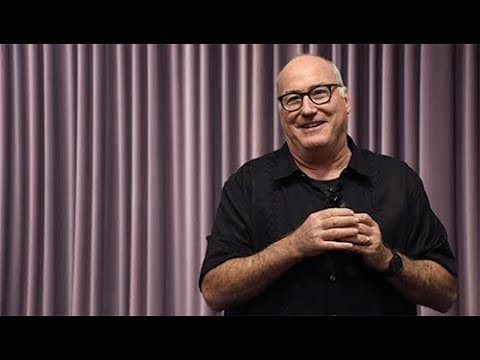
Gale Anne Hurd: Producing a Career from the Ground Up [Entire Talk]

TL;DR
Start by taking chances, learning on the job, and proving you are indispensable. Gale Hurd describes moving from Stanford and Roger Corman to marketing leadership, showing that initiative and willingness to cover multiple roles can create opportunity. Her path shows that early experimentation and seizing a rare chance can shape a lasting career in film.
Transcript
Yes, I'm a Stanford grad. I graduated about 35 years ago from The Farm. As you probably know, none of this existed back then. So, I - actually, I notice there is a Harvard-Westlake shirt here, I actually went to Westlake School For Girls, back before it was a merged high school and - but then my family moved to Palm Springs. Palm Springs had a huge... Read More
Key Insights
- Hurd is a Stanford graduate who shifted from economics to communications and film studies, setting the stage for a production career.
- A turning point came when she joined Roger Corman, where she started as an assistant and gradually expanded to lead marketing, despite lacking initial marketing training.
- The transition to marketing required her to learn quickly and accept a cost cutting move that consolidated duties onto a single role.
- Corman later offered her a chance to run the marketing department, which she accepted to seize an opportunity.
- Early barriers for women in the film industry existed, making her ascent through Corman’s system more exceptional.
- Hurd emphasizes practical, on the job learning over formal pedigree when advancing in Hollywood.
- Her experience demonstrates that doing the hard, unseen work can lead to higher responsibilities and mentorship opportunities.
- Networking and mentorship (Kovacs, Blaustein) played critical roles in uncovering future opportunities for her.
Install to Summarize YouTube Videos and Get Transcripts
Explore YouTube Video Summarizer or Get YouTube Transcript Extractor
Questions & Answers
Q: How did Gale Hurd describe the moment she decided to pursue producing?
Gale Hurd explains that after declaring a second major in communications at Stanford, a pivotal conversation with her advisor and a note about Roger Corman led her to pursue producing, a path she had not initially considered. She recalls realizing during interviews that the industry offered real leadership opportunities, which inspired her decision to chase a producer role.
Q: What was Hurd’s initial role with Roger Corman and how did it evolve?
Hurd started as an assistant at New World Pictures, handling tasks like making coffee, dry cleaning, and script notes. She soon transitioned to the marketing department, a drastic shift from assistant work, as a cost cutting measure that left her with sole responsibility for marketing. This rapid ascent demonstrated her adaptability and willingness to learn on the job.
Q: Why did Hurd agree to take over the marketing department, despite lacking training?
She agreed because opportunity knocked, and she believed in the chance to prove herself. The decision required giving up a personal life and embracing new responsibilities, but she saw it as a unique path to influence and advance in the industry, showing how decisive risk can pay off with the right mindset.
Q: What challenges did Hurd face when she entered the film industry in the 1970s?
Hurd notes that there was no clear career path for women in film production or executive roles at the time, with limited options beyond secretarial or junior positions. She emphasizes the scarcity of pathways and the need to create opportunities for herself by taking on roles others would not or could not fill.
Q: How did mentorship and early education influence Hurd’s career?
Mentors like Julian Blaustein in Stanford’s film and broadcasting program and Steven Kovacs, who recruited her to Roger Corman, provided guidance and opportunities. Their involvement exposed her to real-world film work and helped connect her with key professionals, underscoring how mentorship can unlock career trajectories that formal training alone cannot.
Q: What impact did working with Roger Corman have on Hurd’s career?
Working with Roger Corman exposed Hurd to the mechanics of independent film production, marketing, and distribution. It gave her a hands-on education in how to manage campaigns, juggle budgets, and handle creative decisions, while also introducing her to a network that would later support her ascent in the industry.
Q: How did Hurd describe the process of rising within a company as a woman in that era?
She describes breaking through a male-dominated system by seizing responsibilities that were previously unseen for women, such as leading the marketing department. Her persistence and readiness to take risks allowed her to demonstrate capability beyond traditional gender expectations and ultimately shape a successful career in film production.
Q: What core lesson does Hurd convey about building a career in entertainment?
The core lesson is to take chances, stay indispensable by learning broadly, and be willing to shift roles to seize opportunities. Her story shows that initiative, combined with careful preparation and mentorship, can lead to leadership positions even when the industry seems resistant to change.
Summary
In this video, Gale Anne Hurd talks about her career journey and the lessons she has learned along the way. She shares her experiences from her time as a Stanford graduate to working with Roger Corman and eventually becoming a successful producer in Hollywood. She emphasizes the importance of passion, hard work, and learning from mistakes in order to achieve success in the film industry.
Questions & Answers
Q: How did Gale Anne Hurd end up at Stanford?
Gale Anne Hurd went to Westlake School For Girls before her family moved to Palm Springs. She got into Stanford not knowing much about it and thought it was in Connecticut.
Q: How did Gale Anne Hurd end up studying film and broadcasting?
While studying at Stanford in Britain, she had a fantastic professor named Julian Blaustein who encouraged her to study film and broadcasting. She declared a second major in communications and had to complete the program in two years.
Q: How did Gale Anne Hurd start working with Roger Corman?
After graduating from Stanford, Gale Anne Hurd received a phone call and a letter from Stephen Kovacs, a professor of hers, asking her to interview with Roger Corman. She went to the interview and was offered a job as Corman's assistant.
Q: What did Gale Anne Hurd do as Roger Corman's assistant?
As Corman's assistant, Gale Anne Hurd had various responsibilities such as making coffee, picking up his dry cleaning, giving story notes on scripts, rewriting scripts, casting films, and giving notes to directors.
Q: How did Gale Anne Hurd become the head of the marketing department at New World Pictures?
After working with Roger Corman for about a year as his assistant, Gale Anne Hurd was promoted to head of the marketing department. She had to start over and learn the skills she needed for the job.
Q: What were some of the challenges Gale Anne Hurd faced while working in the film industry?
Gale Anne Hurd faced numerous challenges, such as working long hours, living on a low salary, and dealing with uncertainty and doubt about her career choice. She had to make sacrifices and work hard to overcome these challenges.
Q: How did Gale Anne Hurd transition from marketing to producing?
Gale Anne Hurd made a deal with Roger Corman to work in the marketing department for six months. After that, she asked to be given a job on the set of a film production. She then worked as a production assistant on the film "Humanoids from the Deep" and learned every job on the set.
Q: How did Gale Anne Hurd become a successful producer?
Gale Anne Hurd took advantage of opportunities and learned from her experiences while working with Roger Corman. She spotted talent and supported them through thick and thin, and she never gave up even when faced with failures. She also emphasized the importance of telling the truth, giving back, and having the right partners.
Q: What are some of Gale Anne Hurd's secrets of success?
Some of Gale Anne Hurd's secrets of success include doing what you love, challenging expectations, staying hungry, telling the truth, never giving up, always giving back, and choosing the right product, skills, mentors, and partners.
Q: How does Gale Anne Hurd make decisions on which projects to work on?
Gale Anne Hurd chooses projects that she personally wants to watch and ones that have strong and interesting characters. She responds to character-driven stories and looks for projects that she can connect with on a personal level.
Q: What is the role of a producer and how does it affect the final product?
The role of a producer is to find and develop material into a film or TV show. They are involved in various aspects of the production process, such as budgeting, casting, marketing, and distribution. A good producer is often credited with creating a successful final product, especially if the story or characters resonate with the audience.
Summary & Key Takeaways
-
Gale Hurd explains her unlikely path from Stanford to Roger Corman, highlighting how she leveraged education, experience, and willingness to shift roles to advance.
-
She details a pivotal moment when she was offered head of the marketing department, transforming a three person unit into a one person operation through necessity and opportunity.
-
Her talk underscores the importance of readiness, adaptability, and persistence in breaking into and advancing within the film industry.
Read in Other Languages (beta)
Share This Summary 📚
Summarize YouTube Videos and Get Video Transcripts with 1-Click
Try YouTube Summary with ChatGPT & Claude or YouTube Transcript Generator
Explore More Summaries from Stanford eCorner 📚

Summarize YouTube Videos and Get Video Transcripts with 1-Click
Try YouTube Summary with ChatGPT & Claude or YouTube Transcript Generator