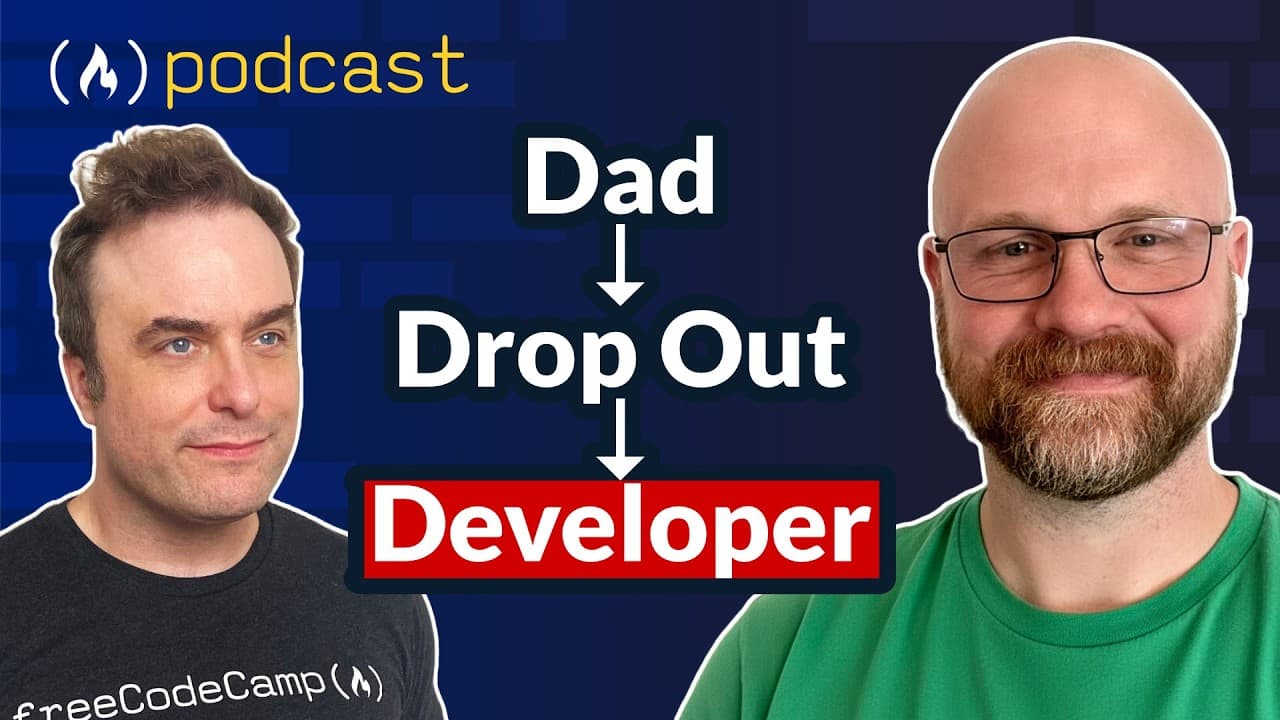
Patrick Hartley on Competing for Remote Dev Jobs
TL;DR
Landing a remote developer job means competing with the global talent pool, not just local candidates, so persistence matters most. Patrick Hartley searched four to five months during heavy tech layoffs before finding the right fit. He turned down an Amazon onsite in Austin to keep working from Oklahoma City and care for his family.
Transcript
Welcome back to the Free Code Camp podcast. I'm Quincy Larson, teacher and founder of Free Code Camp. Today we're talking with Patrick Hartley, a self-taught developer who passed up opportunities to work at big tech companies so he could stay home and work remotely with his family. First, I want to give you some cool community news. Freamp just pub... Read More
Key Insights
- Competing for remote developer roles means competing globally, not locally. Once you leave your local market you are up against the best developers in India, China, and Canada, plus people laid off from companies like Microsoft with far more experience.
- Persistence is the deciding factor in a tough job market. Patrick Hartley searched roughly four to five months, starting about a year before the interview, before finding a company that valued him and felt like a genuinely good fit.
- Tech layoffs intensify competition for remote positions. Patrick was job hunting during a period of heavy layoffs, meaning he competed against experienced developers displaced from large companies rather than only local Oklahoma candidates.
- Turning down big tech can be the right call when family comes first. Patrick declined an Amazon onsite interview in Austin because his family support structure in Oklahoma City outweighed the prestige of the Fang interview experience.
- A strong local family structure can anchor career decisions. Patrick's son has autism and is homeschooled by his wife, while his mother provides additional caretaking, making relocation from Oklahoma City a daunting hurdle to leave behind.
- Local salary ceilings can force developers to look outside their market. Patrick notes that within Oklahoma the job market caps at a certain salary, and to earn above that you are effectively pushed to seek opportunities elsewhere.
- Adapting your skills to local employer demand is a practical strategy. Patrick learned C# and .NET because that is what employers in his relatively small Oklahoma City tech market wanted, pivoting from foundational JavaScript and Python skills.
- Smaller tech communities are tight-knit but limited. Patrick describes Oklahoma City as a small community where developers know of each other, offering real jobs but not the scale or pay of major hubs like Dallas, Austin, or Seattle.
Install to Summarize YouTube Videos and Get Transcripts
Explore YouTube Video Summarizer or Get YouTube Transcript Extractor
Questions & Answers
Q: What is it like competing with the global talent pool for remote developer jobs?
Once you take a remote position you are no longer competing only with local developers. Patrick explains that stepping outside your local borders makes it obvious you face a whole host of people with varying talents and experience levels. He competed against people laid off from Microsoft and developers doing the work far longer than he had, which he found overwhelming and sometimes discouraging.
Q: How long did it take Patrick Hartley to find a remote job?
Patrick started looking close to about a year before the interview and searched for roughly four to five months before finding something that agreed with him. He describes the process as discouraging at times, especially because it coincided with a wave of tech layoffs, but he stuck with it and ultimately found a place he really loved that valued him and felt like a good fit.
Q: Why did Patrick turn down the job at Amazon?
Patrick applied to Amazon, passed through a number of screenings, and was invited to Austin for an onsite interview. After thinking it over and talking with his wife, he decided staying local was the better choice. His son has autism and is homeschooled, his wife provides care, and his mother helps with caretaking, so leaving their strong family structure in Oklahoma City seemed too daunting.
Q: How did Patrick Hartley learn to program?
Patrick is a self-taught developer. When he was 21 he dropped out of college to provide for his family after having a kid. He taught himself programming while working at a thrift shop to make ends meet. After building his own apps and freelancing, he became the founding engineer at a startup that was acquired, and has since worked as a developer at other tech companies over nearly a decade.
Q: Why do developers in smaller markets need to look outside their local area?
Patrick explains that within Oklahoma the job market hits a certain salary ceiling. He could probably find a job locally, but to earn above that cap you are essentially forced to look outside Oklahoma City after a certain point. The local tech community is small and tight-knit, where developers all know of each other, but it does not offer the pay scale of larger markets.
Q: How did tech layoffs affect Patrick's job search?
Patrick was job hunting around the time of significant tech layoffs, which reshaped his competition. Instead of only competing with people in Oklahoma, once he moved into remote positions he was up against people laid off from companies like Microsoft. Many of these candidates had been doing the work far longer and were more experienced in some ways, which made the search more discouraging.
Q: How does Patrick decide which programming skills to learn?
Patrick builds foundational skills with JavaScript and Python and then branches out based on demand. He has learned a lot of C# and .NET because that is what the local employers in his relatively small Oklahoma City tech market want developers to know. His approach is to pivot his skills and learn whatever technologies the available jobs require rather than sticking rigidly to one stack.
Q: Does Oklahoma City have a developer community?
Yes, Oklahoma City has a developer community doing cool work, with tech companies being created there, though Quincy Larson notes it is not a major tech hub like Dallas, Austin, or Seattle. Patrick describes it as a small, tight-knit community where developers all know of each other. Real developer jobs exist there, but the market caps out on salary compared to larger tech centers.
Summary & Key Takeaways
-
Patrick Hartley is a self-taught developer with nearly a decade of experience who dropped out of college at 21 to provide for his family. He taught himself programming while working at a thrift shop, then built his own apps and freelanced.
-
He became the founding engineer at a startup that was acquired and has since worked as a developer at other tech companies. A few months before the interview, he turned down an Amazon opportunity to keep working remotely from Oklahoma City.
-
Patrick shares how competing for remote jobs means facing the global talent pool amid tech layoffs, how local salaries and family needs shaped his choices, and how he adapts his JavaScript and Python foundation to local C# and .NET demand.
Read in Other Languages (beta)
Share This Summary 📚
Summarize YouTube Videos and Get Video Transcripts with 1-Click
Try YouTube Summary with ChatGPT & Claude or YouTube Transcript Generator
Explore More Summaries from freeCodeCamp.org 📚





Summarize YouTube Videos and Get Video Transcripts with 1-Click
Try YouTube Summary with ChatGPT & Claude or YouTube Transcript Generator