How to Invest When the S&P 500 Looks Expensive
TL;DR
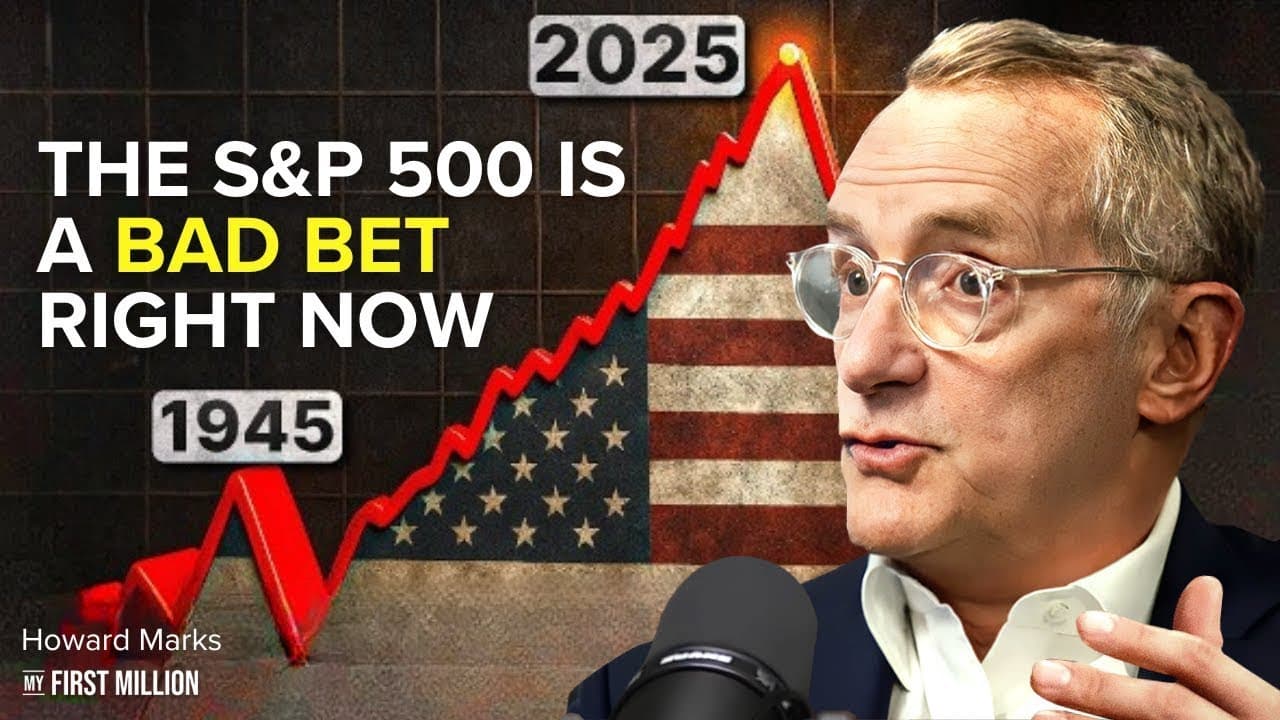
Reduce risk through rebalancing rather than abandoning stocks entirely when valuations are high. Howard Marks argues that an S&P 500 price-to-earnings ratio around 23–25 has historically implied weak 10-year returns, while high-yield bonds offering 7–8 percent may provide a more defensive alternative for cautious investors.
Transcript
All right, here's what I said. I said, "Describe Howard Marks in 280 characters." Here's what he gave you. Howard Marks is a legendary investor co and co-founder of Oak Tree Capital. Known for his sharp memos, contrarian thinking, and risk focused approach, he made billions zigging when others zag, especially in crisises. When he writes, Wall Stree... Read More
Key Insights
- The belief that an investment has no risk is itself a major source of danger because market risk arises largely from human behavior. Carefree investors can push prices upward until assets become precarious, while widespread fear can suppress prices and create unusually attractive opportunities.
- The S&P 500 has returned an average of 10 percent annually over 100 years, but its annual return is almost never between 8 and 12 percent. The historical average therefore should not be mistaken for the normal return in any particular year.
- A genuinely long investment horizon is 20 years or more, according to Marks. American companies may produce prosperity over coming years, but that long-term expectation does not eliminate valuation risk, short-term volatility, or the need to respond when present conditions become unusually unfavorable.
- The price-to-earnings ratio paid for the S&P 500 is negatively correlated with its subsequent 10-year annualized return. Marks cites a chart showing that purchases at a ratio of 23 historically produced returns between 2 percent and minus 2 percent, without exceptions in the displayed data.
- High-yield bonds can provide yields of 7–8 percent in the United States, Europe, and related low-grade credit markets. Their contracts require borrowers to pay interest every six months and return principal at maturity, giving investors a return that can be calculated in advance.
- Taxes are an important disadvantage of bond income because investors must pay tax on that income every year. Marks contrasts an illustrative 8 percent bond yield that becomes 4 percent after tax with a 10 percent equity return that becomes 7 percent after capital gains taxation.
- Portfolio management is a choice along a continuum from aggressive to defensive, not a binary decision between buying and selling. Investors can own somewhat less of the S&P 500 and somewhat more debt when valuations create concern, preserving exposure while reducing overall risk.
- An investor's normal risk position should reflect personal needs, age, wealth, and emotional comfort. Marks uses a speedometer from zero risk to 100 percent aggressive and advises investors to identify an appropriate setting, then remain near it most of the time.
Install to Summarize YouTube Videos and Get Transcripts
Explore YouTube Video Summarizer or Get YouTube Transcript Extractor
Questions & Answers
Q: How should investors respond when the S&P 500 is expensive?
Investors can respond by rebalancing toward a more defensive mix instead of selling all equities or ignoring valuations. Marks suggests owning somewhat less of the S&P 500 and somewhat more debt, including high-yield bonds. The appropriate adjustment depends on the investor's normal risk posture, financial needs, age, and willingness to tolerate pressure without disrupting daily life.
Q: Why can a high S&P 500 price-to-earnings ratio be risky?
A high price-to-earnings ratio means an investor is paying more relative to company earnings, which can lower the return earned over the following years. Marks cites a JP Morgan scatter diagram showing a negative correlation between the S&P 500 ratio at purchase and its next 10-year annualized return. At a ratio of 23, every displayed historical outcome fell between 2 percent and minus 2 percent.
Q: Does the S&P 500 reliably return 10 percent every year?
The S&P 500 does not reliably return 10 percent in an individual year. Marks says it averaged 10 percent annually over 100 years, yet its annual return was almost never between 8 and 12 percent. The index can perform extremely well or very poorly, so the average is a long-term mathematical result rather than a normal annual experience investors should expect consistently.
Q: What does Howard Marks consider a long-term investment horizon?
Marks considers 20 years or more to be the real long term. He believes American companies will, on balance, produce prosperity over coming years, which supports long-term equity ownership. However, that expectation does not mean investors can ignore current valuations, assume smooth annual returns, or treat diversification rules as a substitute for recognizing important changes in present conditions.
Q: Why does Howard Marks view high-yield bonds as an alternative?
High-yield bonds offer a contractual structure and a return that investors can estimate in advance. The borrower agrees to pay interest every six months and return the principal at the end. Marks says low-grade credit in the United States, Europe, and related markets can yield 7–8 percent, which is close to the S&P 500's cited 10 percent long-run average.
Q: What are the disadvantages of choosing bonds over stocks?
The principal disadvantage identified by Marks is that bond income creates a tax obligation every year. He illustrates the tradeoff by comparing an 8 percent bond yield that might become 4 percent after tax with a 10 percent equity return that might become 7 percent after capital gains taxation. Bonds may still appeal to cautious investors who value contractual payments and greater defensiveness.
Q: How should an investor choose an appropriate risk level?
An investor should place their portfolio on a continuum running from aggressive to defensive. Marks compares this decision with a speedometer, where zero represents no risk and 100 represents maximum risk and complete aggressiveness. The appropriate normal setting should reflect the investor's youth, wealth, needs, caution, and desire to avoid giving back money already earned, then remain relatively stable most of the time.
Q: Why does market risk come from investor behavior?
Marks argues that risk does not primarily originate in companies, securities, institutions, or exchanges. It comes from how people behave around them. When investors become carefree and imprudent, their buying can raise prices excessively and make markets precarious. When they become terrified, their selling can suppress prices until assets become unusually cheap, creating conditions in which aggressive buying may be justified.
Summary & Key Takeaways
-
Howard Marks says long-term S&P 500 ownership can still support prosperity, but investors should not assume its historical 10 percent average return will occur consistently. Annual performance is almost never between 8 and 12 percent, showing that the long-run average does not represent a typical individual year.
-
High valuations can sharply reduce expected returns. Marks cites a JP Morgan chart showing that every historical S&P 500 purchase at a price-to-earnings ratio of 23 produced a subsequent 10-year annualized return between 2 percent and minus 2 percent, challenging confidence in another decade of average performance.
-
Marks favors adjusting the mix between aggressive and defensive assets rather than making absolute buy-or-sell decisions. High-yield bonds can offer contractual income and yields of 7–8 percent, although annual taxes reduce their benefit. Each investor should establish an appropriate normal risk posture based on personal circumstances and temperament.
Read in Other Languages (beta)
Share This Summary 📚
Summarize YouTube Videos and Get Video Transcripts with 1-Click
Try YouTube Summary with ChatGPT & Claude or YouTube Transcript Generator
Explore More Summaries from My First Million 📚



Summarize YouTube Videos and Get Video Transcripts with 1-Click
Try YouTube Summary with ChatGPT & Claude or YouTube Transcript Generator