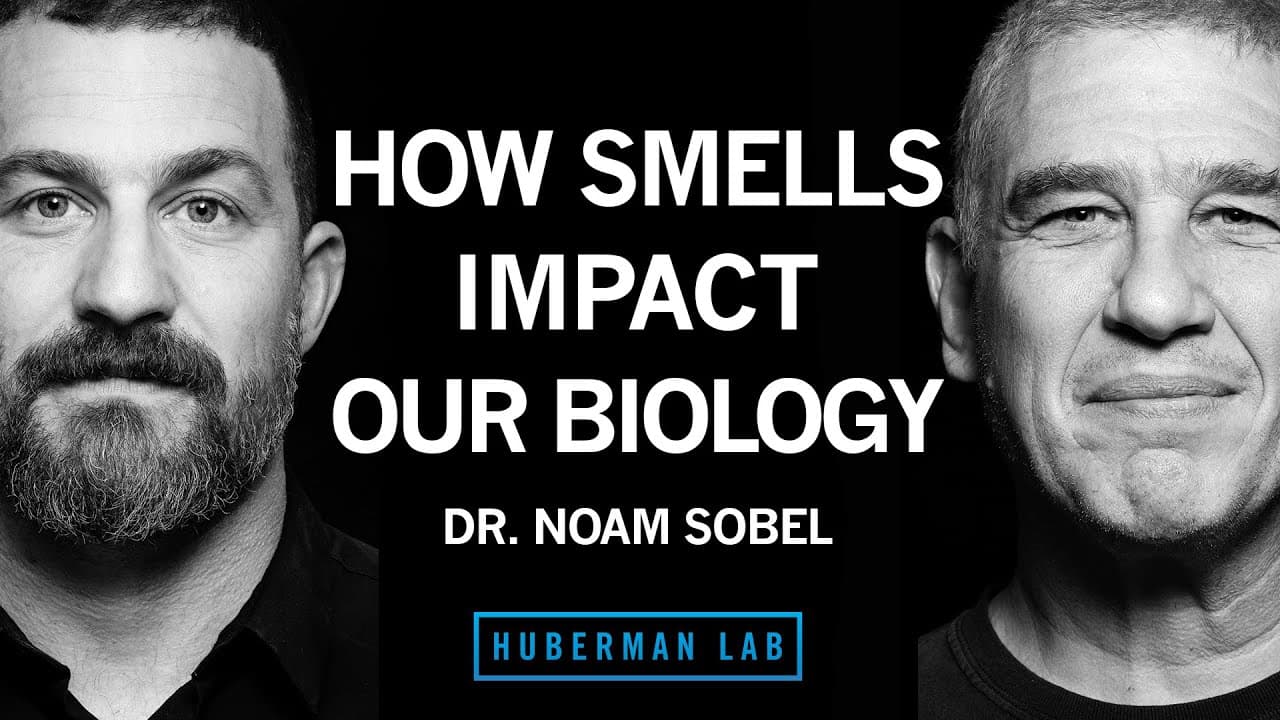
Dr. Noam Sobel: How Smells Influence Our Hormones, Health & Behavior | Huberman Lab Podcast
TL;DR
Humans possess a remarkable sense of smell and their ability to sense and navigate the chemical world around them is comparable to that of dogs. Olfactory experiences have a profound impact on various aspects of human life, including emotions, decision-making, and social interactions.
Transcript
welcome to the huberman Lab podcast where we discuss science and science-based tools for everyday life I'm Andrew huberman and I'm a professor of neurobiology and Ophthalmology at Stanford School of Medicine today my guest is Dr Noam Sobel Dr Noam Sobel is a professor of neurobiology in the department of brain Sciences at the Wiseman Institute of s... Read More
Key Insights
- 😘 Humans have an exceptional sense of smell, with a detection threshold as low as 0.2 parts per billion for certain odorants.
- ❓ Olfactory experiences can have profound effects on emotions, decision-making, and social interactions.
- 😟 The nasal cycle, characterized by alternating nasal airflow, may be related to autonomic nervous system balance and cognitive processing.
- 👣 The ability to track scent trails is present in humans and can be improved through training.
- 🤘 Olfactory loss can be an early sign of neurodegenerative diseases, such as Parkinson's and Alzheimer's.
Install to Summarize YouTube Videos and Get Transcripts
Explore YouTube Video Summarizer or Get YouTube Transcript Extractor
Questions & Answers
Q: Can humans improve their sense of smell through training?
Yes, humans can improve their sense of smell through training. Studies have shown that individuals can enhance their olfactory abilities by engaging in specific olfactory training programs, which involve deliberate and regular exposure to various smells.
Q: Is the ability to track scent trails comparable to dogs?
Yes, humans can track scent trails, albeit to a lesser extent than dogs. Research has demonstrated that humans can track scents by sniffing the air and following the odor plume. Training and practice can enhance this ability.
Q: How does the nasal cycle affect olfaction and overall brain functioning?
The nasal cycle, which involves alternating nasal airflow between the two nostrils, is not solely related to olfaction. It reflects the balance between the sympathetic and parasympathetic branches of the autonomic nervous system and may influence cognitive processing and brain function in general.
Q: Is there a direct pathway from the nostrils to the memory centers in the brain?
Yes, there is a direct pathway from the nostrils to the memory centers in the brain. Olfactory information is transmitted to the olfactory bulb, which then projects to various brain regions, including the hippocampus, a primary center for memory formation and encoding.
Summary & Key Takeaways
-
Humans have a highly developed sense of smell, with a detection threshold as low as 0.2 parts per billion for certain odorants.
-
The olfactory system consists of receptors in the olfactory epithelium, which transduce odorants into neural signals that are transmitted to the olfactory bulb and processed in various brain regions.
-
Humans have the ability to track scent trails, similar to dogs, and can improve their olfactory abilities through training.
-
The alternating nasal airflow, known as the nasal cycle, is related to autonomic nervous system balance and may influence cognitive processing.
Read in Other Languages (beta)
Share This Summary 📚
Summarize YouTube Videos and Get Video Transcripts with 1-Click
Try YouTube Summary with ChatGPT & Claude or YouTube Transcript Generator
Explore More Summaries from Andrew Huberman 📚


Summarize YouTube Videos and Get Video Transcripts with 1-Click
Try YouTube Summary with ChatGPT & Claude or YouTube Transcript Generator