How Does the Boston Dynamics Spot Robot Automate Tasks?
TL;DR
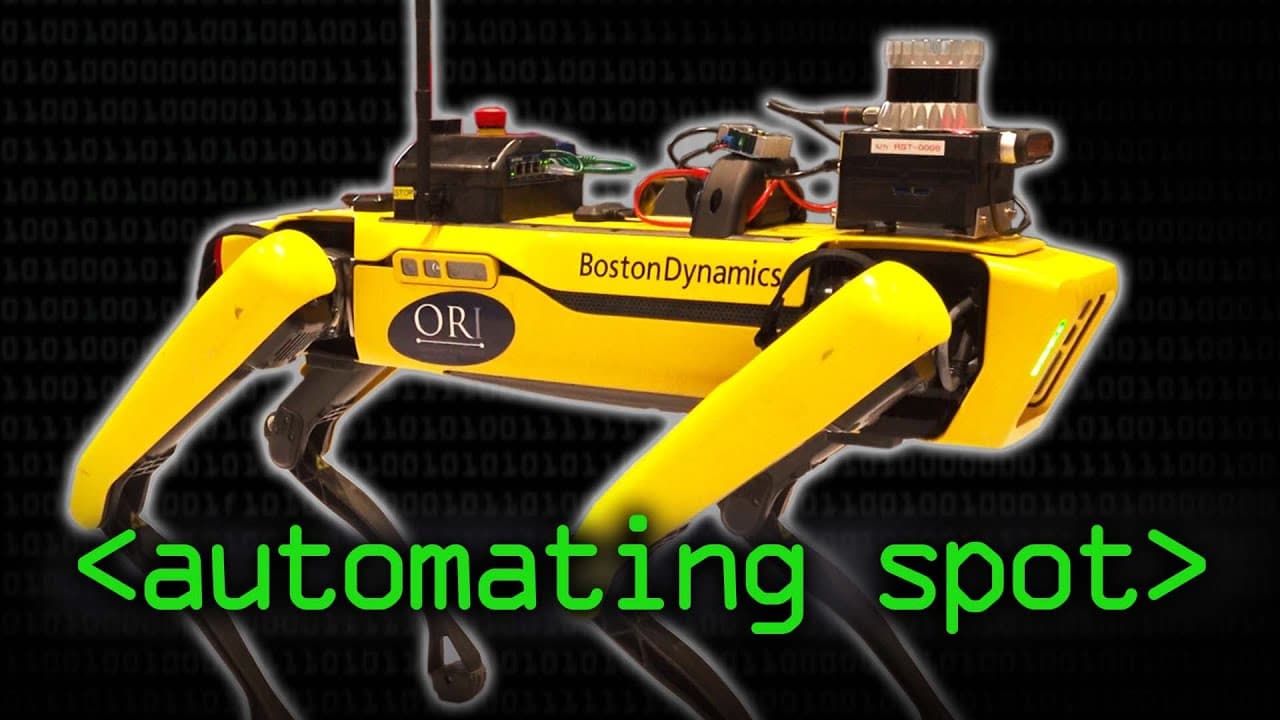
The Boston Dynamics Spot robot automates tasks by using advanced mapping technology and various sensors, enabling it to navigate and inspect facilities autonomously. Equipped with lidar, a RealSense camera, and an Intel NUC, it can perform missions like radiation monitoring while generating 3D maps of its environment.
Transcript
we're only in quite a small space here but the mapping technology will cover much much larger areas we can do whole buildings we can do mine systems all sorts of things so we're the curious in bristol it's big science museum this is a map we built using the robot we navigated the robot around using the same mapping device we can then build up the w... Read More
Key Insights
- 👻 The Spot robot's mapping technology allows it to create detailed maps of areas, making it useful for large-scale facility monitoring.
- 🤖 The payload on top of the robot enables autonomous capabilities, including mission planning and execution.
- 👻 The robot's on-board computation allows for real-time decision-making and coordination between different components.
- 😒 The use of the ROS middleware system allows for efficient communication and integration of different software components.
- 🎟️ While autonomous inspection missions have advantages over fixed sensing systems, they are more suitable for dynamic environments and situations where repeatability and precise observations are required.
- 👾 The mapping stage involves building a 3D representation of the environment using lidar measurements and autonomously placing nodes based on space availability.
- 🤖 During the mission stage, the robot performs predefined tasks at specific locations, such as visual inspections or radiation measurements.
Install to Summarize YouTube Videos and Get Transcripts
Explore YouTube Video Summarizer or Get YouTube Transcript Extractor
Questions & Answers
Q: What mapping technology does the Spot robot use to create maps of different areas?
The Spot robot uses a combination of lidar for laser measurements and an Intel RealSense camera for motion tracking to create detailed maps of different environments.
Q: Can the Spot robot navigate autonomously without any human intervention?
While the Spot robot has autonomous capabilities, it is currently limited to operating within controlled spaces. It requires input from a mission planning system and is typically operated with human assistance to ensure safety.
Q: What is the purpose of the payload on top of the Spot robot?
The payload on top of the robot enables autonomous capabilities. It includes sensors for mapping (lidar and camera) and an Intel NUC for running the necessary algorithms and computations.
Q: What are some examples of autonomous inspection missions that the Spot robot can perform?
The Spot robot can perform various inspection missions, such as radiation monitoring, gas detection, or visual inspections of facilities like oil and gas installations. It can autonomously navigate predefined routes to perform these tasks.
Summary & Key Takeaways
-
The video demonstrates how the Spot robot can be used to create detailed maps of different areas and navigate autonomously within controlled spaces.
-
The payload on top of the robot includes a lidar for laser measurements, an Intel RealSense camera for motion tracking, and an Intel NUC for running algorithms and computations.
-
The robot is capable of autonomous inspection missions, such as radiation monitoring or gas detection, using its mapping capabilities and predefined tasks.
Read in Other Languages (beta)
Share This Summary 📚
Summarize YouTube Videos and Get Video Transcripts with 1-Click
Try YouTube Summary with ChatGPT & Claude or YouTube Transcript Generator
Explore More Summaries from Computerphile 📚




Summarize YouTube Videos and Get Video Transcripts with 1-Click
Try YouTube Summary with ChatGPT & Claude or YouTube Transcript Generator