How Did Ancient Humans Find and Produce Salt?
TL;DR
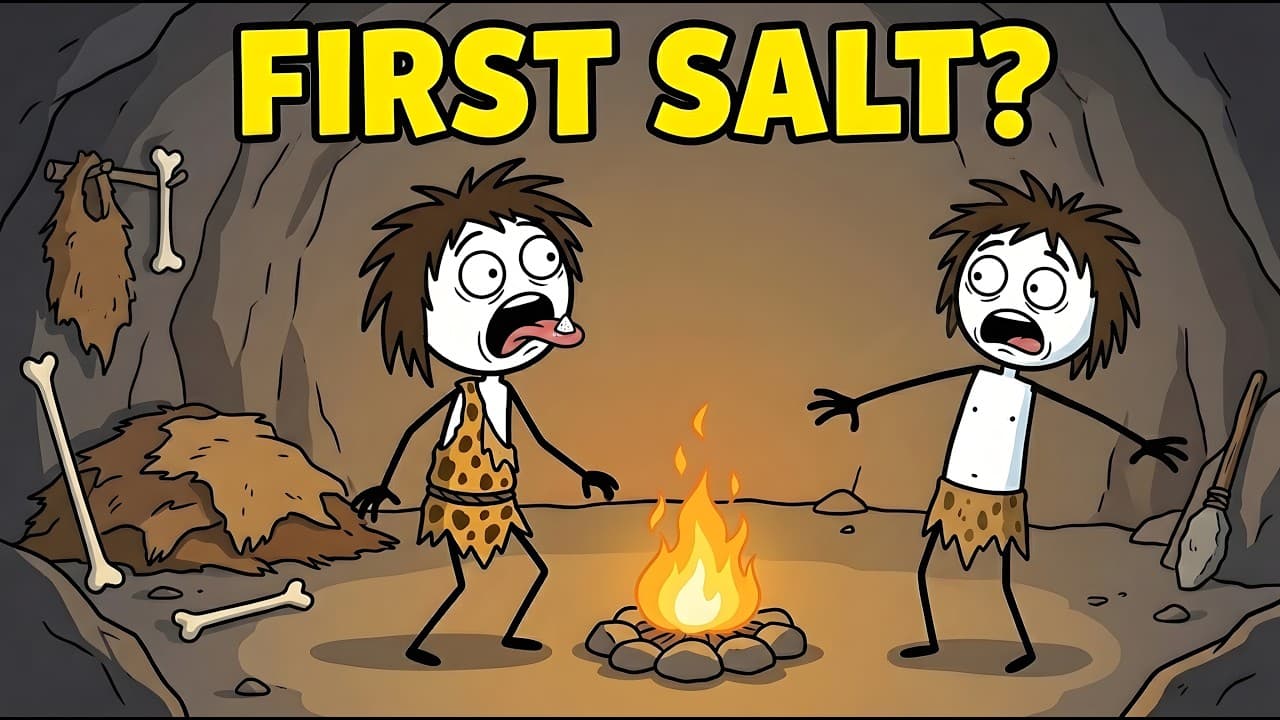
Ancient humans initially obtained essential sodium from animal tissues, mineral-rich clay, salty springs, and deposits located by following wildlife. Deliberate salt production appeared by approximately 6,000 BCE at sites such as Lunca in Romania and Yuncheng Salt Lake in China, as farming and grain-heavy diets reduced natural sodium intake and created demand for extracted, stored, and distributed salt.
Transcript
You reach for the salt shaker without thinking. It's just there, on the table next to the pepper. You shake it over your food before you've even tasted it. The whole action takes less than 2 seconds. But for most of human existence, salt was one of the hardest things on Earth to find. Not inconvenient, not expensive, genuinely physically difficult ... Read More
Key Insights
- Sodium is biologically essential because the heart uses it to fire, neurons use it to transmit signals, and muscles require it to contract properly. Severe deficiency can cause collapsing fluid balance, falling blood pressure, impaired muscle function, and death within days.
- Salt seeking predates deliberate salt production because early humans could satisfy sodium cravings through meat, organs, mineral springs, salt licks, and sodium-rich clay. For hundreds of thousands of years, people found these sources opportunistically rather than collecting, storing, or trading manufactured salt.
- Animal behavior served as a practical guide to sodium deposits. Early humans observed herd movements and repeatedly visited the mineral springs, salt licks, river clay, and other sodium-rich locations sought by elephants, deer, gorillas, and large herbivores.
- Sodium scarcity was a persistent environmental pressure because natural salt deposits were unevenly distributed. Many areas of the East African Rift Valley were relatively sodium-poor, leaving early hominins potentially under-supplied and dependent on movement, ecological knowledge, and unpredictable mineral sources.
- Rare mineral resources were shared across foraging groups rather than kept solely by the finder. Research discussed in the transcript indicates that scarce, valuable foods such as honey, fat, and mineral-rich substances circulated broadly because access affected the survival of the entire group.
- Hunter-gatherer diets could provide sodium without added salt because fresh meat and organs naturally contained it. The Hadza obtained much of their sodium from animal foods, while the Kung consumed roughly 690 mg daily from their natural diet without seasoning food.
- Lunca was an organized salt-production site by approximately 6,000 BCE. Neolithic villagers boiled brine from a natural spring in ceramic vessels, leaving fire pits, structural remains, and hundreds of broken pottery fragments that indicate intensive, repeated production over many seasons.
- Agriculture increased the need for manufactured salt because wheat, barley, millet, and rice contain almost no sodium. As communities settled and depended more heavily on cereal crops, their sodium intake fell, encouraging independent salt extraction systems in Romania, China, and Peru.
Install to Summarize YouTube Videos and Get Transcripts
Explore YouTube Video Summarizer or Get YouTube Transcript Extractor
Questions & Answers
Q: When did humans first begin producing salt deliberately?
The earliest deliberate production described in the transcript dates to approximately 6,000 BCE, roughly 8,000 years ago. At Lunca in northeastern Romania, Neolithic villagers boiled brine from a natural salt spring until crystallized salt remained. Evidence from Yuncheng Salt Lake in China also dates to approximately 6,000 BCE, showing that organized harvesting arose independently in more than one region.
Q: How did ancient humans obtain sodium before salt production?
Before salt could be manufactured, stored, or traded, humans obtained sodium from fresh meat, animal organs, blood, salty springs, natural salt licks, mineral deposits, and sodium-rich soil or clay. These supplies were scattered and unreliable, so groups moved between remembered locations and watched animal behavior to identify places where biologically necessary minerals could be found.
Q: Why does the human body crave salty food?
The craving for salt functions as a biological alarm tied to sodium's essential roles. The heart uses sodium to fire, neurons depend on it to send signals, and muscles need it to contract. Without enough sodium, fluid around cells can collapse, blood pressure can fall, and muscle function can fail, so the nervous system strongly motivates sodium-seeking behavior.
Q: How did animals help early humans locate salt?
Early humans closely observed animals and recognized that they repeatedly traveled to mineral-rich places. Large herbivores seek sodium deposits, elephants travel as far as 40 km to mineral-rich caves at Mount Elgon, gorillas consume sodium-rich plants and riverbank soil, and deer lick road salt. Following these patterns could lead people to springs, clay, and natural salt licks.
Q: What evidence shows that Lunca produced salt repeatedly?
Lunca contained ceramic vessels, fire pits, structural remains, and hundreds of broken pottery fragments associated with boiling brine. Heavy vessels were held over intense heat for hours, causing frequent cracking from thermal stress. The large quantity of broken ceramics indicates that production was not occasional, but continued season after season and possibly across multiple generations of Neolithic villagers.
Q: How did agriculture change humanity's need for salt?
Agriculture shifted diets toward cereal crops such as wheat, barley, millet, and rice, which the transcript states contain almost no sodium. Earlier diets rich in fresh meat and organs could supply sodium naturally. Once settled communities depended mainly on grain, their sodium intake collapsed, creating strong pressure to extract, preserve, transport, and distribute salt deliberately.
Q: Did hunter-gatherers need to season food with salt?
Some hunter-gatherers could meet their sodium needs without adding salt because their unprocessed foods naturally contained it. The Hadza obtained most of their sodium from meat and animal organs during certain seasons. The Kung consumed roughly 690 mg of sodium per day from their natural diet alone, showing that external salt was not always necessary when animal and plant foods remained unprocessed.
Q: How do archaeologists know Lunca salt was distributed?
Chemical analysis connected artifacts found at locations up to 100 km from Lunca with the mineral profile of its salt spring. This matching sodium signature indicates that the product moved well beyond the production site. People were therefore carrying, exchanging, or distributing salt across a broad landscape, creating a deliberate network before writing, bronze, cities, or complex government appeared.
Summary & Key Takeaways
-
Sodium is essential for heart activity, nerve signaling, blood pressure, fluid balance, and muscle contraction. Before people could manufacture salt, hunter-gatherers obtained sodium from meat, organs, mineral-rich soil, springs, and scattered natural deposits. They also watched animals, whose repeated journeys to salt licks and mineral sources revealed where sodium could be found.
-
For most of human history, access to sodium depended on geography, memory, mobility, and cooperation. Early groups revisited temporary deposits, consumed salty clay directly, and shared rare mineral-rich resources. Hunter-gatherers such as the Hadza could receive adequate sodium from animal foods, while the Kung consumed roughly 690 mg per day through an unprocessed natural diet.
-
Deliberate production emerged around 6,000 BCE at Lunca in Romania, where villagers repeatedly boiled spring brine in ceramic vessels. Comparable activity appeared at Yuncheng Salt Lake in China, while Peruvian coastal communities used evaporation basins around 5,000 BCE. Agriculture likely drove this transition because cereal crops provided far less sodium than earlier animal-rich diets.
Read in Other Languages (beta)
Share This Summary 📚
Summarize YouTube Videos and Get Video Transcripts with 1-Click
Try YouTube Summary with ChatGPT & Claude or YouTube Transcript Generator
Explore More Summaries from ThinkMan 📚

Summarize YouTube Videos and Get Video Transcripts with 1-Click
Try YouTube Summary with ChatGPT & Claude or YouTube Transcript Generator