When Did Humans First Eat Sugar?
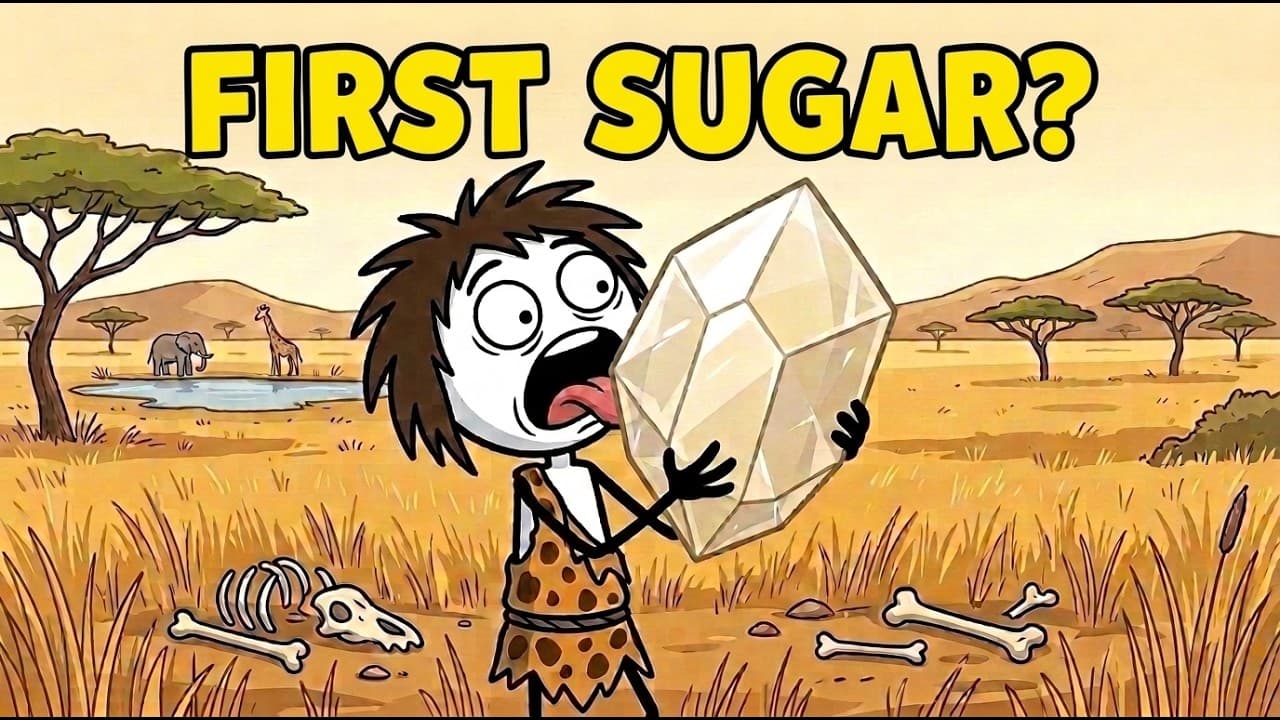
TL;DR
The craving for sugar predates humans by millions of years, originating in ancient primates who preferred sweet fruits. This preference is rooted in the TAS1R2 gene, which helped early primates and humans access quick energy. The Industrial Revolution, not agriculture, dramatically increased sugar consumption, creating a mismatch between ancient cravings and modern abundance.
Transcript
The spoon is small, barely a centimeter of curved metal, the kind that comes free with a jar of instant coffee. You dip it into a bag of white crystals, tip it into a cup, and don't think about it again. It dissolves before you've finished stirring. Nothing about that gesture feels like history. It feels like nothing at all. A reflex, a habit, back... Read More
Key Insights
- Sugar craving predates humans, rooted in ancient primates' preference for sweet fruits.
- The TAS1R2 gene is responsible for sweetness detection, shared across primates.
- Early humans risked their lives for honey, showing the value placed on sugar.
- Sugarcane domestication began in New Guinea around 6,000-8,000 years ago.
- Crystallized sugar was developed in India, transforming it into a tradeable commodity.
- The Industrial Revolution drastically increased sugar availability and consumption.
- Dental studies show a significant shift in oral bacteria during the Industrial Revolution.
- Modern sugar abundance conflicts with ancient scarcity-driven cravings.
Install to Summarize YouTube Videos and Get Transcripts
Explore YouTube Video Summarizer or Get YouTube Transcript Extractor
Questions & Answers
Q: How did ancient primates influence human sugar cravings?
Ancient primates influenced human sugar cravings through their preference for sweet fruits, which provided quick energy. This preference is encoded in the TAS1R2 gene, responsible for sweetness detection, and is shared across the primate family tree. This evolutionary trait has persisted in humans, driving the craving for sugar even before it became widely available.
Q: What role did honey play in early human diets?
Honey played a significant role in early human diets as a concentrated source of sugar. Prehistoric humans risked their lives to gather honey from wild hives, indicating its high value. This practice reflects the ancient importance of sugar as a rare and energy-dense resource, which humans sought despite the dangers involved.
Q: Where and when was sugarcane first domesticated?
Sugarcane was first domesticated in the highlands of New Guinea around 6,000 to 8,000 years ago. Early cultivators grew sugarcane to feed pigs and consumed it by chewing raw stalks to extract the sweet juice. This domestication marked the beginning of sugar as a cultivated crop, although it was not yet refined into the crystallized form we know today.
Q: How did the invention of crystallized sugar impact its use?
The invention of crystallized sugar in India transformed sugar from a perishable liquid into a solid, storable, and tradeable commodity. This innovation allowed sugar to travel long distances and be stored without spoiling, significantly increasing its availability and use. This development marked a turning point in sugar's role in global trade and consumption.
Q: What was the impact of the Industrial Revolution on sugar consumption?
The Industrial Revolution had a profound impact on sugar consumption, making it widely available and affordable. British per capita sugar consumption rose from 4 lb a year in 1700 to 18 lb a year in 1800, driven by industrial-scale production and trade. This shift created a mismatch between ancient sugar cravings and modern abundance, affecting health and dietary patterns.
Q: How did sugar availability change during the Industrial Revolution?
During the Industrial Revolution, sugar availability increased dramatically due to large-scale production on Caribbean plantations using forced labor. This led to a significant rise in sugar consumption, transforming it from a rare luxury to a common dietary staple. The abundance of sugar during this period marked a major departure from its previously scarce availability.
Q: What did dental studies reveal about sugar consumption over time?
Dental studies revealed that the major shift in oral health related to sugar consumption occurred during the Industrial Revolution. Calcified dental plaque analysis showed a stable oral microbiome until this period, when cavity-causing bacteria became dominant. This change highlights the impact of increased sugar availability on oral health, contrasting with the more modest effects of earlier agricultural shifts.
Q: Why is there a mismatch between sugar cravings and modern availability?
There is a mismatch between sugar cravings and modern availability because human biology evolved in an environment of scarcity, where sugar was a rare and valuable resource. The Industrial Revolution's unlimited sugar supply contrasts with ancient scarcity-driven cravings, leading to health issues like cavities and overconsumption. This mismatch highlights the challenges of adapting ancient instincts to modern abundance.
Summary & Key Takeaways
-
The craving for sugar is an ancient instinct, originating tens of millions of years ago in primates who preferred sweet fruits for quick energy. This preference is encoded in the TAS1R2 gene, shared across the primate family. The Industrial Revolution, not agriculture, led to a dramatic increase in sugar availability, creating a mismatch between ancient cravings and modern abundance.
-
Early humans valued sugar highly, risking their lives for honey and eventually domesticating sugarcane in New Guinea. The development of crystallized sugar in India transformed it into a tradeable commodity, spreading its use globally. The Industrial Revolution marked a significant shift in sugar consumption, with British per capita consumption rising fourfold in the 18th century.
-
Dental and genetic studies reveal that the major shift in oral health and sugar consumption patterns occurred during the Industrial Revolution. This period marked a departure from the scarcity-driven sugar consumption of early humans, as industrial production provided an unlimited supply, creating a conflict between ancient cravings and modern availability.
Read in Other Languages (beta)
Share This Summary 📚
Summarize YouTube Videos and Get Video Transcripts with 1-Click
Try YouTube Summary with ChatGPT & Claude or YouTube Transcript Generator
Explore More Summaries from ThinkMan 📚


Summarize YouTube Videos and Get Video Transcripts with 1-Click
Try YouTube Summary with ChatGPT & Claude or YouTube Transcript Generator