How to overcome restlessness and feeling unseen
TL;DR
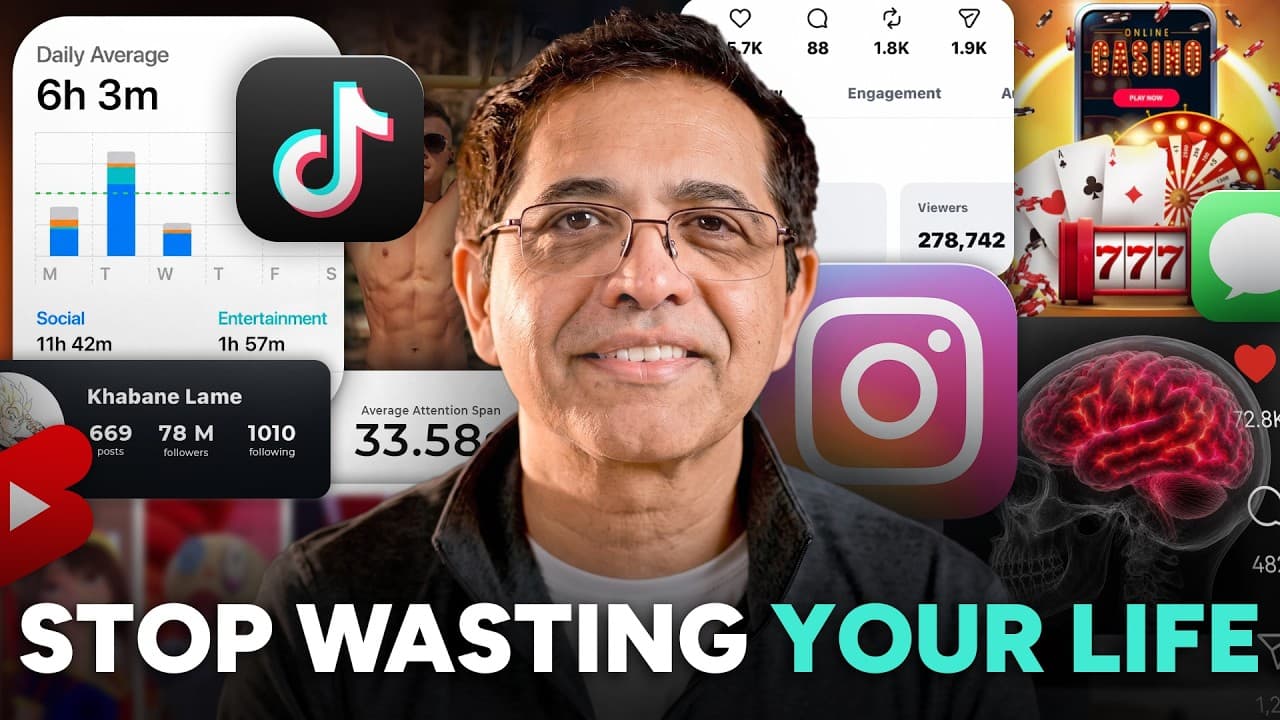
Restlessness, feeling behind, loneliness, and being unseen are the four symptoms of modern life. The remedy is four steps: name the real need behind what you chase, understand the underlying purpose, identify that proxies like money or titles are stunt doubles, and pursue the real goal directly. The video also notes that comparing yourself to others fuels these issues and that social media can amplify loneliness.
Transcript
Modern life is a disease. You want to get ahead. So why do you always feel behind? You want to be useful. So why do you feel unseen? The problem isn't you? Modern life is like a Trojan horse that arrives as a gift and then takes over from the inside. I've lived as a monk in training, as a Wall Street banker, as a CEO and I found the same exact patt... Read More
Key Insights
- Restlessness is driven by the gap between what you chase and why you chase it, not by the amount you own or achieve.
- The four symptoms are restlessness, behind, alone, and unseen, and they appear across careers and life stages, indicating a common modern life pattern.
- The underlying cause is substituting the real hero with a stunt double, making proxies like money or titles the measure of success.
- Goodhart’s law explains how metrics can ruin the value they measure when they become targets, skewing behavior and priorities.
- Money provides security but becomes a restless proxy if it is the sole goal rather than a means to an end.
- Feeling behind is intensified by comparison and social media, which creates an endless chase of better versions of others.
- Loneliness arises because social media replaces real conversations with surface-level connections and constant scrolling cannot substitute for meaningful dialogue.
- Unseenness is threatened by AI and automation, which can replicate skills and reduce the need for human recognition; this increases existential anxiety.
- The remedy centers on reorienting toward the real purpose behind actions, not the proxies that pretend to fulfill them, and adopting a structure similar to Vanguard that emphasizes ownership and clarity over chasing cash or status.
Install to Summarize YouTube Videos and Get Transcripts
Explore YouTube Video Summarizer or Get YouTube Transcript Extractor
Questions & Answers
Q: What are the four symptoms of the modern life pattern discussed in the video?
The four symptoms are restless, behind, alone, and unseen. Restless refers to chronic anxiety and the urge to hustle without stopping. Feeling behind comes from constant comparison with others and the neverending chase for a higher milestone. Loneliness arises as social media replaces real connection with digital signals. Unseen is the fear of not being recognized as AI can perform many skilled tasks cheaper and faster. Each symptom signals a misalignment between what we pursue and why we pursue it.
Q: Why does chasing money not deliver lasting happiness according to the video?
The video cites a Harvard study indicating that people with different wealth levels still want more once they reach a higher threshold. The underlying point is that money does not provide lasting happiness because the target keeps moving; people adjust their expectations as more money becomes the new baseline, so the sense of fulfillment never sticks and restlessness persists.
Q: What is the root cause of the four symptoms as presented?
The root cause is substituting the real hero with a stunt double. We measure something easy to count, like money or a title, and treat it as the symbol of success. This distorts actions and leads to choosing proxies over genuine goals, creating restlessness, comparison, loneliness, and feeling unseen.
Q: What does the video suggest about the role of social media in these symptoms?
Social media is described as not truly social. It keeps people physically present but mentally elsewhere, fostering comparison and a feeling of being behind. It can magnify loneliness because it emphasizes visibility and validation rather than meaningful, face-to-face conversations and real-life connection.
Q: What is Goodhart’s law and how does it apply to modern life according to the talk?
Goodhart’s law states that when a measure becomes a target, it ceases to be a good measure. In modern life, this means that metrics we use to gauge success, such as money or status, can lose their meaningfulness when they become the primary objective, causing behavior to shift away from authentic goals.
Q: What is one practical step to address restlessness and the underlying needs?
One practical step is to name the underlying needs behind what you chase. By asking what that number would actually achieve—whether it is security, retirement, or a certain lifestyle—you clarify the real purpose and can shift focus from chasing a proxy to pursuing a meaningful end.
Q: How does the video propose to view financial life to reduce mental fog?
The video recommends consolidating finances so you have a clear view of income, expenses, and net worth. Having a single source of truth reduces financial fog, provides a sense of control, and helps you understand the real impact of money on your life, rather than using money as a vague trophy.
Q: What is the overall remedy sequence proposed for breaking the four-symptom cycle?
The remedy unfolds in four steps: name the real need behind what you chase, uncover the unspoken need beneath restlessness, behind, loneliness, or being unseen, see through the proxies you measure, and pursue the real thing directly rather than its substitutes. This approach aims to restore alignment between actions and authentic goals.
Summary & Key Takeaways
-
The video explains that modern life creates four symptoms restlessness, feeling behind, loneliness, and being unseen, which originate from substituting real goals with proxies. It argues that money, titles, and other measures become targets that distort actions. The remedy starts with clarifying the true purpose behind what you chase, rather than chasing the proxy.
-
The narrator shares personal experience from a high pressure career to illustrate how success can feel hollow when not aligned with inner needs. He introduces a four-step remedy tracing back to the 1970s Vanguard structure, emphasizing ownership and clarity over superficial metrics.
-
The overall message is to name your true needs, understand the deeper motivations, see through proxies, and go after the real objective directly to regain balance, connection, and a sense of being seen.
Read in Other Languages (beta)
Share This Summary 📚
Summarize YouTube Videos and Get Video Transcripts with 1-Click
Try YouTube Summary with ChatGPT & Claude or YouTube Transcript Generator
Explore More Summaries from Sandeep Swadia 📚





Summarize YouTube Videos and Get Video Transcripts with 1-Click
Try YouTube Summary with ChatGPT & Claude or YouTube Transcript Generator