How to Stop Friends From Draining Your Budget
TL;DR
Protect your budget by separating friendship from spending, stating your limit honestly, and proposing cheaper ways to spend time together. Social obligations such as split bills, weddings, birthday dinners, gifts, and group trips can quietly consume thousands of dollars because declining feels like betrayal, even when several people in the group may share the same financial concern.
Transcript
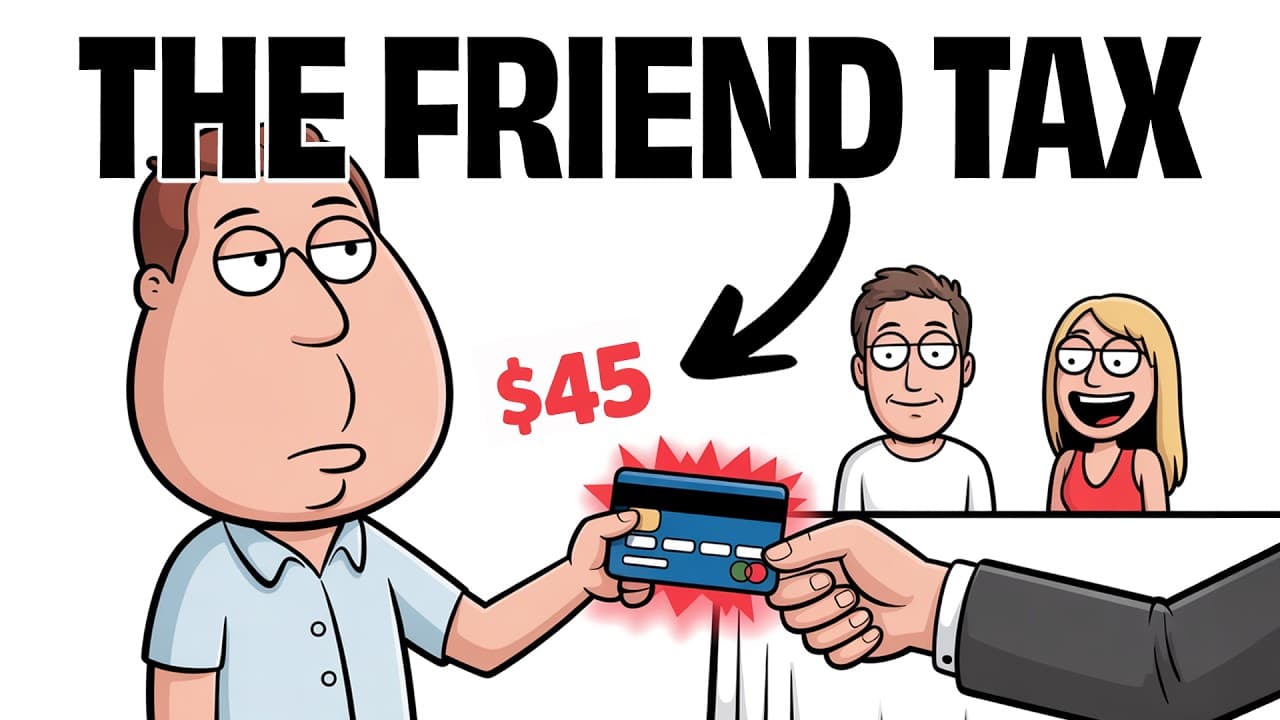
You're sitting at dinner with your closest friends. The bill arrives and someone suggests splitting it evenly. You ordered the cheapest thing on the menu and had water. Your friend ordered three cocktails and appetizer, the lobster, and dessert. You do the mental math. Your meal was $28. Your share of the split bill is 73. You smile, nod, and hand ... Read More
Key Insights
- Unequal bill splitting is a hidden transfer of money between friends. In the opening example, a person whose meal cost $28 pays $73 after the group divides the total evenly, creating a $45 social cost accepted mainly to avoid appearing cheap.
- Social obligations can cost the average American over $4,000 per year. The cited categories include weddings, birthday dinners, drinks after work, weekend trips, group gifts, bachelor parties, and baby showers, with exclusion functioning as the perceived penalty for refusing to participate.
- Destination bachelor parties can cost about $1,400 before the wedding occurs. The example combines a $400 flight, $300 Airbnb share, $200 for dinners, $300 for drinks and activities, and another $200 for cover charges and a group gift.
- Wedding participation can push one friendship’s total cost above $2,000. After the bachelor trip, the guest may spend another $500 on travel and accommodations plus a gift, while people attending four to six weddings during peak wedding season face repeated pressure.
- Birthday dinners can exceed $1,000 annually when they occur every month. A planned $40 burger and beer can become an $85 share after champagne, appetizers, and the birthday person’s meal are divided among the remaining guests.
- Group trips often operate at the spending level of the wealthiest participant. Preferences for nicer hotels and restaurant meals can override another traveler’s plans for a hostel, budget Airbnb, groceries, or other lower-cost choices, causing quieter participants to keep pace through debt.
- Social spending feels like participation rather than an ordinary purchase. The social reward dilutes the pain of payment, so even people who are highly frugal alone may spend heavily with friends and wonder three days later where $200 went.
- Honest alternatives can protect both the relationship and the budget. Saying the proposed cost is unjustifiable, explaining that bank-account stress would prevent enjoyment, and asking about a cheaper plan gives other financially concerned friends permission to speak openly.
Install to Summarize YouTube Videos and Get Transcripts
Explore YouTube Video Summarizer or Get YouTube Transcript Extractor
Questions & Answers
Q: How can I decline an expensive group plan without sounding cheap?
Say that you want to spend time with the group but cannot justify the proposed cost right now. Explain that you would rather choose something cheaper so you can relax and enjoy the gathering instead of worrying about your bank account. Then ask whether anyone else is open to another plan. This frames the decision as a clear financial value rather than pity, defensiveness, or rejection.
Q: What is the friendship tax in personal finance?
The friendship tax is the accumulated cost of social expectations that someone did not freely prioritize, such as unequal split bills, birthday dinners, drinks, weddings, gifts, bachelor parties, and group trips. No formal invoice exists. Instead, the cost appears through many individually reasonable decisions where saying no feels socially riskier than paying, eventually weakening savings despite a decent income.
Q: Why does splitting a restaurant bill evenly create financial pressure?
Even splitting can force careful spenders to subsidize friends who ordered more expensive food and drinks. In the example, one diner orders a $28 meal and water but owes $73 when the group divides the bill equally. The extra $45 is accepted because challenging the arrangement may look cheap, allowing a preference for social harmony to override a fair allocation of costs.
Q: How much can a destination bachelor party and wedding cost a guest?
The bachelor-party example totals about $1,400, including a $400 flight, a $300 Airbnb share, $200 for dinners, $300 for drinks and activities, and another $200 for cover charges and a group gift. The later wedding adds roughly $500 for travel and accommodations plus a gift, pushing the cost associated with one friend’s marriage above $2,000.
Q: Why do group trips become more expensive than expected?
Group trips reveal differences in income, budgets, and preferred comfort. One couple may want a nice hotel while another participant expected a hostel or budget Airbnb. Some travelers may favor restaurants for every meal while others planned to buy groceries. The group then tends to follow its wealthiest member’s spending level, while less comfortable participants quietly use money they cannot afford to spend.
Q: What cheaper activities can replace expensive social plans?
The suggested alternatives include a picnic in the park instead of an expensive restaurant, a house party with a strong playlist instead of a pricey concert, and camping instead of a luxury Airbnb. The important practice is to offer a concrete replacement rather than simply disappear. That approach preserves the invitation to connect and may reveal that others were also worried about money.
Q: Why is social spending difficult to recognize as ordinary spending?
Money spent in a group setting can feel like participation rather than a purchase. The social reward and shared experience dilute the immediate pain of payment, so the brain associates the transaction with fun. As a result, someone who is ruthlessly frugal when alone may spend freely with friends, then notice several days later that $200 disappeared without a deliberate financial decision.
Q: What does a friendship reveal when cheaper plans cause invitations to stop?
A friendship that disappears when one person stops matching expensive habits may have depended primarily on shared spending. The video argues that a genuine friend values someone’s presence rather than purchasing power. Although losing such relationships can hurt, setting financial boundaries distinguishes personal connection from an economic alliance maintained through restaurants, trips, gifts, and other recurring purchases.
Summary & Key Takeaways
-
Social pressure can transform ordinary friendships into recurring financial obligations. Unequal restaurant bills, monthly birthday dinners, weddings, gifts, trips, and lifestyle upgrades appear manageable individually, but together they create a friendship tax. The video estimates that the average American spends over $4,000 annually on social obligations that may not reflect personal priorities.
-
Group spending often follows the preferences of the wealthiest participant, leaving others to keep pace quietly or use debt. Payment also feels less painful when framed as participation, celebration, or memory-making. This psychological effect helps explain why personally frugal people may spend freely in social settings and regret the expense several days later.
-
The proposed solution is to connect without matching every expensive plan. State that the cost is unjustifiable, explain that financial stress would prevent enjoyment, and ask whether others would consider a cheaper alternative. Picnics, house parties, and camping preserve participation while testing whether friends value someone’s presence or primarily their purchasing power.
Read in Other Languages (beta)
Share This Summary 📚
Summarize YouTube Videos and Get Video Transcripts with 1-Click
Try YouTube Summary with ChatGPT & Claude or YouTube Transcript Generator
Explore More Summaries from Nick Invests 📚



Summarize YouTube Videos and Get Video Transcripts with 1-Click
Try YouTube Summary with ChatGPT & Claude or YouTube Transcript Generator