How to Install Free AI Agents from GitHub
TL;DR
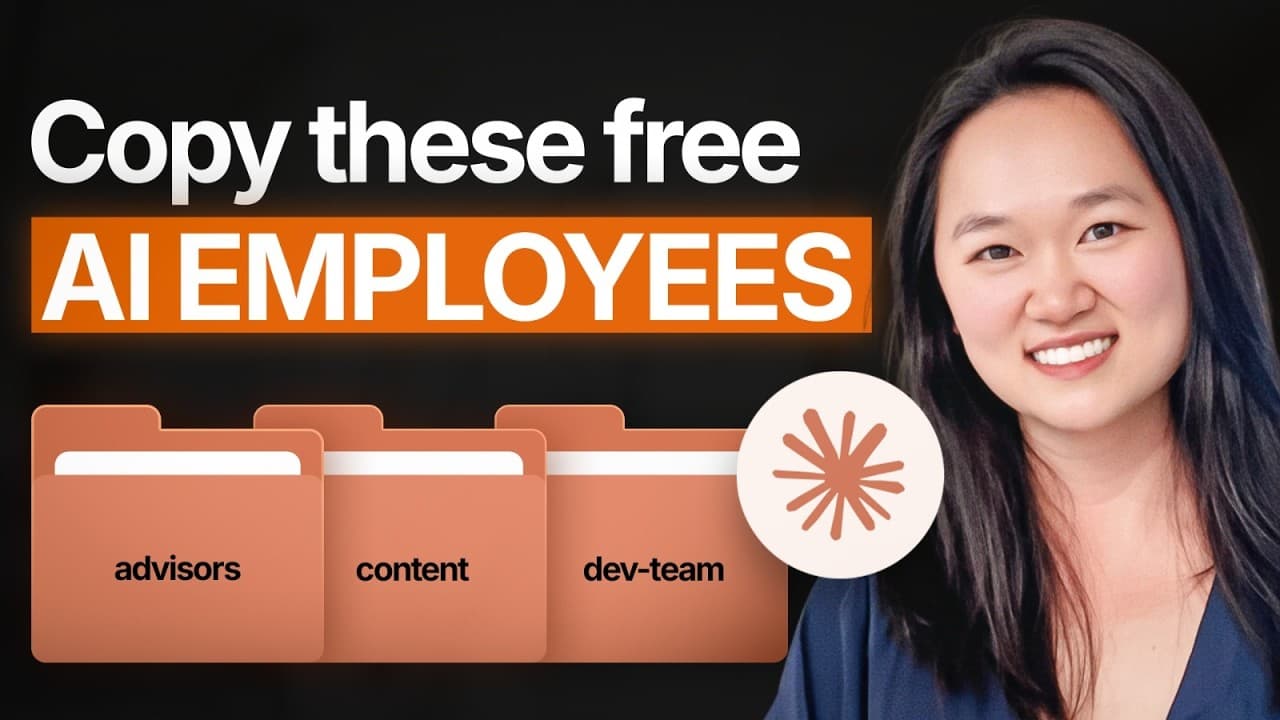
Install free, prebuilt AI agents by downloading the Claude desktop app, opening its Code tab, and cloning selected GitHub repositories into Claude’s local folders. The featured tools can simulate a five-advisor business council or research recent online sentiment across several platforms, giving users agentic workflows that go beyond prompting a standard chatbot.
Transcript
Stanford has just released their annual report on AI. It's over 400 pages, but there are two findings that I think are worth noting. So, I'm going to mention it here. The first is that basically all of the large language models are converging. Now, a couple years ago, there's a big difference between the best models versus the worst models. Today, ... Read More
Key Insights
- AI model performance is described as converging, with the reported difference between the best and worst large language models now below 5%. The practical conclusion presented is that paid, free, and open-source models all work well enough for many current uses.
- Many businesses are described as using AI primarily as a chatbot, entering a prompt and receiving a response. Agentic AI extends this pattern by taking actions, which creates opportunities for workflows that perform research, compare perspectives, and produce structured recommendations.
- GitHub is presented as a source of free, prebuilt AI agents created and open-sourced by developers. Repository stars and forks can help users estimate a project’s popularity and decide which available projects may be worth testing.
- The LLM Council skill works by assigning one Claude system five advisory perspectives: the contrarian, first-principles thinker, expansionist, outsider, and executor. These advisors generate answers in parallel, debate the issue, review one another, and contribute to a consolidated verdict.
- The LLM Council is suited to strategic business decisions such as pricing, product launches, customer acquisition, referral programs, and expansion. Its output can include competing arguments, areas of agreement, overlooked risks, and an executable recommendation for the user.
- Claude’s desktop application is required for the demonstrated skills because they do not work in the web-based version described in the transcript. After downloading the application and signing in, users open the Code tab and run the supplied cloning or installation command.
- The Last 30 Days skill scans recent conversations across Reddit, X, YouTube, TikTok, Instagram, Hacker News, and other listed sites. It compiles honest sentiment, major praises, common complaints, and direct links to relevant online discussions.
- The Last 30 Days results can support product and market research by exposing customer pain points and requests. The Zapier example surfaced interest in human approval for AI-agent workflows, migration complaints, and requests for easier PDF and invoice generation demonstrations.
Install to Summarize YouTube Videos and Get Transcripts
Explore YouTube Video Summarizer or Get YouTube Transcript Extractor
Questions & Answers
Q: How do you install free AI agents from GitHub in Claude?
Download the Claude desktop application from the download page, choose the appropriate operating system, install it, and sign in to your Claude account. Open the Code tab, start a session, and enter the supplied command that clones the selected GitHub repository into Claude’s local folders. After Claude confirms successful installation, invoke the skill using its specified command and verify that its name appears as an available skill.
Q: Why must these GitHub skills use the Claude desktop app?
The demonstrated GitHub skill sets require the desktop version of Claude and are stated not to work in the web-based version. The desktop application provides a Code tab where users can run the repository cloning or installation command. Once the project is placed into Claude’s local folders and loaded successfully, its activation command becomes available for use in later sessions.
Q: What does the LLM Council skill do?
The LLM Council skill analyzes one question through five advisory roles running in parallel: a contrarian, first-principles thinker, expansionist, outsider, and executor. It shows what each advisor thinks, lets the advisors review one another, and then produces a verdict. The final response can also identify blind spots and provide a recommendation, creating an experience similar to consulting a board of advisors.
Q: How can the LLM Council help with business strategy?
The council can compare strategic options such as acquiring customers versus raising prices, adding subscriber perks, launching a referral program, releasing a product, or opening another location. In the bakery example, the advisors debated growth choices and agreed that the company should monetize its loyal subscriber base before prioritizing acquisition. The output also presented blind spots and a recommended course of action.
Q: How can you evaluate a free AI-agent repository on GitHub?
Start by reading the repository page to understand what the project does and what files or instructions it contains. Then inspect its stars and forks. The transcript treats a high star count as an indication that a project is popular and potentially worth attention. This screening method helps distinguish widely used projects from options that may not justify the time required for installation and testing.
Q: What does the Last 30 Days skill research?
The Last 30 Days skill searches recent discussions about a product, service, company, or topic across platforms including Reddit, X, YouTube, TikTok, Instagram, and Hacker News. It compiles sentiment, major praises, common complaints, and possible improvements. Its report also includes direct URLs to relevant conversations, allowing the user to inspect the underlying discussions when more detail is needed.
Q: How can the Last 30 Days skill support product research?
The skill can reveal what users praise, dislike, request, or find difficult about a product and its industry. Those findings can highlight unmet needs, improvement opportunities, and ways to differentiate from competitors. In the Zapier example, the results identified requests involving human approval for AI-agent workflows, complaints from users considering Make.com, and difficulties generating PDFs and invoices through Zapier.
Q: How do you know whether the Last 30 Days skill loaded correctly?
After running the installation command in a new Claude desktop session, wait for Claude to provide confirmation that the skill is ready. Then type the skill’s slash command. The transcript says the command should turn blue and the newly installed skill should appear in the Claude account. If that visual confirmation does not occur, the skill has not been loaded properly and the installation needs checking.
Summary & Key Takeaways
-
Large language models are described as converging in capability while businesses remain behind the technology, often treating AI only as a chatbot. The proposed next step is agentic AI, which can take actions. Prebuilt, open-source GitHub projects offer a faster way to begin experimenting with these workflows without building agents from scratch.
-
The LLM Council skill creates five parallel advisory roles: a contrarian, first-principles thinker, expansionist, outsider, and executor. Users activate the council with a prompt, supply a strategic question, and request a debate. The resulting report includes each perspective, peer reviews, a verdict, identified blind spots, and a final recommendation.
-
The Last 30 Days skill searches recent discussions across sources including Reddit, X, YouTube, TikTok, Instagram, and Hacker News. It summarizes sentiment, praises, complaints, and improvement opportunities while providing links to relevant conversations. Suggested applications include product research, business research, competitor differentiation, and preparation for timely YouTube content.
Read in Other Languages (beta)
Share This Summary 📚
Summarize YouTube Videos and Get Video Transcripts with 1-Click
Try YouTube Summary with ChatGPT & Claude or YouTube Transcript Generator
Explore More Summaries from Helena Liu 📚






Summarize YouTube Videos and Get Video Transcripts with 1-Click
Try YouTube Summary with ChatGPT & Claude or YouTube Transcript Generator