How to Master AI Agent Prompting: Beginner to Expert
TL;DR
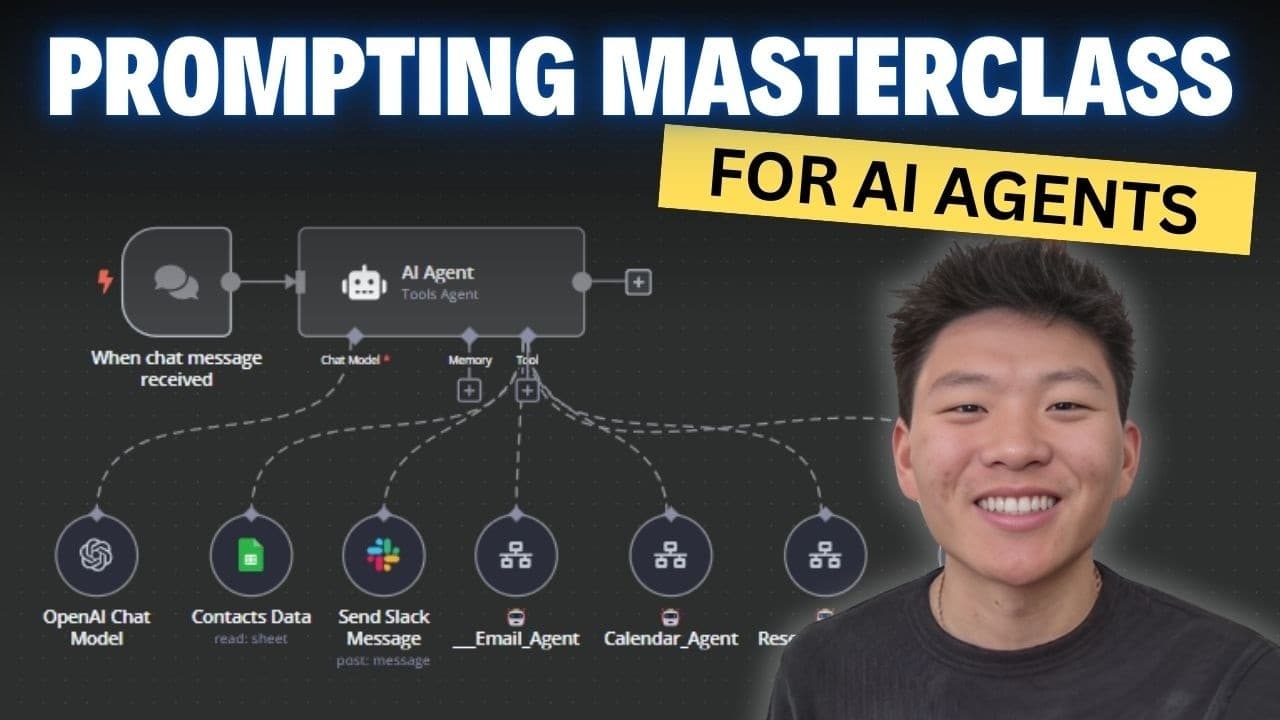
To master AI agent prompting, write precise, well-structured instructions that give the agent everything it needs to execute a task correctly in one try. The masterclass progresses through five modules plus a bonus module, covering core concepts, structured frameworks, role prompting, few-shot examples, token efficiency, and iterative refinement. Read on for practical techniques that make autonomous workflows more accurate, consistent, and reliable.
Transcript
all right we are back with another master class this one is about prompting and prompting specifically for AI agents this course is designed to take you from a complete beginner to almost an expert in creating effective prompts specifically for AI agents by the end of this you'll be able to design prompts to make your agents handle complex tasks au... Read More
Key Insights
- Prompt engineering is creating instructions for AI agents using natural language, similar to programming.
- Effective prompts must be clear and precise, as AI agents execute tasks with no opportunity for clarification.
- Structured prompting organizes information logically, guiding AI through tasks step-by-step.
- Role prompting assigns a specific persona to the AI, aligning its tone and expertise with task requirements.
- Few-shot prompting provides examples to standardize AI responses, enhancing reliability and consistency.
- Tokens represent pieces of language; minimizing token usage reduces computational cost and improves efficiency.
- AI hallucination occurs when AI generates plausible but incorrect responses, mitigated by clear, specific prompts.
- Feedback loops and iterative refinement involve testing and adjusting prompts to enhance AI accuracy over time.
Install to Summarize YouTube Videos and Get Transcripts
Explore YouTube Video Summarizer or Get YouTube Transcript Extractor
Questions & Answers
Q: How do you create effective prompts for AI agents?
State the task in clear, precise, and actionable natural language, including the necessary context and constraints upfront. Because an agent may need to execute the prompt in one try, structure the instructions to leave little room for misunderstanding.
Q: What is prompt engineering for AI agents?
Prompt engineering is the process of creating instructions that guide an AI agent to perform a task exactly as intended. It resembles programming, but the instructions are written in natural language instead of code.
Q: Why is prompting an AI agent different from prompting ChatGPT?
A conversation with ChatGPT can include follow-up questions, clarification, and corrections. An AI agent may receive a prompt inside a workflow and then have to understand and execute it without further discussion, making precision and clarity especially important.
Q: What is structured prompting in AI?
Structured prompting organizes information and instructions in a clear, logical format that guides an agent through a task step by step. This helps the agent handle complex or repeated work more accurately and consistently.
Q: What is role prompting in AI?
Role prompting assigns the AI a particular role or persona. This aligns its tone, expertise, and focus with the requirements of the task, helping it produce more relevant responses.
Q: What is few-shot prompting?
Few-shot prompting gives an AI agent examples of inputs and desired outputs. These examples establish expectations for format, style, and decision-making, improving consistency and reliability.
Q: How can AI hallucinations be reduced through prompting?
Use clear, specific instructions and provide relevant context and constraints. Avoid ambiguity so the agent has less opportunity to generate plausible but incorrect information or stray from the requested task.
Q: How does iterative refinement improve AI prompts?
Iterative refinement means testing prompts, reviewing the agent’s performance, and adjusting the instructions based on the results. Documenting prompt versions and outcomes helps identify effective changes, reduce workflow errors, and improve accuracy over time.
Summary & Key Takeaways
-
Prompt engineering involves crafting clear, precise instructions for AI agents using natural language, enabling them to perform tasks autonomously. Structured prompting, role definition, and few-shot prompting are key techniques to enhance AI reliability.
-
Understanding token usage is crucial for cost efficiency in AI prompting. Minimizing unnecessary tokens reduces computational cost, while structured prompts guide AI agents through tasks logically, ensuring consistent, accurate outputs.
-
Iterative refinement and feedback loops are essential for optimizing AI prompts. Testing, adjusting, and documenting prompt versions help improve AI accuracy, reducing errors in workflows and enhancing task performance.
Read in Other Languages (beta)
Share This Summary 📚
Summarize YouTube Videos and Get Video Transcripts with 1-Click
Try YouTube Summary with ChatGPT & Claude or YouTube Transcript Generator
Explore More Summaries from Nate Herk | AI Automation 📚

Summarize YouTube Videos and Get Video Transcripts with 1-Click
Try YouTube Summary with ChatGPT & Claude or YouTube Transcript Generator