What Is GPT-5 Codex and How Powerful Is It?
TL;DR
GPT-5 Codex is OpenAI's most powerful coding model, able to work autonomously on a single task for over 7 hours while debugging, refactoring, and reviewing code. It scored 74.5% on the SWE-bench Verified benchmark versus 72.8% for GPT-5, and cut incorrect code-review comments from 13.7% down to 4.4%.
Transcript
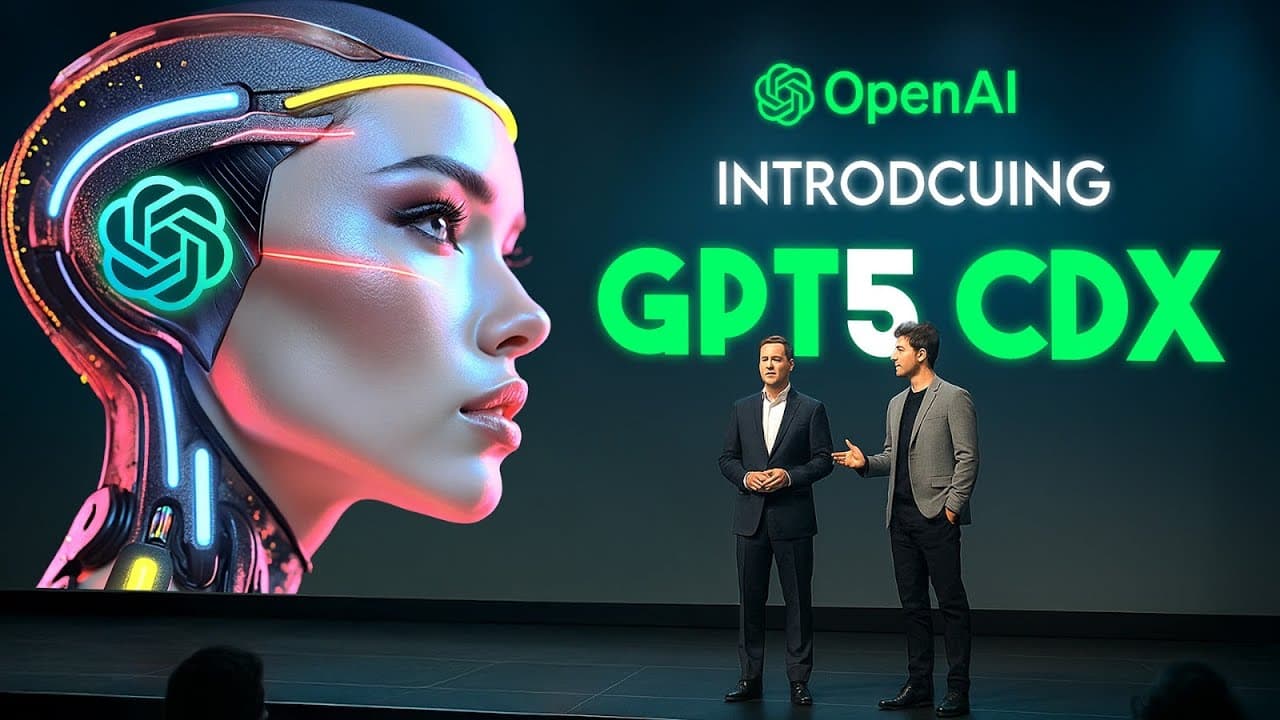
OpenAI just dropped GPT5 Codeex, their most powerful coding model yet. It can take on massive projects, debug, refactor, and keep working on its own for more than 7 hours straight. Developers are already using it to review code and catch problems faster than ever. At the same time, OpenAI is quietly moving back into robotics with hints that humanoi... Read More
Key Insights
- GPT-5 Codex is a version of GPT-5 fine-tuned for software engineering, designed to build projects from scratch, add features and tests, debug, run large refactors, and review code rather than just output snippets.
- The model can work independently on a single task for more than 7 hours, adapting its effort dynamically: seconds for small requests and hours of iterating, testing, and fixing for a full repository refactor.
- On SWE-bench Verified, a set of 500 software engineering tasks, GPT-5 Codex scored 74.5% accuracy compared to 72.8% for GPT-5, with tasks drawn from real bugs and fixes in open-source projects.
- On refactoring tests the gap widened sharply, with GPT-5 Codex hitting 51.3% accuracy versus 33.9% for GPT-5, showing it handles messy jobs in large mature code bases far better.
- GPT-5 Codex is more token-efficient on easy work, using 93.7% fewer tokens than GPT-5 in the bottom 10% of simple cases, while spending twice as long reasoning on the top 10% of hardest tasks.
- For code reviews, GPT-5 Codex cut incorrect comments from 13.7% to 4.4%, raised high-impact comments from 39.4% to 52.4%, and made fewer comments overall at 0.93 per pull request versus 1.32.
- OpenAI is quietly rebuilding robotics after shutting it down in 2020, with job postings returning in January and a focus on teleoperation, simulation, sensing, and prototyping pointing toward humanoid systems.
- A study by OpenAI's econ team and Harvard's David Deming analyzed about 1.5 million conversations across roughly 700 million weekly users, finding roughly half of messages ask for advice, 40% do tasks, and 11% express or play.
Install to Summarize YouTube Videos and Get Transcripts
Explore YouTube Video Summarizer or Get YouTube Transcript Extractor
Questions & Answers
Q: What is GPT-5 Codex?
GPT-5 Codex is OpenAI's most powerful programming model, a special version of GPT-5 fine-tuned for software engineering. It is trained with real-world engineering work in mind, so instead of spitting out snippets that might not compile, it behaves like a teammate. It can build projects from scratch, add features and tests, debug, run large-scale refactors, and review code, and it is now the default engine behind the Codex terminal, VS Code, web, and phone experiences tied to ChatGPT accounts.
Q: How long can GPT-5 Codex work on a task without stopping?
GPT-5 Codex can work independently on a single task for more than 7 hours straight without getting tired. Its thinking time adapts dynamically: for something small and clear-cut it responds in seconds, but for something massive like a full refactor of a large repository it can grind away on its own for up to 7 hours, iterating, testing, fixing errors, and eventually delivering a working result. This ability to sustain long autonomous work is what makes it stand out as a coding partner.
Q: How does GPT-5 Codex perform on the SWE-bench Verified benchmark?
On SWE-bench Verified, a set of 500 software engineering tasks, GPT-5 Codex scored 74.5% accuracy compared to 72.8% for GPT-5 by itself. While that gap sounds small, every percentage point matters because the tasks are real bugs and fixes pulled from open-source projects. On refactoring tests the difference was more dramatic: GPT-5 Codex hit 51.3% accuracy versus 33.9% for GPT-5, showing it is much better at gnarly jobs in big, mature code bases.
Q: How much better is GPT-5 Codex at code reviews?
In tests on open-source repositories, GPT-5 Codex cut incorrect review comments from GPT-5's 13.7% down to just 4.4%. At the same time, the share of high-impact comments jumped from 39.4% with GPT-5 to 52.4% with Codex, and it made fewer comments overall, about 0.93 per pull request versus 1.32. The result is less noise and more useful feedback. Inside OpenAI it already reviews the majority of pull requests and catches hundreds of problems daily before human reviewers step in.
Q: How efficient is GPT-5 Codex with tokens?
GPT-5 Codex knows when to sprint and when to settle in for a marathon. In the bottom 10% of cases where tasks were super simple, it used 93.7% fewer tokens than GPT-5, making it more efficient, quicker, and less wordy. On the flip side, in the top 10% of hardest tasks it went the other direction, thinking more and spending twice as long reasoning, editing, and testing. This dynamic thinking time is what Sam Altman and the team seem most excited about.
Q: How can I access GPT-5 Codex?
GPT-5 Codex access is bundled into ChatGPT Plus, Pro, Business, Edu, and Enterprise plans. The Plus, Business, and Edu tiers give you a few coding sessions per week, while Pro lets you spread work across multiple projects, roughly covering a full work week. Enterprise plans provide pooled credits for teams, and Business can buy more credits if needed. Soon, for people using the Codex CLI with API keys, GPT-5 Codex will also be accessible directly via API. You can use it in the terminal, VS Code, on the web, or on your phone.
Q: Why is OpenAI moving back into robotics?
OpenAI shut down its robotics research in 2020, saying the lack of training data was the problem. After a five-year pause, job postings started appearing again in January, and Wired reported the company is clearly ramping up. The focus is on teleoperation, simulation, sensing, and prototyping, and they are hiring people like Chenuli from Stanford, who worked on humanoid household robots. That strongly suggests they are targeting humanoid, general-purpose robots that could help push toward AGI, though it is not confirmed outright.
Q: What did the largest study on ChatGPT usage find?
OpenAI's econ team, with Harvard's David Deming, analyzed about 1.5 million conversations, the biggest look at consumer use so far, drawn from roughly 700 million weekly users. Adoption broadened fast: users with typically feminine names rose from about 37% in January 2024 to 52% by July 2025, and growth in lower-income countries rose more than four times faster than in richer ones. Roughly half of messages are asking for advice, 40% are doing tasks like drafting and coding, and 11% are expressing or playing, with about 30% work-related and 70% personal.
Summary & Key Takeaways
-
GPT-5 Codex is OpenAI's most powerful coding model, a GPT-5 variant fine-tuned for software engineering that can work autonomously for over 7 hours on large tasks. It builds projects, adds tests, debugs, refactors, and reviews code, adapting its effort from seconds on small requests to marathon sessions on massive refactors.
-
It is now the default engine across the Codex terminal, VS Code, web, and phone experiences, all tied to ChatGPT accounts. On SWE-bench Verified it scored 74.5% versus GPT-5's 72.8%, and on refactoring tests 51.3% versus 33.9%, while using 93.7% fewer tokens on the simplest cases.
-
Beyond Codex, OpenAI is rebuilding its robotics team after a five-year pause, hinting at humanoid systems, and released the largest study of ChatGPT use, analyzing 1.5 million conversations from roughly 700 million weekly users showing broad, fast-growing everyday adoption.
Read in Other Languages (beta)
Share This Summary 📚
Summarize YouTube Videos and Get Video Transcripts with 1-Click
Try YouTube Summary with ChatGPT & Claude or YouTube Transcript Generator
Explore More Summaries from AI Revolution 📚




Summarize YouTube Videos and Get Video Transcripts with 1-Click
Try YouTube Summary with ChatGPT & Claude or YouTube Transcript Generator