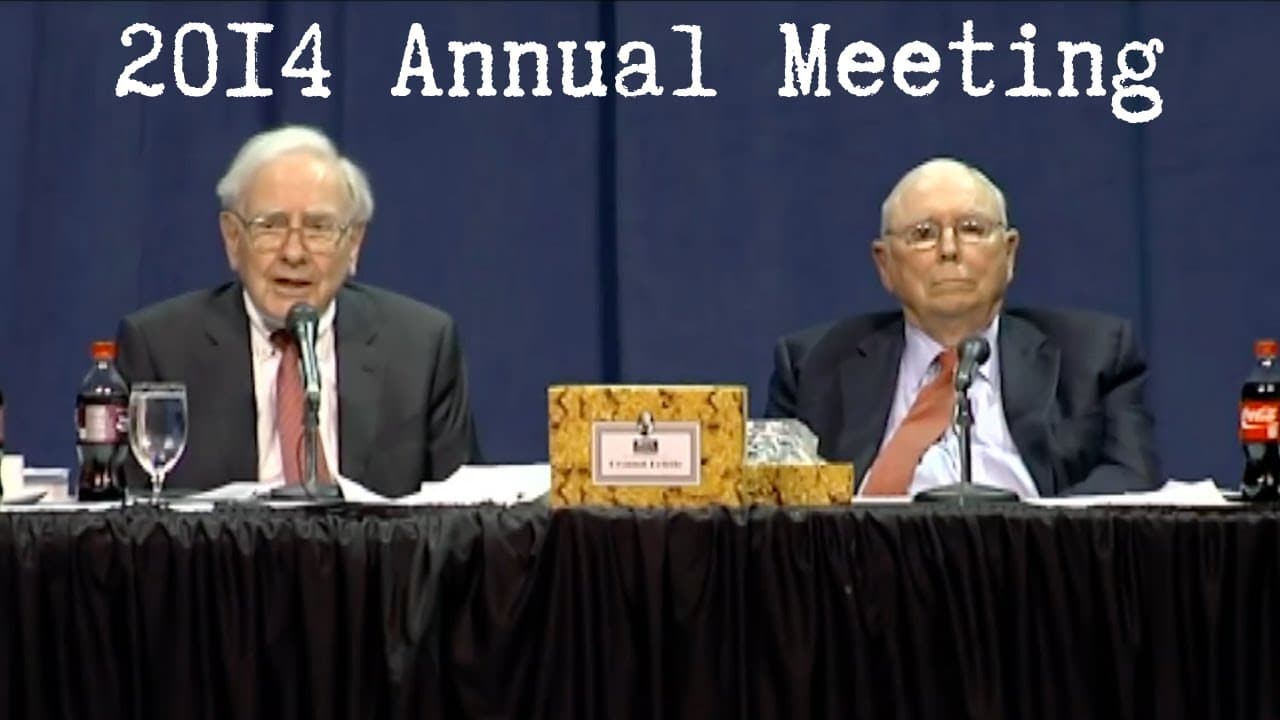
2014 Berkshire Hathaway Annual Meeting (Full Version)
TL;DR
Berkshire Hathaway's insurance float reached $77 billion that Buffett can invest, and as long as underwriting breaks even that money is essentially cost-free and does as much good as net worth. Shareholders overwhelmingly rejected a dividend, voting 45 to 1 against among B holders. Buffett said quarterly earnings should be largely ignored.
Transcript
thank you good morning uh before we start there are two very special guests that i'd like to introduce have stand up uh the first uh even though he was on tour he uh he took a quick uh detour to omaha to be here today and will my friend paul anka please stand up paul [Applause] with all the talk that had been around about my succession i thought it... Read More
Key Insights
- Insurance float at Berkshire reached $77 billion in the first quarter of 2014, and Buffett can invest all of it; whether it costs anything depends on whether the underwriting produces a profit.
- Cost-free float does about as much good as net worth itself, even though it sits as a liability on the balance sheet, which is why Buffett calls the insurance business remarkable.
- Quarterly insurance underwriting results mean little because they can be heavily affected by foreign exchange changes that have nothing to do with the actual insurance business.
- Realized gains or losses on securities should be ignored when interpreting short-term earnings because Berkshire never times sales to produce earnings in any given quarter.
- Berkshire shareholders rejected a dividend proposal decisively: Class A voted over 90 to 1 against, and B shareholders voted 45 to 1 against, with no proxy solicitation done.
- Almost as many B shareholders withheld their vote for Buffett as voted for a dividend, which he joked meant reintroducing a dividend versus keeping him would be a close vote.
- Berkshire releases earnings after markets close, preferably on a Friday, so shareholders get a full weekend to digest the detailed 10-Q rather than just the summary figures.
- Buffett abstained rather than voting against Coca-Cola's executive stock option plan; he considered the plan excessive but admired the company and management and told CEO Muhtar Kent directly.
Install to Summarize YouTube Videos and Get Transcripts
Explore YouTube Video Summarizer or Get YouTube Transcript Extractor
Questions & Answers
Q: What is Berkshire Hathaway's insurance float and why does Buffett value it?
Berkshire's insurance float reached $77 billion in the first quarter of 2014, and it is all Buffett's to invest. Whether the float costs anything is determined by whether the insurance operation produces an underwriting profit. If it even breaks even, the $77 billion is cost-free and does about as much good as net worth itself, even though it appears as a liability on the balance sheet. Buffett called it a very remarkable business.
Q: Why does Buffett say quarterly insurance underwriting results don't mean much?
Buffett explained that insurance underwriting from quarter to quarter really doesn't mean that much. For one thing, it can be quite affected by changes in foreign exchange, which have nothing to do with the actual insurance business, at least in the reality of interim results. Although the first-quarter underwriting profit was satisfactory, it was down from the prior year's first quarter, and that decline more than accounted for the overall drop in operating earnings.
Q: Why does Buffett tell shareholders to ignore quarterly realized gains and losses on securities?
Buffett advises paying no attention to quarterly or even annual realized gains or losses on securities because Berkshire makes no attempt to time the sales of securities to produce earnings in any given quarter. Instead, the firm just tries to manage the money as well as it can and lets the chips fall where they may. He hopes the actions produce a lot of gains over the longer term, but they should be ignored when interpreting short-term earnings.
Q: How did Berkshire shareholders vote on the dividend proposal in 2014?
A shareholder placed a resolution on the ballot suggesting Berkshire pay a dividend. The vote rejected it decisively. Among Class A shares the vote was roughly 90-plus to one against, and less than 40 to one against even after Buffett removed his own votes. Among B shareholders, of whom Berkshire may have around a million, the vote was 45 to one against a dividend, with no proxy solicitation firm hired to influence anyone.
Q: What did the dividend vote reveal about shareholder support for Buffett?
Buffett pointed out a disturbing detail: almost the same number of B shareholders who voted for a dividend also voted against or withheld their vote for him as director. He joked that if directors were forced to choose between paying a dividend and getting rid of him, it would be a close vote. Up until two days before the final figures, the count was virtually a dead heat, running neck and neck.
Q: Why does Berkshire release its earnings on Friday after markets close?
Buffett has always emphasized releasing earnings after the markets close, and preferably after they close on a Friday, so that people have a full weekend to digest the information. There is a lot of information about Berkshire each quarter, contained primarily in the 10-Q made available to read over the weekend. He urges shareholders not to just look at summary figures but to absorb the full 10-Q, which he calls great reading, by Monday morning.
Q: Why did Buffett abstain rather than vote against Coca-Cola's stock option plan?
Buffett was asked why he abstained instead of voting no on Coca-Cola's executive stock option program. He explained that the proposal opposing it was made by a long-time shareholder whose dilution calculations were wildly off, and Berkshire did not want to get into that discussion. Buffett told Coca-Cola CEO Muhtar Kent that Berkshire admired the company and management enormously but considered the compensation plan, though similar to many plans, excessive, so they would abstain.
Q: How is the question-and-answer session at the Berkshire annual meeting structured?
Buffett explained that the Q&A alternates among three groups: journalists on one side, financial analysts on the other, and shareholders in the audience. The questioning runs until roughly noon, breaks for about an hour, then resumes at one o'clock and continues until 3:30, when the meeting adjourns. The formal annual shareholders meeting begins at 3:45 after a 15-minute recess. Journalists like Carol Loomis of Fortune select from thousands of submitted questions.
Summary
In this video, Warren Buffett introduces special guests and then proceeds to introduce the board of directors. He discusses the company's earnings, including the decline in insurance underwriting and the importance of not focusing on short-term gains or losses. Buffett also shares the results of a shareholder resolution for a dividend, highlighting the overwhelming vote against it. The video concludes with Buffett and Charlie Munger answering questions from journalists, financial analysts, and shareholders.
Questions & Answers
Q: Who are the special guests introduced by Warren Buffett at the beginning of the video?
Warren Buffett introduces his friend Paul Anka and Carrie Silva, a woman who organized the event.
Q: How does Warren Buffett describe the performance of the company's insurance underwriting in the first quarter?
Warren Buffett explains that insurance underwriting may vary from quarter to quarter due to factors such as foreign exchange rates, but overall, it is a favorable business for Berkshire Hathaway. He mentions that their underwriting profit was down from the previous year but emphasizes the importance of the float, which is the funds available for investment.
Q: Why does Warren Buffett advise against focusing on quarterly or annual realized gains or losses in securities?
Warren Buffett explains that Berkshire Hathaway does not try to time the sales of securities to produce earnings in any given period. Their goal is to manage the money well over the long term and let the gains or losses fall wherever they may. While short-term gains may not always be favorable, they hope to achieve significant gains over the years.
Q: What voting results does Warren Buffett share regarding the shareholder resolution for a dividend?
Warren Buffett reveals that the shareholder resolution to pay a dividend was overwhelmingly rejected by the shareholders, with the vote being approximately 90 plus to one against the dividend. He explains that the vote was even stronger among the non-tainted shareholders, with a ratio of about 40 to one. Moreover, even among the B shareholders, who are potentially less privileged, the vote against the dividend was 45 to one.
Q: Why did Warren Buffett abstain from voting against Coca-Cola's excessive stock option program proposal?
Warren Buffett shares that a shareholder who owned shares for a long time proposed the option program, and although he believed it to be excessive, he did not want to get into a debate about it. He abstained from voting and communicated directly with Muhtar Kent, the CEO of Coca-Cola, explaining his concerns about the plan being excessive. Warren Buffett believes that their abstention, along with public statements about the plan's excessive nature, made a more significant impact than simply voting against it.
Q: How does Warren Buffett respond to the question about President Obama's effect on the economy?
Warren Buffett acknowledges that there are different opinions about President Obama's impact on the economy. He remarks that American businesses have been doing well, and while the circumstances may not be favorable for all individuals, he believes that Obamacare has provided necessary benefits to many people. He also highlights the significant growth of corporate profits and the decline in corporate taxes.
Q: How does Warren Buffett explain the difference in investment approach between Berkshire Hathaway and 3G Capital?
Warren Buffett articulates that while Berkshire Hathaway focuses on buying and holding successful companies, 3G Capital has a more hands-on approach with zero-based budgeting to improve margins. He states that the two strategies do not blend well together but adds that Berkshire Hathaway is open to partnering with 3G Capital in certain opportunities, as they admire 3G's management capabilities.
Q: How does Warren Buffett explain the difference in stock performance between Berkshire Hathaway and the market index?
Warren Buffett elaborates that Berkshire Hathaway is likely to underperform in very strong up years, match in moderate up years, and outperform in even or down years. He reiterates that over any cycle, they expect to overperform the market but acknowledges that individual years may deviate from this expectation. Additionally, he points out that Berkshire Hathaway's stock performance reflects the net worth after full corporate taxes, while market indexes do not pay any taxes.
Q: How does Warren Buffett respond to the question about narrowing the discount between Berkshire Hathaway's share price and intrinsic value?
Warren Buffett emphasizes that Berkshire Hathaway has been undervalued compared to the intrinsic value of its businesses for quite some time. He mentions the company's willingness to repurchase shares at 120% of book value and how this indicates a significant discount to intrinsic value. However, he does not provide an exact figure for the intrinsic value, explaining that it changes over time and can vary among individuals' calculations. He also mentions that an IPO of individual operating units is not something they would consider.
Q: How does Warren Buffett explain gaining the trust of founders or owners of acquired companies?
Warren Buffett explains that Berkshire Hathaway keeps its promises to the founders or owners of acquired companies. While they do not promise to never have layoffs or never sell a business, they do promise to keep a business unless it encounters significant losses or labor problems. Berkshire Hathaway puts these promises in the annual report to create trust, and they have a track record of maintaining their commitments to the business and its employees.
Q: How does Warren Buffett address the question about his son Howard's role in defending the culture of Berkshire Hathaway?
Warren Buffett clarifies that the non-executive chairman's role, which his son Howard will assume, is not to set compensation or select the CEO but to oversee any necessary change if the board of directors decides it is needed. He mentions that Howard and his other children have a dedication to the culture of Berkshire Hathaway, which is reinforced by their behavior and results. Warren Buffett also highlights that the non-executive chairman role provides an extra safety valve but is unlikely to be crucial for Berkshire Hathaway.
Summary & Key Takeaways
-
Buffett opened the 2014 meeting by introducing guest Paul Anka and thanking Carrie Silva, who organized over 400 employees for the show. He then reviewed first-quarter earnings, noting operating earnings were down, driven mainly by insurance underwriting, which he cautioned means little quarter to quarter.
-
Berkshire's insurance float reached $77 billion, all available to invest. Buffett stressed that if underwriting merely breaks even, this float is essentially cost-free and does about as much good as net worth, making insurance a marvelous business despite the softer first-quarter underwriting profit.
-
A shareholder dividend proposal was rejected overwhelmingly, 45 to 1 among B shareholders. Buffett then addressed Coca-Cola's stock option plan, explaining he abstained rather than voting no, called the plan excessive, and informed CEO Muhtar Kent of his decision beforehand.
Read in Other Languages (beta)
Share This Summary 📚
Summarize YouTube Videos and Get Video Transcripts with 1-Click
Try YouTube Summary with ChatGPT & Claude or YouTube Transcript Generator
Explore More Summaries from Investor Archive 📚
Summarize YouTube Videos and Get Video Transcripts with 1-Click
Try YouTube Summary with ChatGPT & Claude or YouTube Transcript Generator