How Do Beginners Start Swing Trading in 2025? Full Step-by-Step Guide
TL;DR
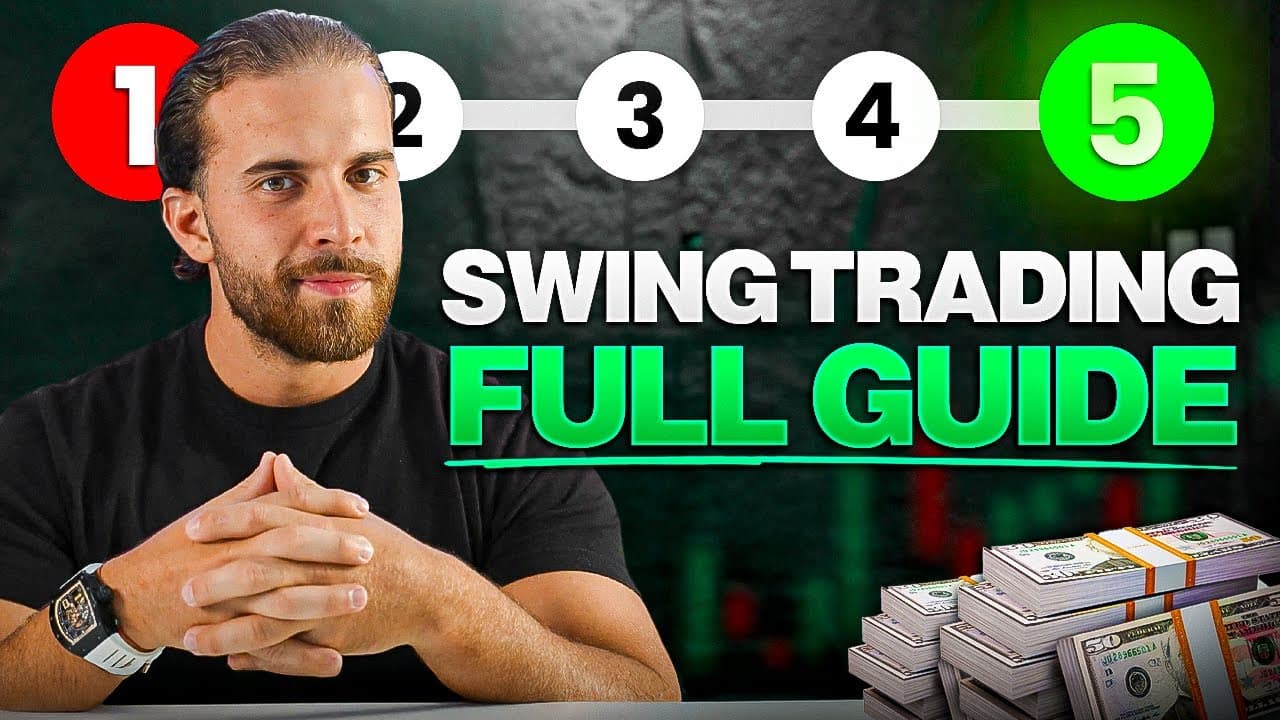
Beginners can start swing trading by analyzing higher time frames, waiting for one or two high-quality positions per week, and holding each trade for roughly 7 days to 2–3 weeks. The approach favors slow-moving markets that respect market structure and requires only about 1–3 hours in front of the charts each week, according to the speaker. Read on to understand its schedule, trade selection, risk approach, and patience requirements.
Transcript
trading is already hard enough and imagine only having a small window of 5 to 6 hours or even just a couple of minutes and this is usually not doable for a lot of people because they work jobs and the different time zones that the market is available in those small window periods and that's exactly where swing trading falls into place everybody can... Read More
Key Insights
- Swing trading is suitable for those with busy schedules as it allows holding positions for several days to weeks.
- A swing trader typically takes one to two high-quality trades a week, focusing on market trends.
- Swing traders analyze markets using higher time frames to identify significant movements.
- Patience is crucial for swing traders, as trades are not executed daily but rather when the market presents optimal opportunities.
- Swing traders focus on low-volume markets to maximize profit potential over time.
- The strategy involves setting trades and allowing them to run without constant monitoring.
- Swing trading can be more profitable than day trading or scalping due to capturing larger market moves.
- Entry signals are crucial and often involve identifying engulfing candlestick patterns.
Install to Summarize YouTube Videos and Get Transcripts
Explore YouTube Video Summarizer or Get YouTube Transcript Extractor
Questions & Answers
Q: How can a beginner start swing trading in 2025?
Begin by analyzing markets on higher time frames and looking for slow-moving markets that respect market structure and the chosen strategy. Wait patiently for one or two high-quality positions per week, then set the trade’s take-profit and stop-loss levels and allow it to run.
Q: What is swing trading?
Swing trading means holding a position for more than 7 days, often through a weekend, and usually closing it within about 2 to 3 weeks. The speaker distinguishes this from day trading, where a position lasts only for the day, and scalping, where it may last from 15 minutes to 2 hours.
Q: How long does a swing trader hold a position?
A swing trader generally holds a position for 7 days or longer, with about 2 to 3 weeks described as the usual maximum. The speaker also gives 7 to 9 days as an example of the type of extended move a swing trader may seek.
Q: How many trades should a swing trader take each week?
The guide recommends taking no more than one or two positions per week. Opportunities may not appear every day and can sometimes take weeks, so the emphasis is on waiting for higher-quality trades rather than trading frequently.
Q: How much time does swing trading require each week?
According to the speaker, a swing trader may spend only about 1 to 3 hours per week in front of the charts. Before entering, the trader can check the market once or twice a day; after entry, the suggested approach is to let the position reach either its take-profit or stop-loss level.
Q: What kinds of markets does the guide recommend for swing trading?
The guide recommends low-volume, slower-moving markets that respect market structure and the trading strategy. The aim is to capture a larger move over roughly 7 to 9 days instead of targeting movement within a single hour or day.
Q: Can someone with a full-time job or school schedule swing trade?
The speaker says swing trading can suit people working a 9-to-5, attending school full-time, working other shifts, or living in different time zones. Because positions run for several days and do not require constant monitoring, traders can review or enter them when they have free time.
Q: Why is patience important in swing trading?
Swing traders may wait days or weeks for one of their limited high-quality setups. The speaker says having work or school to focus on can help prevent constant chart watching, while too much free time may create impatience and tempt a trader to become unnecessarily active.
Summary & Key Takeaways
-
Swing trading offers flexibility and higher potential profits by holding positions for 7 days to 3 weeks. Traders focus on high-quality trades, analyzing market trends on higher time frames. Patience is key, as trades are set and left to run without constant monitoring, making it suitable for those with busy schedules.
-
The strategy involves taking one to two trades a week, focusing on low-volume markets to capture significant moves. Swing traders use top-down analysis to identify trends and entry points, often looking for engulfing candlestick patterns as signals.
-
Swing trading can be more profitable than day trading or scalping due to the ability to capture larger market movements. The approach requires discipline and a deep understanding of technical analysis, making it appealing to those seeking a strategic and less time-intensive trading method.
Read in Other Languages (beta)
Share This Summary 📚
Summarize YouTube Videos and Get Video Transcripts with 1-Click
Try YouTube Summary with ChatGPT & Claude or YouTube Transcript Generator
Explore More Summaries from fxalexg 📚






Summarize YouTube Videos and Get Video Transcripts with 1-Click
Try YouTube Summary with ChatGPT & Claude or YouTube Transcript Generator