How to Get Your Brand Into ChatGPT Answers
TL;DR
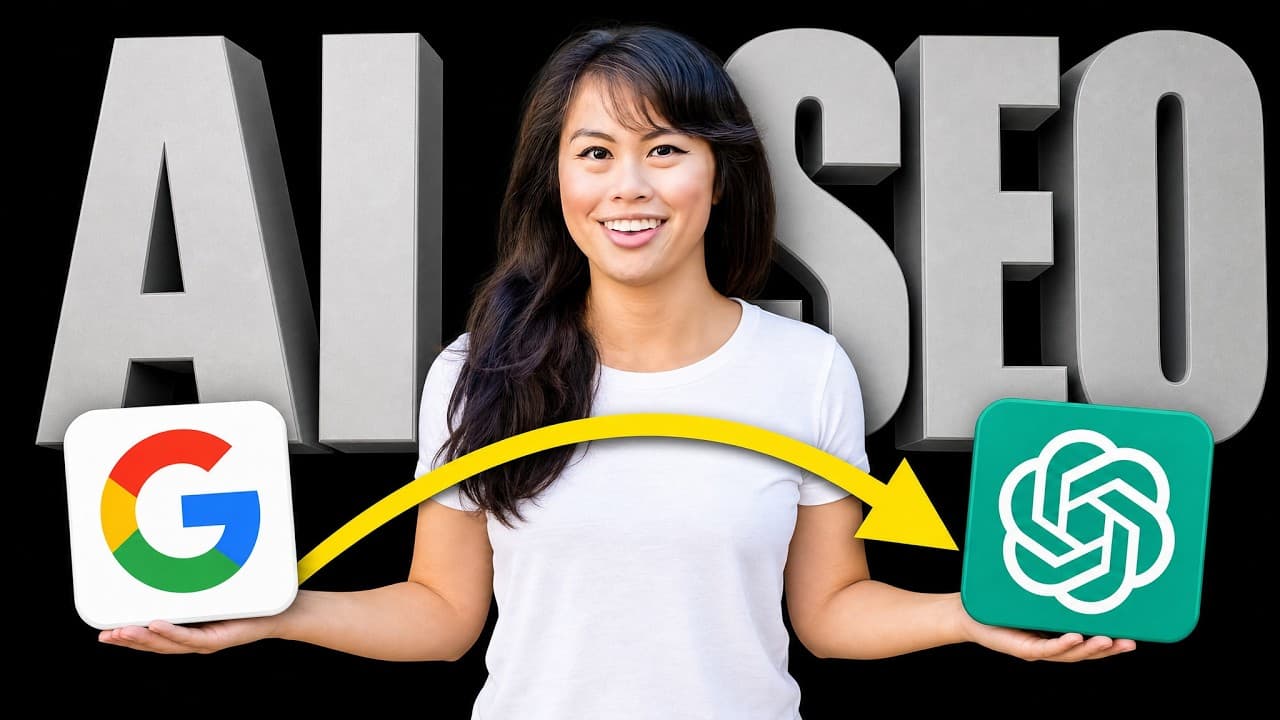
AI SEO focuses on getting your brand, product, or offer included directly in answers from tools such as ChatGPT and Claude. Unlike traditional SEO, which targets prominent positions among Google links, answer engine optimization requires content that AI systems can use when responding to detailed customer questions, where only a few brands may be mentioned.
Transcript
Hello. Um, I'm just doing a quick audio check. Let me know if you can hear me. Okay. Hello. Hello. Hello. Can everybody hear me? Can you guys hear me? Okay, sweets. Oh, today will be really intense. Um, this newsletter will come out tomorrow. I spent a lot of time on it. Um, it's going to basically walk through uh my entire SEO playbook for 2026. U... Read More
Key Insights
- Traditional SEO is the practice of optimizing content to appear prominently in Google search results. The established approach emphasizes relevant words on websites and blog posts, backlinks from other websites, and placement on the first page, with the top three results treated as ideal.
- AI SEO is focused on getting a company, brand, product, or offer included inside an AI-generated answer. Instead of competing to become one of several visible search links, a business seeks a direct mention when ChatGPT or Claude responds to a prospective customer's question.
- Answer engine optimization is commonly abbreviated as AEO. The transcript notes that people interpret the term as either answer engine optimization or ask engine optimization, while the presenter prefers the simpler label AI SEO for describing optimization across AI tools.
- The customer journey is shifting from link selection to synthesized answers. A customer can open ChatGPT or Claude, describe a question and its context, then receive a longer consolidated response rather than a page containing 10 immediately visible links.
- AI sources are often less visible than traditional search results. Although an AI response may reference several links while researching an answer, those sources can remain hidden unless the user actively looks for them, making inclusion in the written response especially important.
- AI answers may mention fewer than three brands. This limited space differs from Google's multiple pages of results, so the stated objective is to become one of the small number of companies explicitly named in the response rather than merely appearing among underlying sources.
- Customer questions should guide AI SEO efforts. The presenter uses the query about posting to Instagram from Claude as a concrete example, arguing that a relevant company, tool, product, or offer should appear when an AI system answers that specific type of request.
- Incognito testing is a practical way to check brand visibility in AI answers. The presenter opened a fresh incognito browser window, entered a target question, and inspected whether her product appeared, offering a direct method for observing performance from a clean browsing context.
Install to Summarize YouTube Videos and Get Transcripts
Explore YouTube Video Summarizer or Get YouTube Transcript Extractor
Questions & Answers
Q: What is AI SEO and how does it work?
AI SEO is the practice of helping a company, brand, product, or offer appear directly inside answers generated by tools such as ChatGPT and Claude. A customer asks a question, often with detailed context, and the AI researches information before composing a response. The business objective is to be included in that response, not merely listed among hidden supporting sources.
Q: How is AI SEO different from traditional SEO?
Traditional SEO aims to place a website near the top of Google search results, ideally within the first three links, so users click through to the site. AI SEO targets inclusion within a synthesized answer from ChatGPT or Claude. The distinction matters because AI presents a written response and may name fewer than three brands instead of displaying pages of links.
Q: What does AEO mean in AI search optimization?
AEO stands for answer engine optimization, although the transcript notes that some people call it ask engine optimization. It describes the effort to get a company or brand included in an AI system's answer to a customer's question. The presenter uses AI SEO as a preferred alternative term because the approach can apply across AI tools, including ChatGPT and Claude.
Q: Why are backlinks used in traditional SEO?
Backlinks are links from other websites to your website. In the traditional SEO model described in the transcript, businesses combine backlinks with relevant words on websites and blog posts to improve their placement in Google search results. The intended outcome is a first-page position, preferably among the first three results, where customers are more likely to notice and click the site.
Q: Why does ranking as an AI source differ from ranking on Google?
Google traditionally gives users a visible list of results that they can examine and click. An AI tool instead researches sources and produces a consolidated response, while many of its referenced links remain hidden unless the user looks for them. Therefore, being one of the underlying sources is not the complete objective. The brand should appear in the answer itself.
Q: How can a business test whether it appears in AI answers?
A business can open a fresh incognito browser window, submit a question that a prospective customer would ask, and examine the generated result for its brand, product, or website. The presenter demonstrates this process with a query about posting to Instagram from Claude. Using a clean window provides a direct way to inspect whether the intended business appears for that question.
Q: What customer questions should an AI SEO strategy target?
An AI SEO strategy should target questions that connect a customer's practical need with the company's tool, product, offer, or expertise. The transcript gives the example of asking how to post to Instagram from Claude. The goal is for the relevant business to be included when an AI system researches that request and constructs its response for the customer.
Q: Why is direct brand inclusion important in ChatGPT and Claude?
Direct inclusion matters because ChatGPT and Claude are described as becoming a home base where customers ask questions and provide detailed context. The resulting answer may mention only two or three brands, while supporting links can remain out of immediate view. A company named within the response is therefore more visible than one that appears only among sources the user may never inspect.
Summary & Key Takeaways
-
Traditional SEO was built around ranking links in Google search results. Businesses placed relevant words on websites and blog posts, sought backlinks from other websites, and tried to reach the first page, ideally one of the top three positions, so potential customers would click through and discover their products or services.
-
AI SEO, also called answer engine optimization or AEO, changes the target from a search-results position to inclusion within an AI-generated response. Customers ask ChatGPT or Claude questions, often with detailed context, and the AI researches sources before producing a consolidated answer in which a company, tool, product, or offer may appear.
-
The practical goal is to identify questions customers ask AI systems and make the business relevant to the resulting answers. The presenter demonstrates this with a fresh incognito search for how to post to Instagram from Claude, where her website appeared first, and attributes 1.4 million website views in 2026 to her broader work.
Read in Other Languages (beta)
Share This Summary 📚
Summarize YouTube Videos and Get Video Transcripts with 1-Click
Try YouTube Summary with ChatGPT & Claude or YouTube Transcript Generator
Explore More Summaries from Sabrina Ramonov 🍄 📚


Summarize YouTube Videos and Get Video Transcripts with 1-Click
Try YouTube Summary with ChatGPT & Claude or YouTube Transcript Generator