How to Engineer Context for AI Coding Agents
TL;DR
Treat prompts, rules, documentation, specifications, and agent memory as engineered assets that must be generated, evaluated, distributed, and observed. Repeated evaluations, including format validation, model-based judging, and sandboxed end-to-end tests, reveal whether context reliably changes agent behavior and provide feedback for improving it across teams and tools.
Transcript
[music] There's a there's a few people who want to start earlier. Uh I know I'm going to take the opportunity to officially open kind of the uh architect track. There's no track host, so I do it myself. So, thank you for coming here. I hope you already had like a good conference. Um, it's amazing that like so many people showed up. Uh, maybe before... Read More
Key Insights
- Context is becoming a primary input to software creation because developers can increasingly describe desired changes while coding agents generate the implementation. Prompts, persistent instructions, documentation, specifications, and reusable skills therefore require deliberate engineering rather than treatment as temporary text.
- Reusable skills can replace large amounts of rigid procedural code when the required workflow must adapt to different ecosystems and tools. A skill can instruct an agent to identify a package manager, determine the technology environment, and then guide the user through the appropriate sequence.
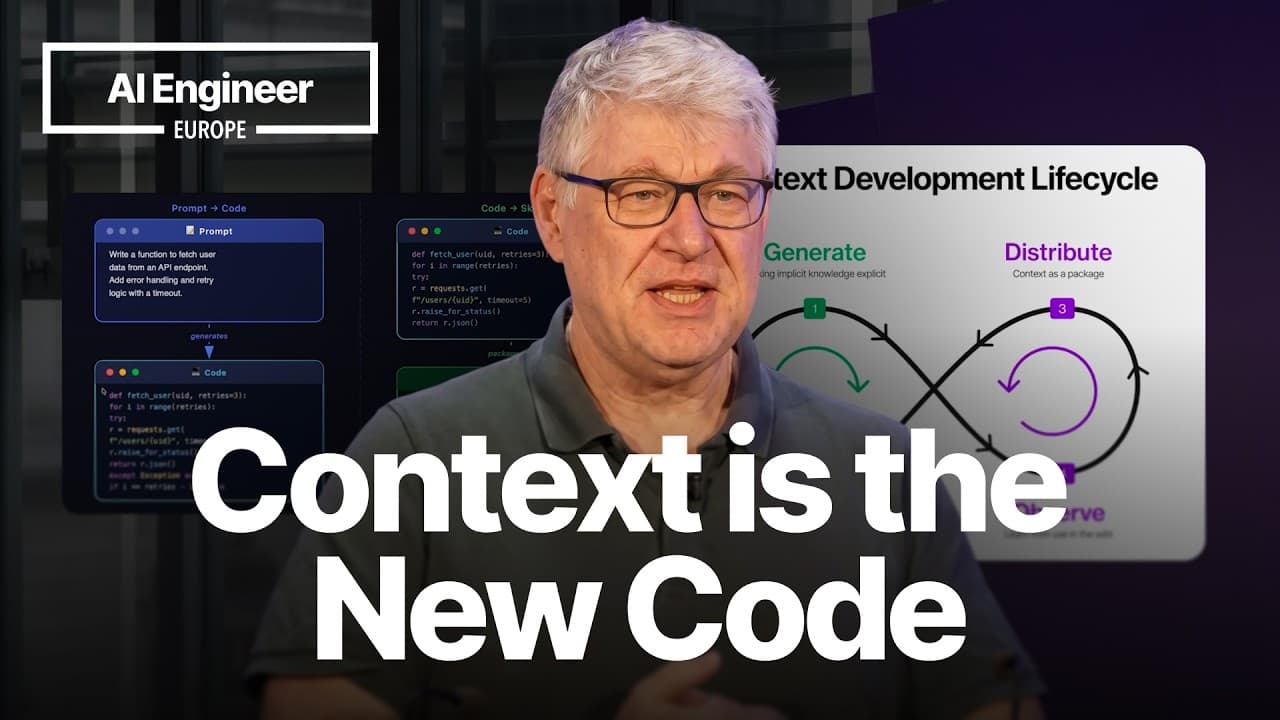
- The Context Development Lifecycle is a continuous loop of generating, evaluating, distributing, and observing context. Results from evaluation and real use feed back into revisions, creating an iterative process modeled on established software delivery practices.
- Current documentation is essential context when coding agents may lack knowledge of the library version being used. Supplying version-relevant, agent-optimized documentation reduces uncertainty about APIs and gives the agent better material for producing code suited to the selected dependency version.
- Context generation extends beyond manually typed prompts because agents can retrieve information from repositories, collaboration systems, tickets, and other organizational sources through connected tools. Specifications can also be decomposed by an agent into plans and step-by-step prompts for execution.
- Context validation can begin with linting that checks structural requirements such as required descriptions and permitted lengths. A second layer can assess whether instructions are explicit, sufficiently detailed, and complete enough for an agent to understand and apply reliably.
- Model-based evaluations can test whether generated code follows team-specific rules. For example, an evaluator can judge whether an endpoint uses a required prefix, allowing teams to measure whether repository instructions actually influence outputs across different coding agents.
- End-to-end context tests work by giving an evaluator tools and a sandbox so it can execute the generated system, not merely inspect its files. Because AI output is nondeterministic, the same evaluation should run multiple times and report how consistently the expected behavior succeeds.
- More videos from this channel:
- More from this channel: AI Engineer
Install to Summarize YouTube Videos and Get Transcripts
Explore YouTube Video Summarizer or Get YouTube Transcript Extractor
Questions & Answers
Q: What is the Context Development Lifecycle?
The Context Development Lifecycle is a repeating process for managing the prompts, rules, documentation, specifications, and memory that guide AI agents. Its stages are Generate, Evaluate, Distribute, and Observe. Teams create context, test whether it produces the intended behavior, share it with relevant people or systems, monitor its results, and use those observations to revise the context.
Q: Why does context need to be managed like code?
Context needs disciplined management because small changes to agent instructions can alter generated code and behavior, while the impact may not be obvious from reading the instruction alone. Like code, context benefits from versioning, review, tests, CI/CD, and observation. These practices help teams determine whether instructions remain effective across agents, models, repositories, and changing development environments.
Q: How can reusable skills replace procedural code?
Reusable skills can express an adaptive workflow in natural-language instructions instead of encoding every possible ecosystem and tool combination in rigid program logic. The example describes an onboarding skill that first identifies the package manager and ecosystem, then performs the appropriate steps with the user. This approach can address more variations than maintaining separate procedural implementations for Python, NodeJS, and different packaging tools.
Q: How should teams test instructions for AI coding agents?
Teams can test agent instructions at several levels. Structural validation can verify required fields and length limits. A model can review whether the context is explicit, complete, and understandable. Output evaluations can judge whether generated code follows a specific convention, while sandboxed agent evaluations can run the resulting system and confirm that its behavior works end to end.
Q: Why should context evaluations run multiple times?
Context evaluations should run multiple times because AI agent outputs are nondeterministic. The same prompt and evaluation may not produce identical results on every run, so a single pass or failure does not provide a reliable measure. Repeating a scenario, such as running it five times, reveals how consistently the context produces the intended outcome and makes CI/CD results more informative.
Q: How does current documentation improve agent output?
Current documentation gives an agent direct information about the specific library version a project uses. Without it, the model may confuse version two with version three or generate code based on outdated behavior. Pulling relevant, preferably agent-optimized documentation into the working context helps the coding agent select APIs and implementation details that match the project’s actual dependency version.
Q: What is the difference between output checks and end-to-end context tests?
An output check inspects generated artifacts and judges whether they follow a rule, such as requiring an API path to begin with a designated prefix. An end-to-end test gives the judging agent tools and a sandbox so it can start or execute the generated system and call the endpoint. The second approach verifies actual behavior rather than only the appearance of the code.
Q: How can evaluation feedback improve context automatically?
Evaluation feedback can identify missing details, unclear language, invalid structure, or instructions that fail to influence generated output. Once tests expose those weaknesses, an automated code action or similar workflow can ask an agent to revise the context using the reported findings. The improved context can then be evaluated again, distributed, observed, and refined through the same lifecycle.
Summary & Key Takeaways
-
Context is becoming as important as manually written code because developers increasingly direct coding agents through prompts, rules, documentation, and reusable skills. Complex procedural code can sometimes become contextual workflows that ask an agent to identify the user’s ecosystem, determine the relevant tools, and complete appropriate steps interactively.
-
The Context Development Lifecycle consists of generating, evaluating, distributing, and observing context. Generation includes reusable instructions, agent files, current library documentation, tickets, connected organizational sources, and specifications. Evaluation then measures whether that context is valid, understandable, complete, and capable of producing outputs that follow organization-specific requirements.
-
Context evaluations can range from format linting and clarity feedback to model-based output checks and sandboxed end-to-end scenarios. Because agent results are nondeterministic, evaluations should run repeatedly rather than relying on a single pass. Their feedback can guide automated context improvements and support integration with existing CI/CD practices.
Read in Other Languages (beta)
Share This Summary 📚
Summarize YouTube Videos and Get Video Transcripts with 1-Click
Try YouTube Summary with ChatGPT & Claude or YouTube Transcript Generator
Explore More Summaries from AI Engineer 📚

Summarize YouTube Videos and Get Video Transcripts with 1-Click
Try YouTube Summary with ChatGPT & Claude or YouTube Transcript Generator