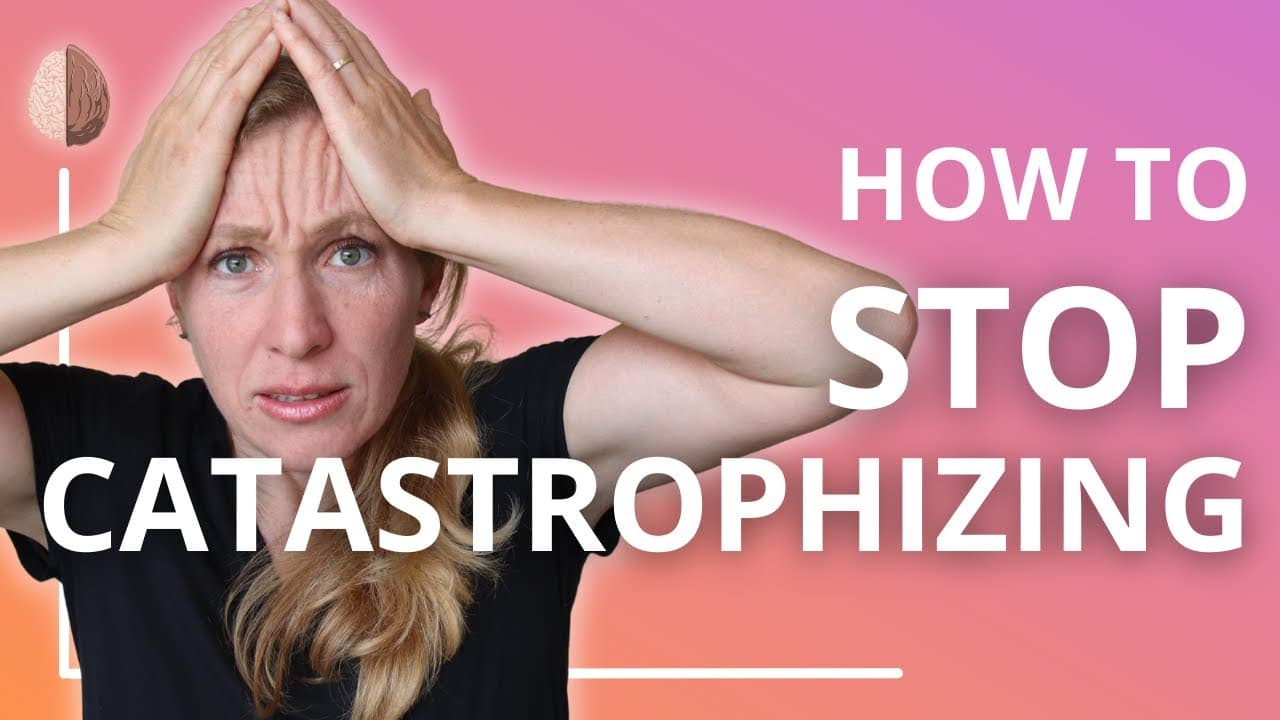
How Do You Stop Catastrophizing and Reduce Anxiety? Cognitive Distortion Skill #6
TL;DR
You can stop catastrophizing by recognizing when you expect the worst, pausing to challenge that interpretation, and replacing it with a more rational response. Emma McAdam explains three things you can do to interrupt this cognitive distortion, which can increase anxiety and depression, close off opportunities, and create the outcomes you fear. Read on for concrete examples and healthier ways to respond to uncertainty.
Transcript
Hi, everyone. I'm Emma McAdam. I'm a licensed marriage and family therapist. And in this video we're going to talk about catastrophizing, which is expecting the worst. Catastrophizing is an excellent way to make yourself anxious and depressed and completely ruin your life. Oh, yeah, and I'm going to teach you three things you can do to stop cat... Read More
Key Insights
- Catastrophizing is a cognitive distortion involving imagining worst-case scenarios.
- This thinking error increases anxiety and depression by focusing on negative outcomes.
- Recognizing when you're catastrophizing is the first step to overcoming it.
- Challenging and replacing catastrophic thoughts with rational alternatives is crucial.
- Developing emotional resilience helps manage anxiety and embrace uncertainty.
- Fear-based motivation is unsustainable and often leads to increased anxiety.
- Positive goals and values provide healthier motivation than fear of failure.
- Acceptance and Commitment Therapy can help build emotional resilience and embrace life fully.
Install to Summarize YouTube Videos and Get Transcripts
Explore YouTube Video Summarizer or Get YouTube Transcript Extractor
Questions & Answers
Q: How can I stop catastrophizing?
First, recognize when you are turning a difficult situation into something horrible, terrible, and unrecoverable. Pause to challenge that interpretation, replace it with a more rational alternative, and focus on positive goals and values instead of fear.
Q: What is catastrophizing?
Catastrophizing is a common cognitive distortion, or thinking error, in which you view a current or future situation as a catastrophe. It means imagining the worst and treating a genuine difficulty as though something horrible is likely to happen and recovery will be impossible.
Q: What are some examples of catastrophizing?
A student may worry about failing one test, then imagine being kicked out of school, working a dead-end job, and dying homeless. Other examples include viewing a panic attack as a catastrophe, believing depression will last forever, or treating exclusion from a text group as total rejection.
Q: Why do people catastrophize?
People may believe that expecting the worst will help prevent rejection, failure, or tragedy. The transcript explains that this habitual response usually does the opposite by increasing distress and cutting people off from possible solutions.
Q: How can catastrophizing increase anxiety and depression?
Repeated catastrophic thinking creates a picture of the future as bleak, threatening, or hopeless. The transcript says these patterns can lead to anxiety or depression and make people imagine that they will never recover.
Q: How can catastrophizing become a self-fulfilling outcome?
Expecting a bad response can change your behavior in ways that invite that response. For example, entering a conversation expecting defensiveness may make you harsher or more rigid, while expecting rejection from a crush may stop you from asking the person out at all.
Q: What does the flat-tire and jack story illustrate about catastrophizing?
A stranded driver needs to borrow a jack but imagines that the farmer will be hostile, rob him, attack him, or shoot him. When the farmer simply asks whether he can help, the driver angrily rejects the imagined offer and leaves, cutting himself off from the solution he needed.
Q: How can Acceptance and Commitment Therapy help with catastrophizing?
Acceptance and Commitment Therapy can help build emotional resilience and improve how a person handles difficult emotions and uncertainty. It emphasizes accepting risk while moving toward personally meaningful values and goals rather than relying on fear-based motivation.
Summary & Key Takeaways
-
Catastrophizing involves imagining the worst-case scenarios, leading to increased anxiety and depression. Recognizing when you're doing it and challenging these thoughts is crucial. Replace catastrophic thoughts with more rational alternatives to reduce anxiety and depression.
-
Fear-based motivation, often stemming from catastrophizing, is unsustainable and increases anxiety. Instead, focus on positive goals and values for healthier motivation. Acceptance and Commitment Therapy can help build emotional resilience and embrace life's uncertainties.
-
Catastrophizing cuts off opportunities and leads to self-fulfilling negative outcomes. By recognizing and challenging these thoughts, and focusing on positive goals, individuals can reduce anxiety, depression, and embrace a more fulfilling life.
Read in Other Languages (beta)
Share This Summary 📚
Summarize YouTube Videos and Get Video Transcripts with 1-Click
Try YouTube Summary with ChatGPT & Claude or YouTube Transcript Generator
Explore More Summaries from Therapy in a Nutshell 📚



Summarize YouTube Videos and Get Video Transcripts with 1-Click
Try YouTube Summary with ChatGPT & Claude or YouTube Transcript Generator