Can Humans Become Physically Immortal From Aging?
TL;DR
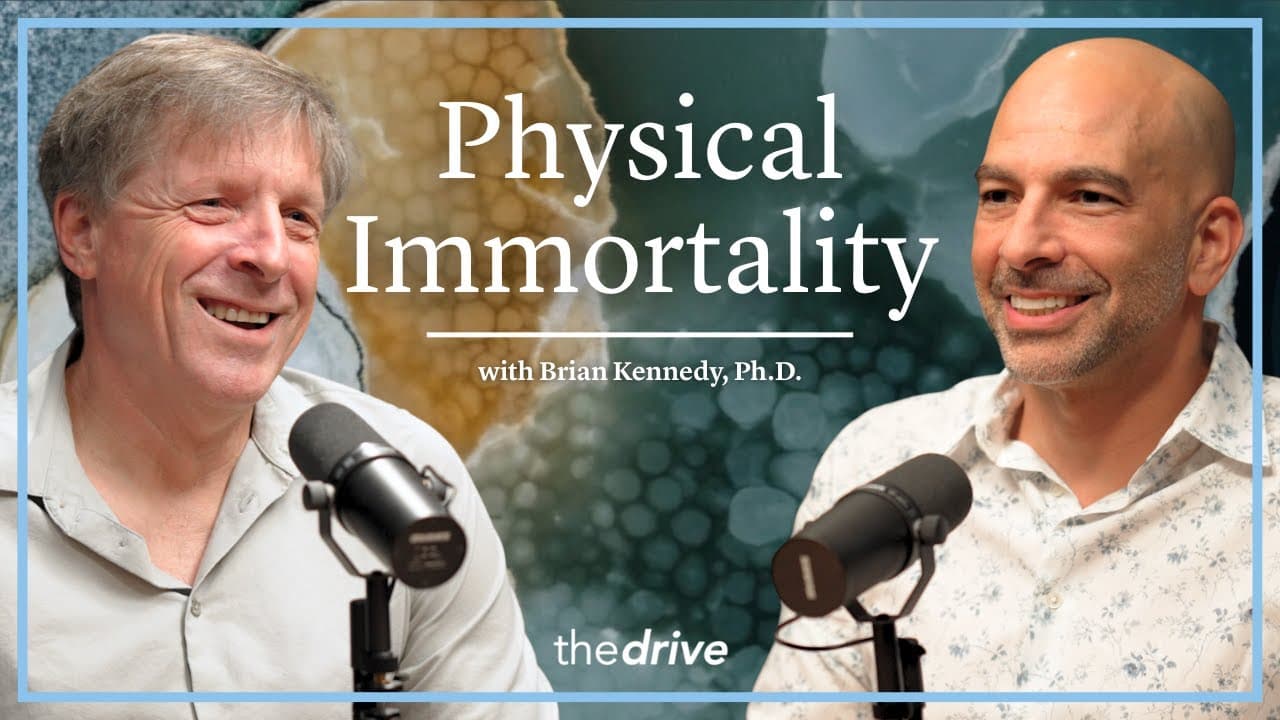
Physical immortality from aging is almost certainly impossible, since nothing observed so far suggests resilience can rise high enough to stop death from disease. Even supercentenarians who live to 110 remain frail, showing a roughly 20-year phase shift rather than an escape from inevitable decline. The bigger priority is preserving health in life's final decade.
Transcript
Do you think that immortality is impossible unless we define it through kind of like AI copying your brain? Let's put that I mean physical immortality. Do you believe that that is that is impossible? Well, I I like to tell people that I'm immortal because I think the mindset that it gives me is a very healthy mindset for me. We can come to you know... Read More
Key Insights
- Physical immortality from aging is regarded as possible but extremely unlikely, with the odds of achieving that level of change described as nonzero but close to zero, and no evidence so far suggests resilience can rise high enough to prevent death from disease.
- Supercentenarians who reach 110 still appear feeble and frail, looking like people in the final years of life; longevity extends the timeline by roughly 20 years but does not undo the inevitability of decline.
- A phase shift illustrates this: one grandmother lived to 101, was driving at 90, quit around 95, and bowled a 238 game at 93, yet at that age looked like someone in their 70s rather than escaping aging.
- Aging research should be funded closer to the level cancer receives, splitting into a translational question about slowing aging now and a basic science question about whether aging can be stopped or reversed, which no one can yet answer.
- The big four chronic diseases are cardiovascular disease, cancer, dementing diseases, and metabolic diseases; cardiovascular and metabolic disease are the most preventable because their causes are best understood and they respond to lifestyle modification.
- Cancer is viewed as the most inevitable major disease because it stems from an accumulation of mutations and affects the immune system differently than normal aging, making it potentially less approachable from a longevity viewpoint.
- The immune system and inflammation have been underestimated as drivers of disease; interventions improving immune function affect certain tumors, and inflammation may be a primary driver of Alzheimer's and dementia too.
- Scientific fields narrow prematurely because researchers trace their lineage to a few PIs whose favored models become their ticket to prizes, causing focus on one or two mechanisms while other, possibly more important, drivers go unstudied for decades.
Install to Summarize YouTube Videos and Get Transcripts
Explore YouTube Video Summarizer or Get YouTube Transcript Extractor
Questions & Answers
Q: Can humans become physically immortal by never dying from aging?
It is considered possible but extremely unlikely. The speaker says the odds of achieving that level of change in aging are nonzero but close to zero, and he has seen nothing so far suggesting resilience can rise high enough that a person cannot die from disease. He remains skeptical it can be done, though he would not rule out the possibility entirely. Physical immortality here means not dying from aging, since anyone could eventually be hit by a bus.
Q: Do people who live to extreme old age escape frailty?
No. Even centenarians and supercentenarians remain remarkably frail. At 110, someone still looks like a person in the final years of life, much as an 84 or 85 year old would. Longevity produces what is described as a phase shift of about 20 years, so a 90 year old might look and function like someone in their 70s, but this delay does not undo the inevitability of eventual decline toward the end of life.
Q: Why should we focus on health span rather than immortality?
Most people in the final decade of life are physically too frail to enjoy it, are cognitively less sharp even without Alzheimer's, live in pain, and fracture their hips, so they cannot do what gave them joy. The argument is that slowing aging now to improve population health is a pressing translational goal, arguably more valuable than chasing escape velocity or immortality when so many people suffer a poor final decade.
Q: How does aging research funding compare to disease funding?
Aging is underfunded relative to major diseases, and the speaker argues it should be funded somewhere closer to the level of cancer. Most money has flowed into the private sector, including biotech, supplement companies, and longevity clinics, while academic basic science funding lags. Participants were surprised at how desperate the differences are, noting that reallocating even 10% from disease-specific pools to aging could have an enormous effect given how little aging currently receives.
Q: What are the big four chronic diseases and which are most preventable?
The big four are cardiovascular disease, cancer, dementing or neurodegenerative diseases, and metabolic diseases. Cardiovascular disease, ironically the most deadly today, is considered the least inevitable and most preventable because its causes are best understood and it responds to lifestyle modification and tools targeting hypertension and dyslipidemia. Metabolic disease is placed in a similar preventable category as cardiovascular, both being highly modifiable compared with cancer and dementia.
Q: Why is cancer considered the most inevitable age-related disease?
Cancer is viewed as different from the other major diseases and possibly less modifiable by longevity interventions. It arises from an accumulation of mutations, making it a more defined event, and it also affects the immune system in a way that differs from normal aging. Because of this, it may be less approachable from a longevity viewpoint. The inevitability is thought to stem from both the accumulation of mutations and the weakening of the immune system.
Q: What role do inflammation and the immune system play in aging diseases?
Their role has been completely underestimated. The immune system increasingly appears central to cancer, as interventions that improve immune function have a big role in certain tumors. The speaker expects the same to hold for Alzheimer's and dementia, where inflammation and the immune system may be primary drivers rather than secondary factors. Recognizing this could reshape how diseases long attributed to one or two mechanisms are understood and treated.
Q: Why do scientific fields focus on too few disease mechanisms?
Progress is said to happen one funeral at a time. As a field grows, researchers can trace their lineage back to four or five principal investigators whose favored models become entrenched and seen as their ticket to prizes. This leads people to focus on a subset of disease mechanisms while excluding others that may be more important. Alzheimer's is cited as an example, where decades of focus on removing plaques left other, possibly more important, drivers unstudied.
Summary & Key Takeaways
-
The discussion centers on whether humans can become physically immortal, meaning not dying from aging rather than accidents. The speaker considers it possible but highly unlikely, saying nothing so far suggests resilience can reach a level that prevents death from disease, though he would not fully rule it out.
-
Even the longest-lived people illustrate the limit: supercentenarians at 110 still look frail, and a grandmother who lived to 101 stayed active into her 90s but ultimately declined. Longevity produces a phase shift of about 20 years rather than eliminating the inevitability of aging's decline.
-
The conversation shifts to funding, arguing aging science deserves cancer-level investment and that reallocating even 10% from disease-specific pools could make an enormous difference. Cancer is seen as the most inevitable disease, while inflammation, the immune system, and premature narrowing of research fields are highlighted as underexplored drivers.
Read in Other Languages (beta)
Share This Summary 📚
Summarize YouTube Videos and Get Video Transcripts with 1-Click
Try YouTube Summary with ChatGPT & Claude or YouTube Transcript Generator
Explore More Summaries from Peter Attia MD 📚
Summarize YouTube Videos and Get Video Transcripts with 1-Click
Try YouTube Summary with ChatGPT & Claude or YouTube Transcript Generator