What Is Prompt Engineering for AI Mastery?
TL;DR
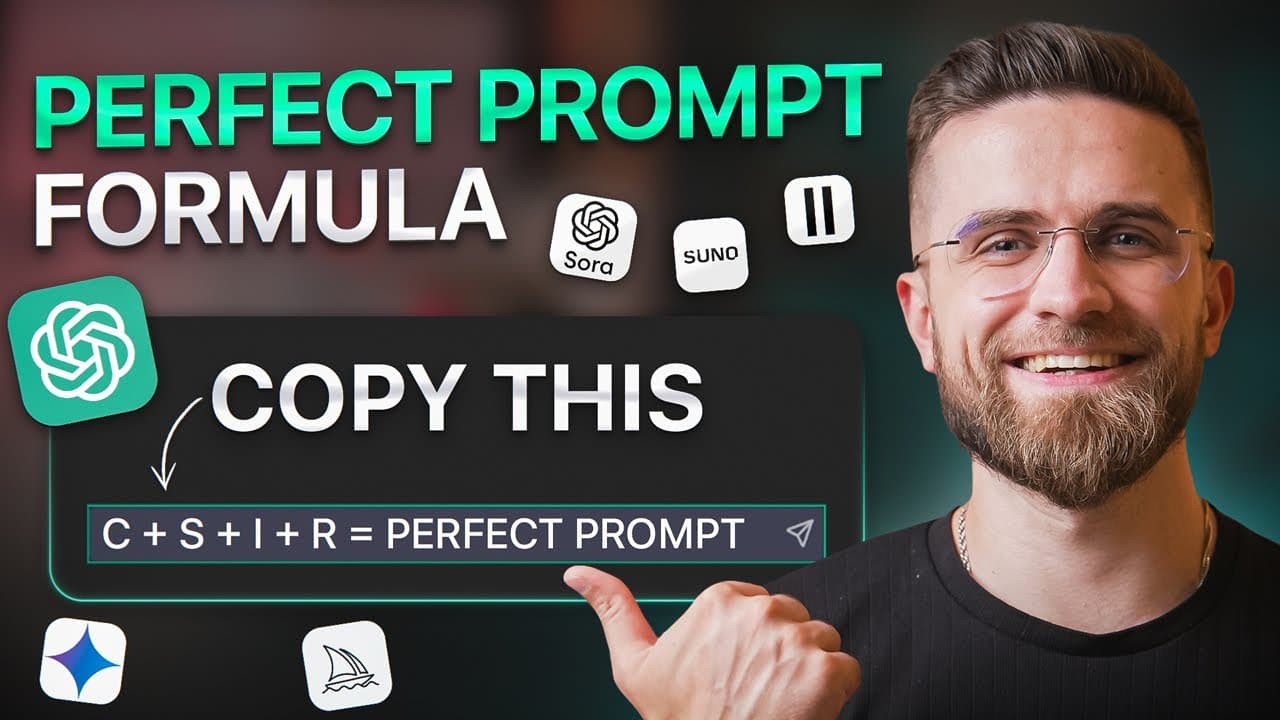
Prompt engineering is the art of creating effective queries for AI to enhance the quality of its responses. By using clear instructions, detailed context, and specific requests, you can significantly improve AI output, whether for text or image generation.
Transcript
how does AI actually see your prompts here's where most people get it wrong when you say write about a cat sitting on a couch your human brain knows what a cat is what a couch is and you picture it in your mind but Ai No AI does not see words or images like we do it's all math literally every word you type gets turned into number ki... Read More
Key Insights
- AI interprets prompts through mathematical patterns, not human-like understanding, relying on extensive data training to predict responses.
- Prompt engineering requires clear, concise instructions, avoiding unnecessary words for better AI comprehension and output.
- Descriptive prompts with specific details like tone, audience, and format yield more accurate AI responses.
- Iterative prompting refines AI outputs step-by-step, enhancing clarity and precision for complex tasks.
- Negative prompting excludes unwanted elements, refining AI-generated images to match user vision more closely.
- Different AI platforms have unique quirks; understanding parameters like temperature and token limits fine-tunes outputs.
- Image generation prompts benefit from detailed subject, description, and style instructions, enhancing visual quality.
- Resolution and layout considerations are critical for high-quality AI-generated images, especially for larger projects.
Install to Summarize YouTube Videos and Get Transcripts
Explore YouTube Video Summarizer or Get YouTube Transcript Extractor
Questions & Answers
Q: How does AI interpret prompts?
AI interprets prompts by converting words into numerical patterns, similar to barcodes. It doesn't understand words or images like humans but relies on mathematical connections and patterns learned from extensive data training to predict the most likely response.
Q: What is prompt engineering?
Prompt engineering is the art of crafting precise and descriptive prompts to guide AI in generating accurate and relevant outputs. It involves understanding AI's pattern recognition capabilities and structuring prompts to include specific details such as tone, audience, and format for better results.
Q: Why is specificity important in prompts?
Specificity in prompts is crucial because it reduces the AI's guesswork, leading to more accurate and tailored responses. By providing detailed instructions about the topic, tone, audience, and format, users can ensure that the AI's output aligns closely with their expectations, minimizing the need for follow-up adjustments.
Q: What is iterative prompting?
Iterative prompting is a technique where prompts are refined step-by-step to improve AI outputs. It involves starting with a broad prompt and gradually adding layers of detail and specificity, allowing the AI to build upon previous responses. This approach is particularly effective for complex tasks, ensuring clarity and precision.
Q: How does negative prompting work?
Negative prompting involves specifying elements to exclude from AI-generated outputs, particularly in image generation. By listing unwanted styles, objects, or colors, users can filter out distractions and refine the AI's focus, ensuring the final result aligns more closely with their vision.
Q: How do AI platforms differ in handling prompts?
Different AI platforms have unique ways of handling prompts and parameters. For instance, ChatGPT, Claude, and Gemini use temperature settings to control response creativity, while image generators like DALL-E and MidJourney have specific phrasing requirements. Understanding these quirks helps in fine-tuning outputs across platforms.
Q: What are the key components of image generation prompts?
Effective image generation prompts consist of three main components: subject, description, and style. The subject is the main focus, the description provides context and details, and the style defines the aesthetic or artistic approach. This structured approach ensures high-quality visual outputs from AI.
Q: Why are resolution and layout important in AI-generated images?
Resolution and layout are crucial for the quality of AI-generated images, especially for printing or larger projects. High resolution ensures clarity and detail, while specifying layout terms like 'square' or 'portrait' influences the image's orientation. These factors significantly impact the final visual appearance and usability.
Summary & Key Takeaways
-
AI processes prompts by converting words into numerical patterns, predicting responses based on its vast training data. Understanding this helps in crafting effective prompts.
-
Prompt engineering involves structuring prompts with clarity and specificity, ensuring AI delivers accurate and creative outputs. Techniques like negative prompting and iterative refinement are key.
-
Image generation with AI requires detailed prompts covering subject, description, and style. Platform-specific quirks and resolution settings are important for achieving desired visual results.
Read in Other Languages (beta)
Share This Summary 📚
Summarize YouTube Videos and Get Video Transcripts with 1-Click
Try YouTube Summary with ChatGPT & Claude or YouTube Transcript Generator
Explore More Summaries from AI Master 📚



Summarize YouTube Videos and Get Video Transcripts with 1-Click
Try YouTube Summary with ChatGPT & Claude or YouTube Transcript Generator