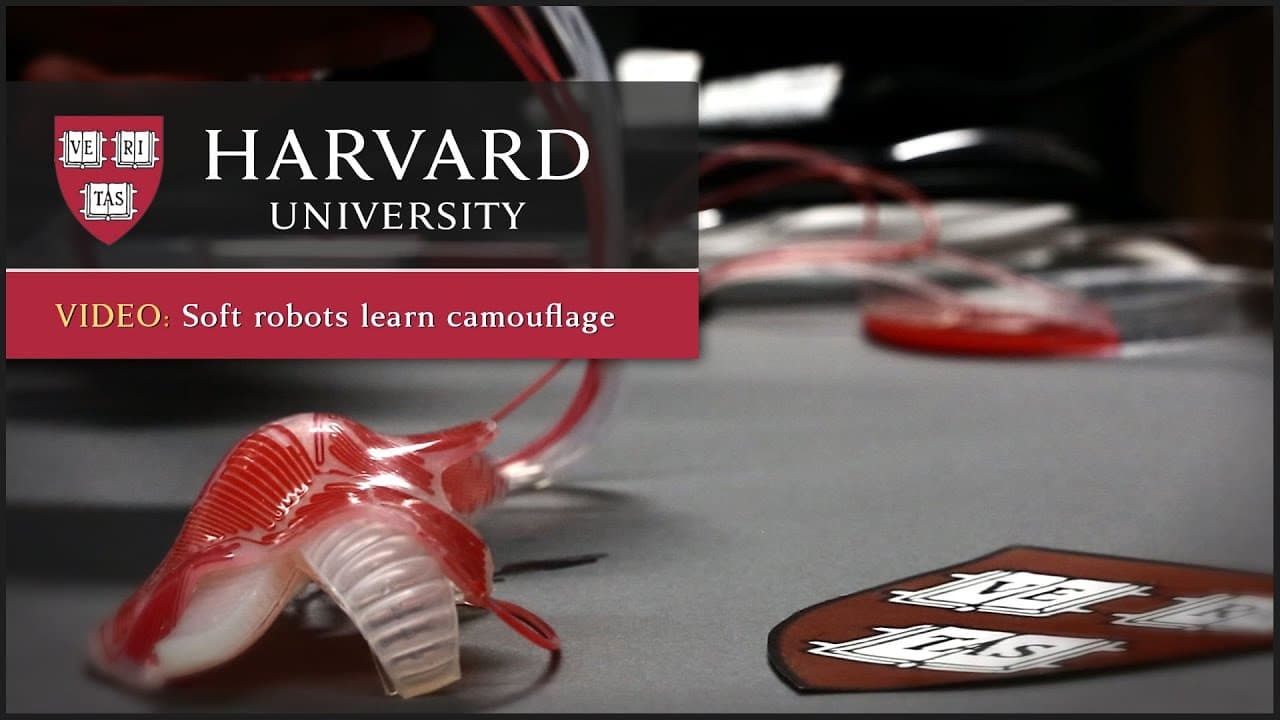
Harvard researchers demonstrate soft robot camouflage system
Transcript
Read and summarize the transcript of this video on Glasp Reader (beta).
Install to Summarize YouTube Videos and Get Transcripts
Explore YouTube Video Summarizer or Get YouTube Transcript Extractor
Summary
Soft robotics is a program that draws inspiration from organisms like octopi and squid, which have the ability to manipulate their environment and change their color and appearance. These robots have advantages in terms of manipulation, maneuverability, fabrications, and cost over traditional hard robots. The goal is to incorporate these natural abilities into robots to make them useful in various fields such as surgery and rescue operations.
Questions & Answers
Q: What is soft robotics?
Soft robotics is a program that explores the use of soft and flexible materials to create robots that are inspired by organisms like octopi and squid. These robots have advantages in terms of manipulation, maneuverability, fabrications, and cost over traditional hard robots.
Q: What inspired the development of soft robotics?
The development of soft robotics was inspired by the remarkable abilities of organisms like octopi and squid. These organisms can change their color and appearance to signal each other or blend in with their environment. The goal was to incorporate these abilities into robots to enhance their functionality.
Q: What advantages do soft robots have over traditional hard robots?
Soft robots have several advantages over traditional hard robots. First, they have enhanced manipulation capabilities due to their flexible and deformable nature. This allows them to perform tasks that would be challenging for rigid robots. Second, soft robots have improved maneuverability as they can bend and twist to navigate complex environments. Third, their fabrication is often simpler and more cost-effective compared to hard robots, as they involve the use of soft and flexible materials.
Q: How can soft robots be useful for surgeons?
Soft robots can be highly valuable in surgical procedures. Their flexibility allows them to navigate through delicate tissues and reach inaccessible areas. This can potentially minimize the invasiveness of surgical procedures and reduce patient trauma. Additionally, the ability of soft robots to change their color and appearance can aid surgeons by providing real-time feedback on the condition of tissues and organs.
Q: How can soft robots be used in rescue operations?
Soft robots have the potential to be instrumental in rescue operations. Their ability to change colors and even glow in the dark can be harnessed to guide rescue workers to specific locations, such as survivors in hazardous environments. This feature can significantly enhance the efficiency and effectiveness of rescue operations by providing clear visual cues.
Q: Can you provide an example of how soft robots could assist rescue workers?
Imagine a scenario where rescue workers are searching for survivors in a collapsed building. Soft robots, equipped with the ability to change colors, could be sent ahead to locate survivors and display their position by changing to a bright or glowing color. This visual guidance system would be a fast and effective way for rescue workers to locate survivors in a complex and challenging environment.
Q: What are the main challenges in developing soft robots?
Developing soft robots comes with its own set of challenges. One of the main challenges is finding suitable materials that are flexible yet robust enough to withstand repeated use. Another challenge is designing control systems that can accurately manipulate the soft robot's movements and deformations. Additionally, integrating the ability to change color and appearance adds another layer of complexity, requiring advancements in material science and engineering.
Q: How can soft robots be improved in terms of their color-changing abilities?
Improving the color-changing abilities of soft robots requires advancements in material science and engineering. Researchers need to develop materials that can reliably change color, exhibit a wide range of colors, and maintain their appearance over time. Additionally, control systems need to be refined to provide precise and responsive control over color changes in the robot.
Q: Are there any limitations to soft robotics?
Despite their advantages, soft robotics also has some limitations. Soft robots tend to be slower in terms of their movements compared to traditional hard robots. They are also more sensitive to external factors such as environmental conditions. Addressing these limitations will require further research and advancements in soft robotics technology.
Q: How do you envision the future of soft robotics?
The future of soft robotics is promising. With ongoing advancements in material science, engineering, and control systems, we can expect to see even more sophisticated and capable soft robots. These robots will find applications in various fields, including healthcare, industry, exploration, and rescue operations, where their unique capabilities can offer new solutions and improvements.
Takeaways
Soft robotics, inspired by organisms like octopi and squid, offers a new approach to robot design and functionality. With their advantages in manipulation, maneuverability, fabrications, and cost, soft robots have the potential to revolutionize fields such as healthcare and rescue operations. The ability to change color and appearance further expands their applications. However, challenges in materials, control systems, and speed need to be addressed for the continued advancement of soft robotics technology. The future of soft robotics holds promise for innovative solutions across various industries and domains.
Read in Other Languages (beta)
Share This Summary 📚
Summarize YouTube Videos and Get Video Transcripts with 1-Click
Try YouTube Summary with ChatGPT & Claude or YouTube Transcript Generator
Explore More Summaries from Harvard University 📚




Summarize YouTube Videos and Get Video Transcripts with 1-Click
Try YouTube Summary with ChatGPT & Claude or YouTube Transcript Generator