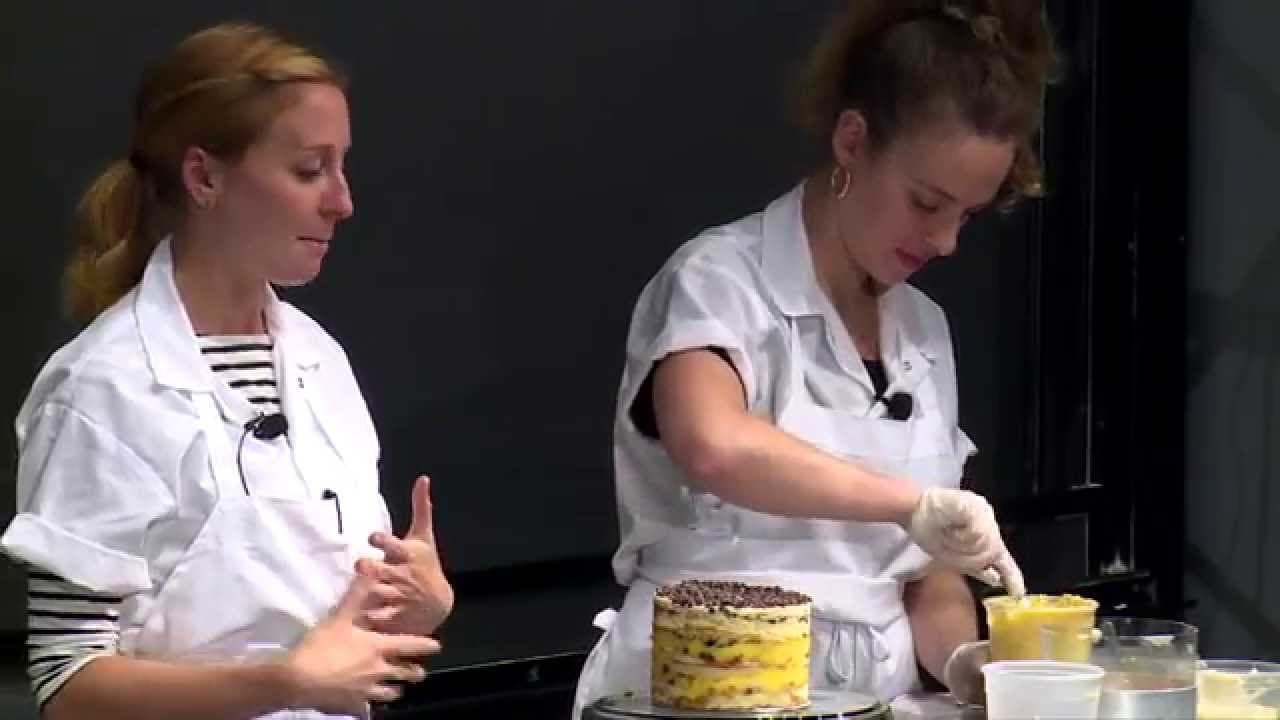
Christina Tosi: Emulsions and Foams, Science and Cooking Public Lecture Series
TL;DR
Emulsions and foams are crucial techniques in baking that create unique textures and flavors. Emulsions help bind ingredients like butter and sugar, resulting in rich treats, while foams introduce airiness, enhancing the overall experience of baked goods such as Milk Bar's corn flake chocolate chip marshmallow cookies.
Transcript
MICHAEL BRENNER: So welcome. So my slide says that it's week 10 of the lectures of this series, which I find remarkable that we've been going for 10 weeks already. And this week, the topic for this week, the scientific topic for this week, is emulsions and foams. And we're very fortunate to have Christina Tosi from Milk Bar who's here [INAUDIBLE]. ... Read More
Key Insights
- 🇦🇬 Milk Bar's baking techniques combine traditional methods with scientific understanding to create unique and delicious treats.
- 🙂 Ingredients like butter and sugar can be bonded together through creaming to create a light and fluffy texture.
- 🤩 Emulsions and foams play a key role in creating unique flavors and textures in Milk Bar's baked goods. These techniques allow for the incorporation of ingredients like cereal milk and liquid cheesecake for added depth of flavor.
- 🎙️ More videos with Christina Tosi:
Install to Summarize YouTube Videos and Get Transcripts
Explore YouTube Video Summarizer or Get YouTube Transcript Extractor
Questions & Answers
Q: How does Milk Bar incorporate the science of emulsions and foams into their baking techniques?
Milk Bar uses emulsions and foams to create unique textures and flavors in their baked goods. They often start with a basic ingredient, like butter or sugar, and use techniques such as creaming to bind them together and create a light and fluffy texture.
Q: What is the role of volume fraction in emulsions and foams?
Volume fraction refers to the amount of air or liquid in a mixture. For example, in Milk Bar's corn flake chocolate chip marshmallow cookie, the volume fraction of corn flakes affects the texture and structure of the cookie, making it crispy and light.
Q: How does Milk Bar add flavor to their baked goods?
Milk Bar uses a combination of traditional and innovative ingredients to add flavor to their baked goods. They incorporate ingredients like cereal milk, corn flake crunch, and liquid cheesecake to create unique and delicious flavors in their cookies, cakes, and other treats.
Q: How does the 10-minute creaming process used in Milk Bar's cookies contribute to their texture?
The 10-minute creaming process helps to incorporate air into the butter and sugar, resulting in a lighter and fluffier texture in the final cookies. This process also helps to bond the butter and sugar together, creating a more cohesive dough.
Summary
In this video, Michael Brenner introduces the topic of emulsions and foams before handing over to Christina Tosi from Milk Bar. Christina discusses the creative process behind some of their popular desserts and treats, such as cereal milk ice cream, crack pie, compost cookies, and more. She explains their approach of taking simple inspiration points and using their formal culinary knowledge and techniques to create unique and delicious treats. Christina also talks about their use of pantry ingredients like crunch and crumb, and showcases some of their unusual creations, including croissant-like pastries with unexpected fillings. The video also includes a discussion about finding great people to join their team at Milk Bar.
Questions & Answers
Q: What is the importance of volume fraction in emulsions and foams?
Volume fraction is a critical factor in determining the physical properties of emulsions and foams. It is the ratio of the volume of the dispersed phase (such as oil or air) to the volume of the continuous phase (such as water). It affects the texture, stability, and overall quality of emulsions and foams. For example, the volume fraction of oil in mayonnaise determines its stability, while the volume fraction of air in whipped cream affects its texture and ability to hold its shape.
Q: How does volume fraction impact the solidification of M&Ms?
M&Ms provide an interesting example to demonstrate the concept of volume fraction and solidification. When the volume fraction of M&Ms is low, they pour like a liquid. However, when packed tightly in a jar, the volume fraction increases and they become solid. This demonstrates that there is a critical volume fraction at which a material transitions from a liquid to a solid. In the case of M&Ms, this critical volume fraction is about 70%.
Q: How does volume fraction relate to the elasticity of a material?
The volume fraction of particles or droplets in a material is closely related to its elasticity or solid-like behavior. As the volume fraction increases, the material becomes more solid and exhibits higher elasticity or stiffness. This can be described by an equation called the elastic modulus, which quantifies the solid-like behavior of a material. For example, in the case of M&Ms, the critical volume fraction of about 70% corresponds to the point at which they become solid and have an elastic modulus.
Q: How does the concept of volume fraction apply to emulsions and foams?
The concept of volume fraction applies to emulsions and foams as well. In emulsions, the important factor is the volume fraction of dispersed droplets (such as oil) in the continuous phase (such as water). Similarly, in foams, the volume fraction of air bubbles in a solid or liquid matrix plays a crucial role. The volume fraction influences the stability, texture, and other physical properties of emulsions and foams, just like in the case of M&Ms.
Q: How are droplets made in emulsions and why don't they come apart?
Droplets in emulsions are typically formed through processes such as whisking or blending, where the larger droplets are sheared and broken down into smaller droplets. This process is similar to what happens when M&Ms are packed together and sheared, causing them to break apart into smaller pieces. However, droplets in emulsions are not solid like M&Ms, so additional measures are needed to prevent them from coalescing or coming apart. This is where surfactants come into play. Surfactants, which are molecules that like to reside on the interface between different phases, serve as a protective "armor" around the droplets, preventing them from coming into direct contact and coalescing.
Q: How does the "armor" in mayonnaise work to stabilize the emulsion?
In mayonnaise, the "armor" or protective layer around the oil droplets is provided by the egg, specifically the egg yolk. The egg yolk contains lecithin, a natural emulsifier that helps oil and water mix together and form a stable emulsion. When making mayonnaise, the oil is slowly added to the egg yolk while whisking vigorously, allowing the lecithin to coat the oil droplets and prevent them from coming together. This results in a stable emulsion with a high volume fraction of oil.
Q: How much mayonnaise can you make with one egg?
The amount of mayonnaise you can make with one egg depends on the ratio of oil to egg yolk and the desired consistency. Different recipes may call for different amounts of oil per egg yolk, ranging from 1 cup to 200 milliliters or more. In a mayonnaise contest, someone was able to make 850 milliliters of mayonnaise (more than three cups) with one egg yolk, demonstrating that with the right technique and patience, a significant amount of mayonnaise can be made with a single egg.
Q: What is the significance of the "crunch" and "crumb" pantry ingredients at Milk Bar?
The "crunch" and "crumb" are staple pantry ingredients at Milk Bar that add texture and flavor to their creations. The crunch is made by crushing dry pantry items like corn flakes, pretzels, or cookies, binding them with fat and sugar, and toasting them in the oven. This results in clusters of crunchy, caramelized goodness that can be used as toppings or fillings in various desserts. The crumb, on the other hand, is made by combining dried powders like cocoa powder or milk powder with flour, sugar, and fat, and then baking it to create a sandy texture. The crumb can be used as a coating, pie crust, or flavoring ingredient in cookies, cakes, and more.
Q: How does Milk Bar approach the creative process and the reinvention of classic pastries?
Milk Bar's approach to the creative process involves taking simple inspiration points and using their formal culinary knowledge and techniques to reinvent classic pastries. They strive to find ways to honor everyone's favorite parts of a pastry while pushing beyond the original form and creating something unique. This involves challenging the status quo, embracing the creative spirit, and not being afraid to try new ideas. They also focus on making a personal connection with their customers through the desserts they create, as they believe that the experience and connection with the food is as important as its taste and quality.
Q: How do you find great people to join the team at Milk Bar?
Finding great people to join the team at Milk Bar is a constant work in progress. They believe that great people attract great people, so they strive to create a positive and inspiring work environment that naturally draws in talented individuals. They are very selective in their hiring process and look for individuals who share their passion for creating delicious and unique desserts. Building a strong team is crucial for maintaining the quality and consistency of their products, and they are careful to ensure that every team member aligns with their vision and values.
Summary & Key Takeaways
-
Milk Bar's approach to baking is a combination of traditional baking techniques and innovative flavor combinations.
-
Their recipes often start with a basic ingredient, like butter or sugar, and use techniques such as emulsions and foams to create unique textures and flavors.
-
The corn flake chocolate chip marshmallow cookie, in particular, showcases their use of emulsions to bind together extra butter and sugar for a rich and delicious result.
Read in Other Languages (beta)
Share This Summary 📚
Summarize YouTube Videos and Get Video Transcripts with 1-Click
Try YouTube Summary with ChatGPT & Claude or YouTube Transcript Generator
Explore More Summaries from Harvard University 📚

Summarize YouTube Videos and Get Video Transcripts with 1-Click
Try YouTube Summary with ChatGPT & Claude or YouTube Transcript Generator