How to Choose the Right AI Agent Architecture
TL;DR
Choose an AI agent by asking where it runs, how it orchestrates intelligence, and which interface it uses. OpenClaw favors local control and modularity but demands technical and security responsibility, while Perplexity Computer emphasizes cloud delegation and convenience in exchange for payment, vendor dependence, and trust with your data.
Transcript
Open Claw is the most consequential meto moment in the history of AI all the way since Chad GPT which in the history of AI is a long time but in real life is like two years. And all of the coverage of OpenClaw has either been about oh it's a horse race between these other people who are copying OpenClaw etc. or it's been about oh my gosh what a ter... Read More
Key Insights
- AI agent selection is an architectural decision involving execution location, intelligence orchestration, and interface design. Evaluating products on these three axes makes their intended users and tradeoffs clearer than treating every new release as another generic OpenClaw competitor.
- Execution location is a primary determinant of an agent's privacy posture, security exposure, and accountability. A local, cloud-based, or hybrid design changes where data resides, which party manages safeguards, and who bears responsibility when an agent performs a damaging action.
- Intelligence orchestration is the mechanism that assigns work to one model, multiple selected models, or user-provided models. This design affects operating cost, output quality, the ability to create subagents, and the degree to which customers become dependent on one vendor.
- The interface contract is the channel through which a person communicates with an agent. Messaging services, desktop applications, and phones create different user experiences, while modular interface support gives technical users more freedom to fit an agent into existing workflows.
- OpenClaw is a sovereignty-focused framework that runs locally with the user's API keys and data. Its modular architecture allows users to connect different language models, components, and messaging platforms, supporting extensive customization and reducing dependence on any single provider.
- OpenClaw's flexibility creates substantial security responsibility for its users. The transcript reports more than 30,000 publicly exposed instances involving weak or missing plugin authentication and more than 800 compromised skills documented after a supply-chain attack on the skills registry.
- Perplexity Computer is a delegation-focused service that runs in the cloud and independently breaks desired outcomes into subtasks. It manages models and orchestration for the customer, reducing setup burdens while requiring trust in Perplexity's security, product decisions, and handling of connected data.
- AI agent competitors are turning different weaknesses in OpenClaw into distinct product strategies. Some simplify the implementation, target enterprise deployments, emphasize an agent operating system, or transfer technical responsibility to a managed service, illustrating how a category-defining product creates opportunities around its limitations.
Install to Summarize YouTube Videos and Get Transcripts
Explore YouTube Video Summarizer or Get YouTube Transcript Extractor
Questions & Answers
Q: How should you choose the right AI agent?
Choose an AI agent by evaluating three things: where it runs, who controls its intelligence orchestration, and how you communicate with it. These factors expose the product's real tradeoffs in data privacy, security responsibility, cost, model quality, vendor dependence, and daily usability. The right choice depends on which combination matches your technical ability, trust requirements, and desired level of control.
Q: What are the three main axes for comparing AI agents?
The three axes are execution location, intelligence orchestration, and interface contract. Execution location asks whether the agent runs locally, in the cloud, or through a hybrid arrangement. Orchestration asks whether one model, multiple selected models, or user-provided models perform the work. The interface contract asks whether users interact through messaging platforms, desktop software, phones, or another channel.
Q: Why does an AI agent's execution location matter?
An agent's execution location determines important aspects of data privacy, security exposure, and responsibility. A locally operated system keeps infrastructure and decisions closer to the user, while a cloud service transfers more operational work to its provider. The choice also affects whom the user must trust with data and who is expected to respond if the agent deletes information or performs another harmful action.
Q: Who is OpenClaw best suited for?
OpenClaw is best suited for developers and technical power users who want maximum control over infrastructure, models, modules, data, and communication channels. Users can replace components like interchangeable building blocks and connect their preferred services. That freedom also requires comfort with installation, configuration, authentication, and security decisions, so the framework is not presented as an easy choice for nontechnical users.
Q: How does OpenClaw support user control and data sovereignty?
OpenClaw runs on the user's machine with the user's API keys and data, making local ownership central to its design. It allows different language models to be connected and supports modular components and messaging platforms such as Telegram, WhatsApp, Signal, and Slack. This interoperability lets users assemble their own system instead of accepting one company's fixed model, interface, or infrastructure choices.
Q: What security risks does OpenClaw present?
OpenClaw's modularity and user-managed infrastructure create a large security surface that customers must actively manage. According to the transcript, researchers found more than 30,000 publicly exposed instances associated with weak or missing authentication in plugins. It also states that a supply-chain attack affected the skills registry, with more than 800 compromised skills documented. These issues make sound configuration and security judgment essential.
Q: How does Perplexity Computer differ from OpenClaw?
Perplexity Computer emphasizes delegation, while OpenClaw emphasizes sovereignty. Perplexity runs computation in the cloud, breaks an outcome into subtasks, assigns agents, and manages orchestration for the user. OpenClaw instead gives users local infrastructure and interchangeable components. Perplexity reduces technical responsibility, but customers must trust the provider with their data, model selection, security approach, and future product decisions.
Q: What are the tradeoffs of using Perplexity Computer?
Perplexity Computer offers a managed experience in which users describe an outcome and the service handles task decomposition, agents, models, and cloud computation. The stated price is $200 per month, so users must be committed enough to justify the cost. They also need to connect their data and accept that Perplexity controls orchestration, selects models, and determines how the product evolves.
Summary & Key Takeaways
-
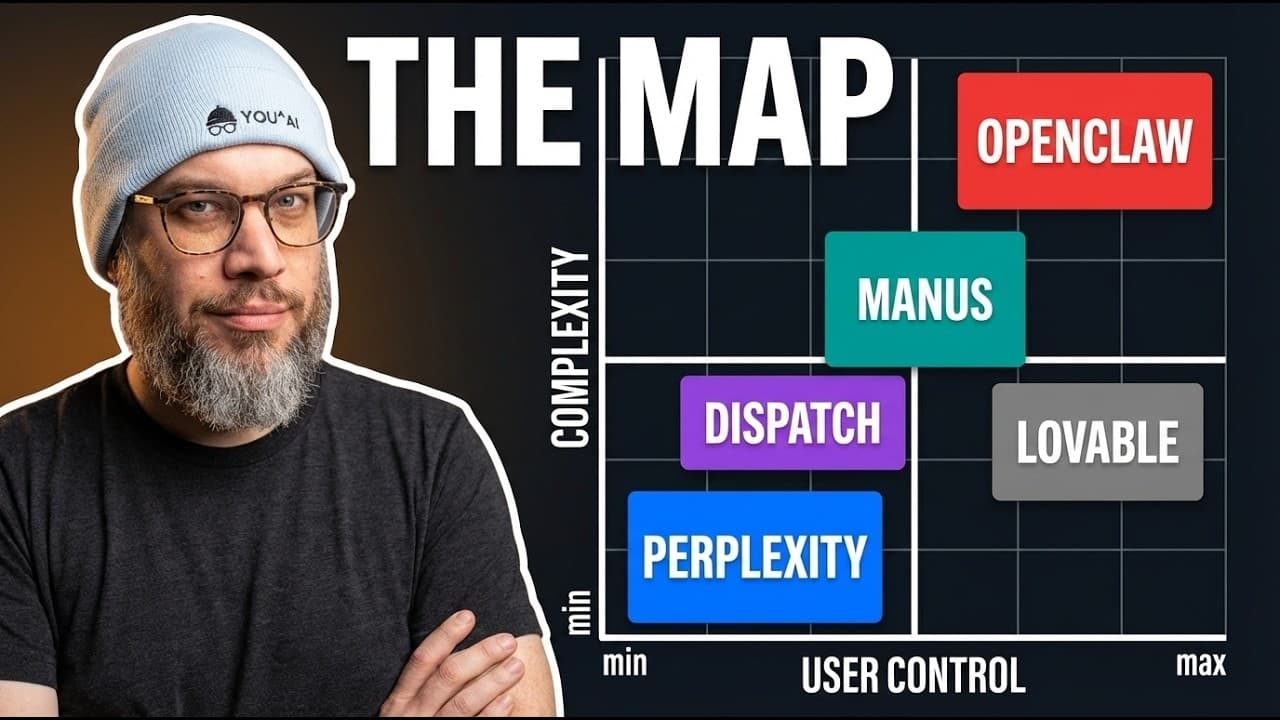
AI agent products should be compared through three architectural questions: where the agent runs, who orchestrates its intelligence, and how users communicate with it. These choices reveal practical differences in privacy, security, cost, model quality, vendor dependence, and product experience that a simple spectrum of user control cannot fully capture.
-
OpenClaw represents the sovereignty approach because it runs locally, accepts the user's API keys and data, and supports interchangeable models, modules, and messaging platforms. Its flexibility appeals to developers and technical power users, but installation complexity and a broad security surface make it unsuitable for many nontechnical users without careful infrastructure management.
-
Perplexity Computer represents delegation because it runs tasks in the cloud, decomposes requested outcomes into subtasks, and manages orchestration for the user. That convenience shifts responsibility toward Perplexity, but requires customers to pay for the service, provide their data, accept the company's model decisions, and trust how the product develops over time.
Read in Other Languages (beta)
Share This Summary 📚
Summarize YouTube Videos and Get Video Transcripts with 1-Click
Try YouTube Summary with ChatGPT & Claude or YouTube Transcript Generator
Explore More Summaries from AI News & Strategy Daily | Nate B Jones 📚






Summarize YouTube Videos and Get Video Transcripts with 1-Click
Try YouTube Summary with ChatGPT & Claude or YouTube Transcript Generator