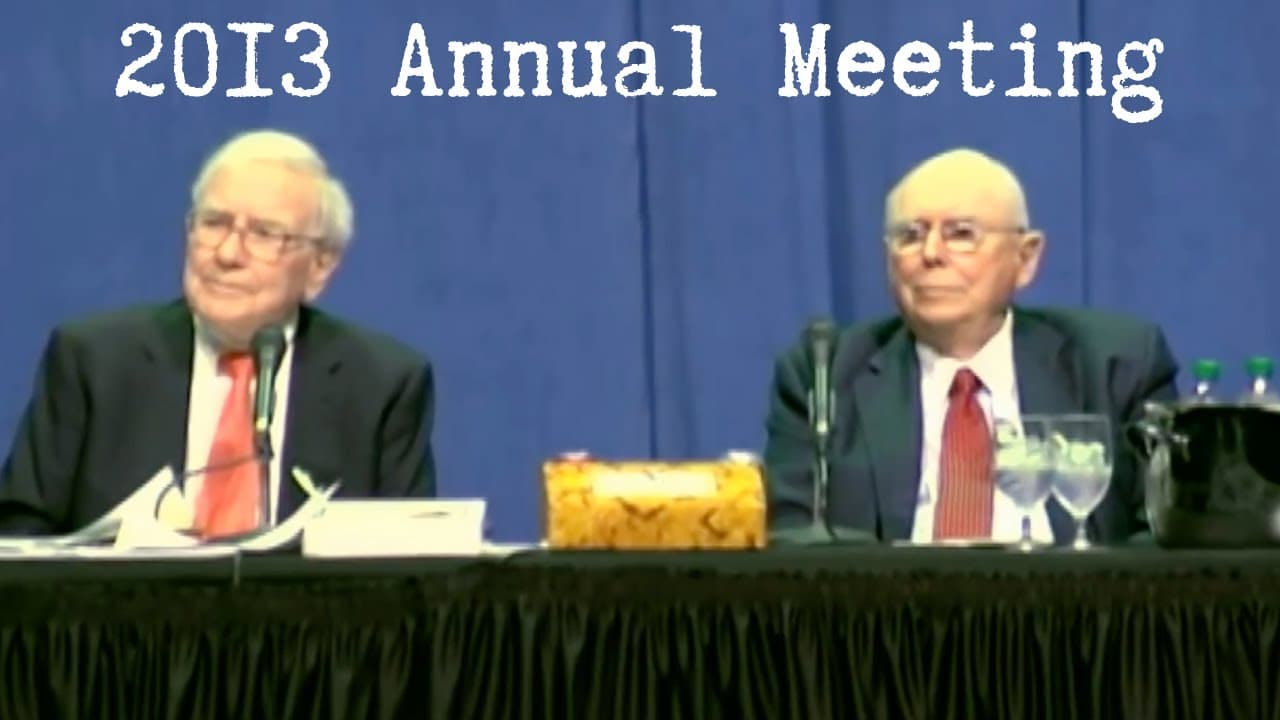
2013 Berkshire Hathaway Annual Meeting (Full Version)
TL;DR
Berkshire Hathaway’s strong first-quarter results were driven by nearly $3.8 billion in operating earnings, solid performance across major businesses, benign insurance conditions, GEICO policy growth, and increased railroad traffic. Buffett cautioned that currency effects and a $255 million pre-tax Swiss Re settlement made the quarter look better than its underlying performance. Read on to understand the operating measures and business developments behind the reported figures.
Transcript
morning kind of all worn out we're going to well first of all i really want to thank brad underwood he puts the movie together every year does a terrific job [Applause] andy hayward and amy are responsible for the cartoon they also produce a secret millionaires club which has been a huge hit this year and i really want to thank them for their part ... Read More
Key Insights
- Operating earnings are the preferred measure for assessing Berkshire's underlying quarterly performance because reported results can include currency effects, settlements, and other accounting items. Buffett characterized the first quarter as very good while cautioning that the headline result looked somewhat stronger than the operating reality.
- Foreign-currency movements can reduce insurance liabilities when the dollar strengthens against currencies in which future claims will be paid. Buffett also noted that Berkshire's many international business interests make the company's total exposure difficult to classify simply as benefiting or suffering when the dollar changes.
- The Swiss Re settlement produced a $255 million pre-tax gain for Berkshire after a disagreement over a life reinsurance contract lasting well over a year. Swiss Re also reported a $100 million gain from the settlement, illustrating how accounting treatment can allow both parties to recognize favorable results.
- GEICO's closure ratio is the percentage of prospective customers who purchase a policy after receiving a quote. Its significant improvement indicated that many customers found meaningful savings, strengthening policy growth and supporting Buffett's expectation that GEICO might add as many as one million policies during the year.
- GEICO's persistency rate is the rate at which existing customers renew their policies. Buffett called improvement in persistency pure gold because longer customer relationships increase the economic value of the insurer's policy base without immediately appearing as a separate asset on the income statement or balance sheet.
- Each additional GEICO policy has an estimated mathematical value of at least $1,500 to Berkshire. On Buffett's calculation, adding one million policies would build approximately $1.5 billion of intrinsic value, even though that increase would not be directly recorded in Berkshire's reported financial statements.
- Berkshire's railroad car loadings increased 3.8 percent during the first 17 weeks, while four other major United States Class I railroads collectively increased 0.4 percent. Buffett said the difference represented significant money and linked part of Berkshire's advantage to growing oil shipments.
- Iscar became wholly owned by Berkshire after the company purchased the family's remaining 20 percent interest for about $2 billion. Buffett described the business relationship positively, said Iscar had performed extremely well, and stated that the company would remain part of Berkshire permanently.
Install to Summarize YouTube Videos and Get Transcripts
Explore YouTube Video Summarizer or Get YouTube Transcript Extractor
Questions & Answers
Q: What drove Berkshire Hathaway’s strong first-quarter results in 2013?
Berkshire reported nearly $3.8 billion in operating earnings as its businesses generally performed well, particularly its large non-insurance operations. Insurance also had a benign quarter, although Buffett said currency effects and a $255 million pre-tax Swiss Re settlement made the reported result look somewhat stronger than the underlying performance.
Q: Why did Warren Buffett emphasize operating earnings?
Buffett said shareholders should focus on operating earnings because they better represented how Berkshire’s businesses performed. The reported figures also benefited from foreign-currency effects and the Swiss Re settlement, which were not purely recurring operating results.
Q: How did the stronger dollar affect Berkshire’s insurance earnings?
The stronger dollar reduced the dollar value of certain future insurance liabilities payable in pounds or euros, creating a small benefit. Buffett said currency changes also affected Berkshire’s international businesses and investments in other ways, so he could not determine whether a stronger dollar helped or hurt the company overall.
Q: What happened in Berkshire Hathaway’s settlement with Swiss Re?
Berkshire settled a disagreement with Swiss Re concerning a life reinsurance contract after the dispute had lasted well over a year. Berkshire recorded a $255 million pre-tax gain, while Swiss Re also reported a $100 million gain from the settlement.
Q: Why were GEICO’s closure ratio and persistency rate important?
GEICO’s closure ratio measured how many people bought a policy after receiving a quote, while its persistency rate measured how many policyholders renewed. Both improved significantly, helping GEICO add policies and retain customers; Buffett described improved persistency as “pure gold.”
Q: How did GEICO policy growth increase Berkshire Hathaway’s intrinsic value?
Buffett estimated that each GEICO policy had a mathematical value of at least $1,500 to Berkshire. Adding one million policies would therefore build about $1.5 billion into Berkshire’s intrinsic value, even though that increase would not appear on the income statement or balance sheet.
Q: Why was Berkshire’s railroad outperforming other major railroads?
Berkshire’s railroad car loadings increased 3.8 percent during the first 17 weeks, compared with 0.4 percent for four other major United States Class I railroads. Buffett said nearby oil discoveries supported the difference by generating substantial shipments, with more traffic expected.
Q: What did Berkshire Hathaway’s purchase of the remaining Iscar stake accomplish?
Berkshire purchased the family’s remaining 20 percent interest in Iscar for about $2 billion, making Iscar wholly owned by Berkshire. Buffett said Iscar had performed extremely well and would remain part of Berkshire permanently.
Summary
In this video, Warren Buffett discusses various topics related to Berkshire Hathaway and its businesses. He thanks the individuals responsible for the success of the company, introduces directors, presents the earnings for the quarter, talks about the insurance earnings and a settlement disagreement, discusses GEICO's closure rate and persistency rate, talks about the success of the railroad business, and mentions Berkshire Hathaway's position as the fifth most valuable company in the world. He also addresses questions about Berkshire's growth and book value per share, competitive advantages of Iscar over Sandvik, the goals of recent business moves, worries about succession planning, material announcements over social media, and the status of the US dollar as the world's reserve currency.
Questions & Answers
Q: What were the key accomplishments and individuals mentioned by Warren Buffett in the video?
Warren Buffett thanked Brad Underwood, who puts the movie together every year, Andy Hayward and Amy, who produced a cartoon called "Secret Millionaires Club," and Carrie Silva, who organizes the event. He also introduced the directors of Berkshire Hathaway.
Q: What were the earnings for the quarter? How did the different businesses perform?
The earnings for the quarter were good, with operating earnings of almost $3.8 billion. All of Berkshire's businesses did well, with insurance earnings being helped by a strong dollar reducing liabilities. There was also a settlement disagreement with Swiss Re that resulted in a gain of $255 million for Berkshire.
Q: What was the high point of the first quarter for Berkshire Hathaway?
The high point of the first quarter was the increase in both the closure rate and the persistency rate at GEICO. The closure rate, which measures the number of people who get a quote and go on to buy a policy, improved significantly, resulting in a gain in persistency. This increase in policyholders adds value to Berkshire's intrinsic value.
Q: How is Berkshire Hathaway's railroad business performing?
Berkshire Hathaway's railroad business is doing very well, with a gain in car loadings of 3.8 compared to the other major railroads' gain of 0.4 percent. The business has been helped by the discovery of oil near the railroad tracks, resulting in increased shipments.
Q: What is Berkshire Hathaway's position in the market?
Berkshire Hathaway is currently the fifth most valuable company in the world.
Q: What is Berkshire Hathaway's strategy for succession planning?
Berkshire Hathaway's board is focused on preserving the company's culture and finding a successor CEO who will have more brains, energy, and passion for the business than Warren Buffett. The culture of Berkshire Hathaway is considered one of a kind and is expected to continue even after Buffett's departure.
Q: What is the reasoning behind Berkshire Hathaway's recent business moves?
Berkshire Hathaway signed a portfolio underwriting arrangement with Aon and hired former AIG executives to enter the commercial insurance market. The goal is to increase market share and become a significant player in the commercial insurance business. Buffett believes they have the right people and capital to be successful in this new venture.
Q: What would be the potential effect if the US dollar loses its status as the world's reserve currency?
Warren Buffett believes it is extremely unlikely that any currency will replace the US dollar as the world's reserve currency for many decades, if ever. He views both the US and China as the global economic superpowers.
Q: What is Warren Buffett's opinion on the SEC's new position on the distribution of material information through social media?
Warren Buffett disagrees with the SEC's new position, stating that accuracy and simultaneity are crucial in disclosure. He believes that Business Wire, a unit of Berkshire Hathaway, does an excellent job of ensuring accurate and simultaneous distribution of material information.
Q: Has Berkshire Hathaway changed its approach to acquisitions recently?
While Berkshire Hathaway has paid higher prices for some recent acquisitions, Warren Buffett believes they have paid up for extraordinary businesses and that paying a premium can be justified for good businesses. He also mentioned the importance of size and the advantage it can bring in certain market conditions.
Q: How will Berkshire Hathaway perform in the future with its size and the shift towards more mature businesses?
Warren Buffett acknowledges that Berkshire Hathaway cannot achieve the same level of growth as it did in the past due to its size. However, he believes that even with some diminution in returns, they can still achieve satisfactory results. He also mentioned that Berkshire Hathaway owns multiple businesses that would individually be on the Fortune 500 list, and they are actively seeking more acquisitions.
Takeaways
In summary, Berkshire Hathaway's performance for the quarter was good, with all businesses performing well. Warren Buffett discussed the settlement of a disagreement with Swiss Re, the success of GEICO's closure rate and persistency rate, the positive performance of the railroad business, and Berkshire Hathaway's position as the fifth most valuable company in the world. He addressed concerns about succession planning, the SEC's new position on material information distribution, the status of the US dollar, and the company's move towards more mature businesses. Overall, Berkshire Hathaway's strategy remains focused on finding good businesses, preserving its culture, and achieving satisfactory returns despite its size.
Summary & Key Takeaways
-
Berkshire began its 2013 shareholder meeting by reporting a strong first quarter with nearly $3.8 billion in operating earnings. Buffett said the quarter looked somewhat better than its underlying performance because insurance results benefited from currency movements and a $255 million pre-tax gain arising from the settlement of a disagreement with Swiss Re.
-
GEICO showed significant improvement in both its closure ratio, the percentage of people who buy after receiving a quote, and its persistency rate, the percentage who renew. Buffett described these measures as extremely valuable because each policy has an estimated mathematical value of at least $1,500, although that value is not recorded directly in Berkshire's statements.
-
Berkshire's railroad was performing well, with car loadings rising 3.8 percent during the first 17 weeks, compared with 0.4 percent for four other major United States Class I railroads. Oil discoveries near the railroad's tracks helped freight volumes, while Berkshire also completed its purchase of the remaining 20 percent of Iscar for about $2 billion.
Read in Other Languages (beta)
Share This Summary 📚
Summarize YouTube Videos and Get Video Transcripts with 1-Click
Try YouTube Summary with ChatGPT & Claude or YouTube Transcript Generator
Explore More Summaries from Investor Archive 📚
Summarize YouTube Videos and Get Video Transcripts with 1-Click
Try YouTube Summary with ChatGPT & Claude or YouTube Transcript Generator