How Does Google’s Willow Quantum Chip Work?
TL;DR
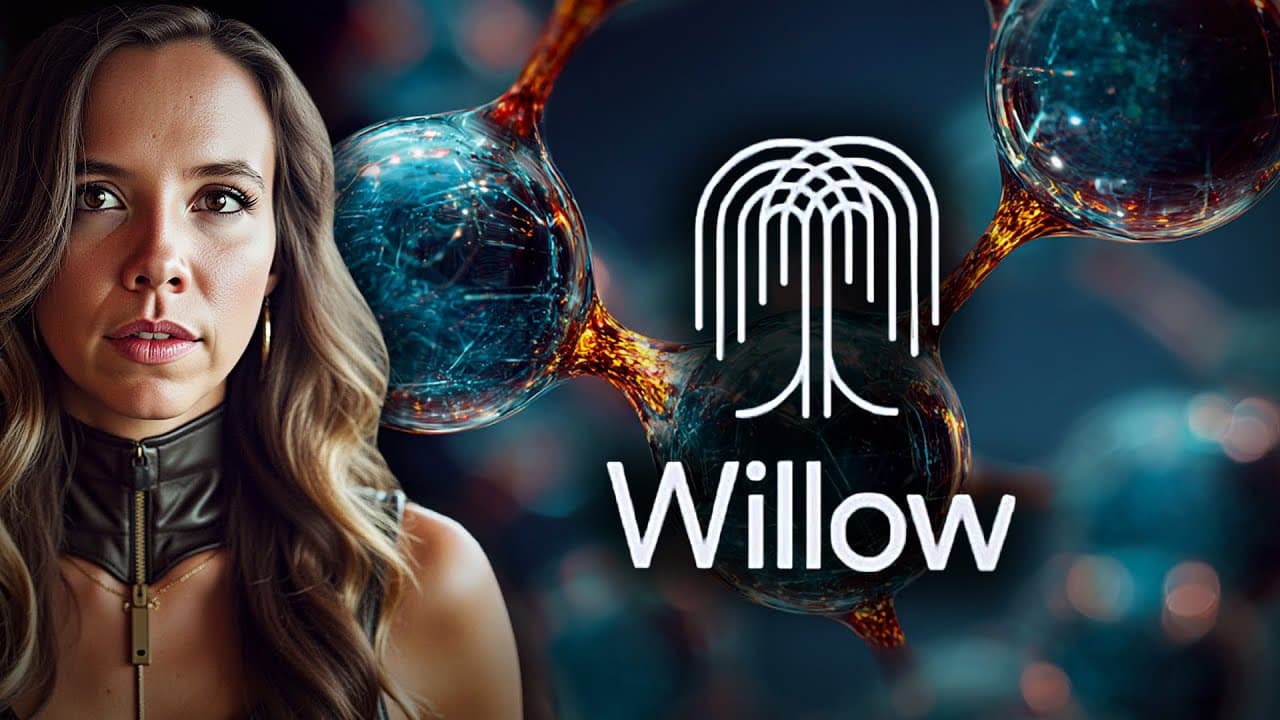
Google’s 105-qubit Willow chip reportedly achieved below-threshold error correction and ran a Quantum Echoes algorithm that can reveal molecular structures beyond the reach of conventional methods. The transcript argues that these advances could accelerate drug discovery, materials research, and AI, while emphasizing that fault-tolerant systems, industrial scaling, and quantum-proof digital infrastructure remain essential next steps.
Transcript
October 22nd, 2025. This is the date everything changed. Google just achieved what experts have been calling impossible verifiable quantum advantage. And what I'm about to share with you isn't just about faster computers. This is about breaking the laws of physics as we've understood them for 200 years. Hey, if we haven't met, I'm Dr. McCoy, Julia ... Read More
Key Insights
- Willow is a 105-qubit quantum chip that reportedly demonstrated below-threshold error correction. This means the system can correct mistakes faster than it produces them, an important step toward logical qubits that remain coherent long enough to perform extended and increasingly complex calculations.
- Willow’s reported gate fidelities are 99.97% for single-qubit operations and 99.88% for entangling operations. The transcript interprets these rates as evidence that quantum hardware is becoming sufficiently accurate to support useful experiments while progressing toward more reliable, fault-tolerant computation.
- The Quantum Echoes algorithm works by disturbing one qubit, reversing the system’s evolution, and measuring how that disturbance propagated. The resulting quantum butterfly effect can reveal molecular relationships that conventional NMR spectroscopy struggles to detect, creating what Google calls a longer molecular ruler.
- Quantum molecular analysis could accelerate drug discovery, materials science, chemistry, and biological research. The transcript argues that better simulation of molecular interactions may reduce computational barriers, expose previously inaccessible structures, and support the design of medicines, catalysts, batteries, superconductors, and materials not found in nature.
- Quantum engines can reportedly convert quantum correlations into usable work at the atomic scale. German researchers are described as exceeding efficiency limits associated with the Carnot principle, suggesting that classical thermodynamic constraints may not apply in the same way to systems powered by entanglement and other quantum correlations.
- Fault-tolerant quantum computing is the next major objective after below-threshold error correction. Google’s stated direction involves scaling beyond Willow’s 105 qubits toward millions of qubits and producing a long-lived logical qubit capable of sustaining complex calculations without rapidly losing coherence.
- Quantum computing creates both security opportunities and threats. The transcript says sufficiently capable systems could break current encryption, while quantum methods could also enable quantum encryption. This creates pressure to make digital infrastructure quantum-proof before powerful machines can compromise banks and other protected systems.
- Quantum computing and AI could form a reinforcing development loop. AI can help design improved quantum computers, while quantum processors may accelerate machine learning through algorithms that treat superposition and entanglement as computational resources, creating capabilities whose longer-term consequences are difficult to predict.
Install to Summarize YouTube Videos and Get Transcripts
Explore YouTube Video Summarizer or Get YouTube Transcript Extractor
Questions & Answers
Q: What did Google’s Willow quantum chip achieve?
Google’s Willow chip reportedly achieved below-threshold quantum error correction, meaning it can correct errors faster than they arise. The 105-qubit processor is also described as reaching 99.97% fidelity on single-qubit gates and 99.88% on entangling gates. According to the transcript, it performed one trillion measurements and supported the Quantum Echoes algorithm for investigating molecular structures that conventional techniques struggle to analyze.
Q: How does the Quantum Echoes algorithm work?
The Quantum Echoes algorithm begins by disturbing one selected qubit inside the processor. The system’s evolution is then run backward, like reversing a recording, and researchers measure how the original disturbance spread through the full quantum system. The transcript describes this as a quantum butterfly effect that extracts information about molecular structures and acts as a longer molecular ruler between more distant atoms.
Q: Why is below-threshold quantum error correction important?
Below-threshold error correction means a quantum computer can fix errors faster than it creates them. That matters because fragile quantum states can lose coherence and accumulate mistakes before useful calculations finish. Willow’s reported demonstration therefore represents progress toward long-lived logical qubits and fault-tolerant machines that can execute complex calculations for extended periods rather than being limited to short, specialized laboratory experiments.
Q: How could quantum computing improve drug discovery?
Quantum computing could improve drug discovery by simulating molecular structures and interactions that are too difficult for classical computers to calculate efficiently. The transcript argues that this capability may shorten a development process that currently takes 10 to 15 years and costs billions. It could also support personalized medicine by modeling individual genetic variations and improve researchers’ understanding of biology at the molecular level.
Q: What does quantum computing mean for materials science?
Quantum computers could search chemical and material possibility spaces that classical systems cannot practically explore. The transcript identifies potential applications such as room-temperature superconductors, batteries with 10 times current energy density, new catalysts, and materials that do not exist in nature. Improved molecular simulation could help researchers predict useful properties before manufacturing candidates, changing how materials are discovered and designed.
Q: Can quantum systems exceed classical thermodynamic limits?
The transcript says German researchers demonstrated that atomic-scale quantum engines can exceed efficiency limits associated with the Carnot principle. These systems reportedly convert not only heat but also quantum correlations into usable work. The claim is framed as showing that limits used to design classical engines for 200 years may not apply identically at the quantum level, potentially enabling molecular motors, medical nanobots, and atom-scale machines.
Q: When could fault-tolerant quantum computing become practical?
The transcript predicts another major leap within 18 to 36 months, with fault-tolerant quantum systems appearing during 2026–2027. It then forecasts commercially available quantum services for specific applications by 2028 and quantum-classical hybrid systems becoming common in research laboratories by 2030. These dates are presented as the speaker’s timeline, with long-lived logical qubits and large-scale hardware remaining necessary milestones.
Q: What security risks could powerful quantum computers create?
Powerful quantum computers could break current encryption and potentially expose banks and other protected digital systems, according to the transcript. The same computational abilities that support medicine and clean energy might also assist biological weapon design. Quantum technology could enable quantum encryption as a defense, but organizations must make infrastructure quantum-proof before machines become capable enough to defeat existing cryptographic protections.
Summary & Key Takeaways
-
Google’s Willow chip is presented as evidence that quantum computing is moving beyond demonstrations toward verifiable applications. Its reported below-threshold error correction means errors can be corrected faster than they accumulate. The chip has 105 qubits and reportedly achieves 99.97% fidelity for single-qubit gates and 99.88% for entangling gates.
-
The Quantum Echoes algorithm disturbs a selected qubit, reverses the system’s evolution, and measures how the disturbance spread. According to the transcript, this creates a longer molecular ruler for examining relationships between more distant atoms. The technique could improve molecular analysis for pharmaceutical research, biology, chemistry, and the design of new materials.
-
The transcript forecasts fault-tolerant systems during 2026–2027, specialized commercial quantum services by 2028, and common quantum-classical research systems by 2030. It also identifies risks, including broken encryption, biological weapon design, and unequal access. Organizations are advised to develop quantum expertise, investigate applications, and prepare digital infrastructure for quantum threats.
Read in Other Languages (beta)
Share This Summary 📚
Summarize YouTube Videos and Get Video Transcripts with 1-Click
Try YouTube Summary with ChatGPT & Claude or YouTube Transcript Generator
Explore More Summaries from Julia McCoy 📚






Summarize YouTube Videos and Get Video Transcripts with 1-Click
Try YouTube Summary with ChatGPT & Claude or YouTube Transcript Generator