How to Determine Addresses in Class A Networks
TL;DR
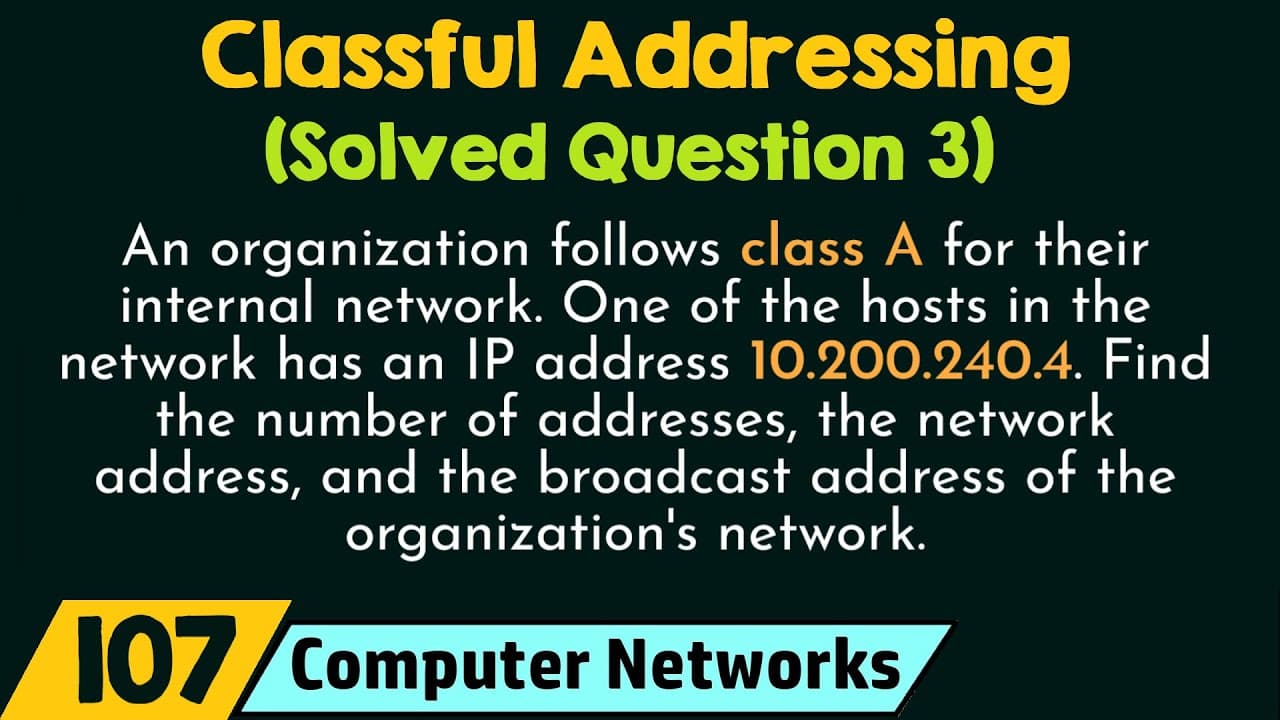
To calculate the number of addresses, network address, and broadcast address for a Class A network, focus on the first octet, which indicates the network portion. A Class A network has 128 possible networks and allows for a substantial 16,777,214 usable host addresses. The network and broadcast addresses can be easily derived based on the first octet and the subnet mask of 255.0.0.0.
Transcript
in the previous lectures we have seen class full addressing solved questions using class c and class b now we will see the last question in class full addressing with class a as an example we will start the session with the outcomes upon the completion of this session the learner will be able to find the number of addresses network address broadcas... Read More
Key Insights
- 👻 Class A networks have a large number of networks and hosts per network.
- 🏛️ The first octet represents the network portion in a class A network.
- 🏛️ Network addresses in a class A network have a fixed first octet but varying remaining octets.
- 🍉 Classful addressing has limitations in terms of wasting IP addresses and the need for classless addressing.
Install to Summarize YouTube Videos and Get Transcripts
Explore YouTube Video Summarizer or Get YouTube Transcript Extractor
Questions & Answers
Q: How many networks are possible in a class A network?
In a class A network, there are 128 possible networks, ranging from 0.0.0.0 to 127.0.0.0.
Q: How many hosts are possible per network in a class A network?
A class A network can have 16,777,214 hosts, which is determined by subtracting 2 from 2^24.
Q: What is the network address for an IP address of 10.200.240.25 in a class A network?
The network address for a class A network with an IP address of 10.200.240.25 is 10.0.0.0.
Q: What is the broadcast address for a class A network with the IP address range of 10.0.0.0 to 10.255.255.255?
The broadcast address for the mentioned class A network is 10.255.255.255.
Key Insights:
- Class A networks have a large number of networks and hosts per network.
- The first octet represents the network portion in a class A network.
- Network addresses in a class A network have a fixed first octet but varying remaining octets.
- Classful addressing has limitations in terms of wasting IP addresses and the need for classless addressing.
- Subnetting allows for more efficient use of IP addresses by creating custom-sized networks.
Summary & Key Takeaways
-
In class A network addressing, the first octet represents the network portion, and the remaining three octets represent the host portion.
-
Class A networks have a large number of networks (128) and a massive number of hosts per network (16,777,214).
-
To find the network address in a class A network, only the first octet needs to match, while the remaining three octets can vary.
Read in Other Languages (beta)
Share This Summary 📚
Summarize YouTube Videos and Get Video Transcripts with 1-Click
Try YouTube Summary with ChatGPT & Claude or YouTube Transcript Generator
Explore More Summaries from Neso Academy 📚

Summarize YouTube Videos and Get Video Transcripts with 1-Click
Try YouTube Summary with ChatGPT & Claude or YouTube Transcript Generator