How to boost IELTS Speaking score with feedback
TL;DR
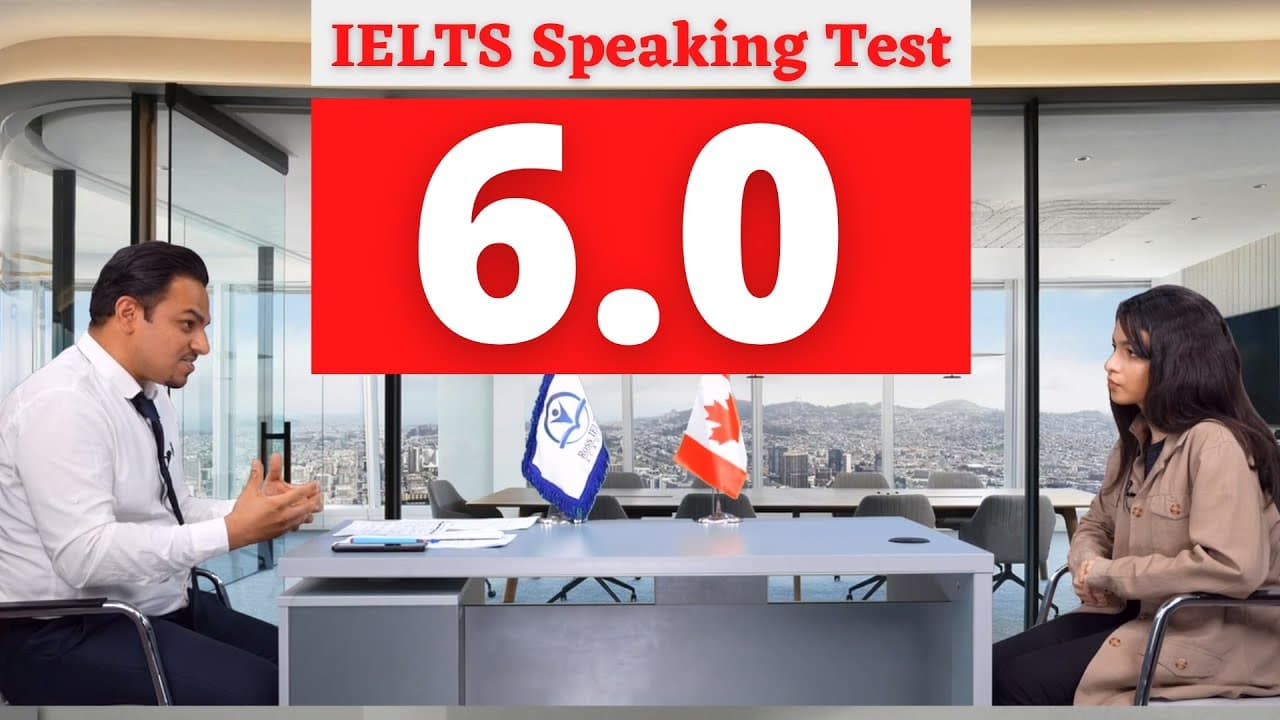
The video presents a Band 6 IELTS Speaking mock and detailed feedback. It analyzes fluency, coherence, lexical resource, grammar, and pronunciation, then offers practical tips to improve. Viewers learn to paraphrase questions, expand connective use, and practice under exam-like conditions to lift performance.
Transcript
well are you ready yes from here starts the speaking test this is the speaking mock test of the international English language testing system taking place in rles Academy the candidate is Bahar the candidate number is 0141 3278 The Examiner is Joseph examiner number 44 3533 good afternoon good afternoon my name is jph would you please tell me your ... Read More
Key Insights
- The evaluation focuses on four criteria: fluency and coherence, lexical resource, grammatical range and accuracy, pronunciation.
- The speaker demonstrates coherence by staying on topic and providing relevant, extended responses.
- A wider range of connectives and fillers is recommended to boost fluency and cohesion and move toward a higher band.
- Paraphrasing questions helps manage time and showcases vocabulary versatility.
- Parliamentary style accuracy is emphasized, including correct use of tenses and agreement to improve grammar scores.
- Proper intonation and pronunciation are highlighted as essential, not just accent, with guidance on rhythm and stress.
- The feedback identifies specific errors such as misused words and suggests corrections to improve clarity.
- Exam-style practice is presented as a core method to acclimate to the test format and timing.
Install to Summarize YouTube Videos and Get Transcripts
Explore YouTube Video Summarizer or Get YouTube Transcript Extractor
Questions & Answers
Q: How does the video suggest improving fluency for IELTS Speaking?
To improve fluency, the video recommends keeping speaking at length without losing track of ideas, using a wider range of connectives, fillers, and boosters, and practicing speaking under exam-like conditions to build comfort with extended responses and faster word recall. Regular practice with target vocabulary helps sustain flow.
Q: What role do paraphrasing and rephrasing play in the advice?
Paraphrasing questions is presented as a key technique to buy thinking time and show flexibility with language. It helps the candidate avoid repetition, demonstrates lexical variety, and allows the speaker to structure an answer with synonyms and alternative expressions, which can boost both coherence and lexical resource scores.
Q: Which criteria are identified as the core measures of speaking performance?
The core criteria are fluency and coherence, lexical resource, grammatical range and accuracy, and pronunciation. Each area is evaluated for both accuracy and range, with emphasis on staying on topic, using varied vocabulary, constructing complex sentences, and producing clear, natural pronunciation with proper intonation.
Q: What specific grammar improvements are recommended?
Improvements include using a mix of simple and complex structures, employing subordinate clauses, and ensuring correct tense usage and agreement. The feedback notes a desire for more complex sentences and conditional forms, which can significantly raise the grammatical range and accuracy score when used correctly.
Q: How is pronunciation addressed in the feedback?
Pronunciation is addressed by focusing on natural rhythm, intonation, and stress placement rather than accent. The guidance emphasizes avoiding monotone speech and using rising and falling intonation to convey meaning, which helps the listener understand and aligns with higher band expectations.
Q: What practice approach is endorsed for exam readiness?
The endorsed approach is practicing under exam-like conditions, including timed responses and mock speaking tests. This familiarizes candidates with the format, reduces anxiety, and helps learners manage time effectively while maintaining coherence and accuracy across all four scoring criteria.
Q: What is suggested to handle questions about advantages and disadvantages?
To handle such questions, the guidance recommends paraphrasing and using synonyms to discuss pros and cons, while structuring arguments with clear logic. This demonstrates lexical flexibility and grammatical accuracy, and helps to present a balanced, well-supported answer within the time limit.
Q: What is the potential outcome of applying the tips in the video?
If the tips are applied, a candidate can improve global speaking performance, especially by expanding vocabulary, using varied sentence structures, and refining pronunciation. The expected outcome is a higher band score through improved fluency, coherence, lexical resource, grammatical range, and pronunciation across practice and real tests.
Summary & Key Takeaways
-
This summary highlights the mock test setup and the four criteria used to assess speaking performance, namely fluency, lexical resource, grammatical range and accuracy, and pronunciation, along with actionable feedback to push toward a higher band.
-
The reviewer notes that using a wider range of connectives and paraphrasing questions can improve coherence and lexical flexibility, suggesting targeted practice to develop more complex sentence structures while maintaining accuracy.
-
The review emphasizes practice under exam conditions, the importance of avoiding topic drift, and strategies for improving intonation and natural rhythm to enhance overall speaking performance.
Read in Other Languages (beta)
Share This Summary 📚
Summarize YouTube Videos and Get Video Transcripts with 1-Click
Try YouTube Summary with ChatGPT & Claude or YouTube Transcript Generator
Explore More Summaries from Ross IELTS Academy 📚
Summarize YouTube Videos and Get Video Transcripts with 1-Click
Try YouTube Summary with ChatGPT & Claude or YouTube Transcript Generator