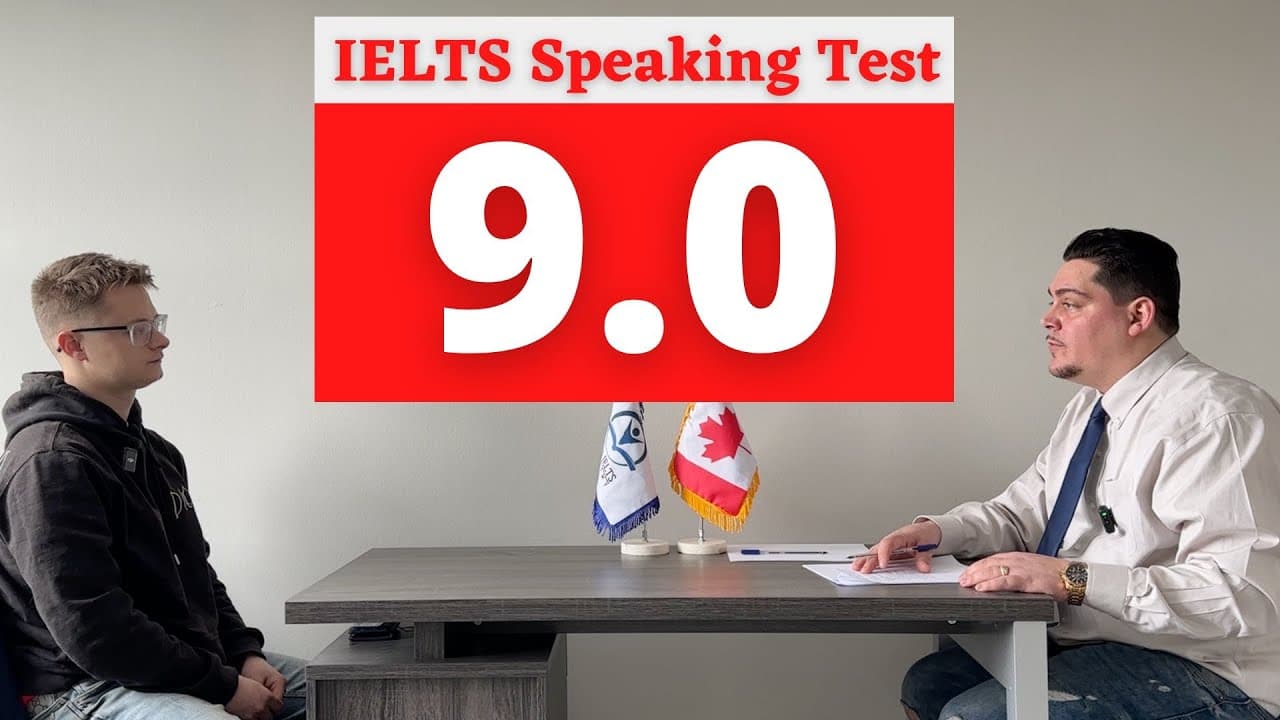
How Did Joseph Achieve Band 9 in the 2025 IELTS Speaking Test?
TL;DR
Joseph achieves Band 9 in IELTS Speaking by giving fluent, relevant answers supported by reasons, examples, and personal experiences while demonstrating strong vocabulary, grammar, pronunciation, and intonation. He handles questions about food, communication, hobbies, and helping strangers, then receives nine out of nine overall. Read on to see how he develops answers across all three parts of the test.
Transcript
In part one, I asked you some personal questions. Let's talk about food. What is your favorite type of food? Um, my favorite type of food. Um, there's a lot of food out there. If I really had to dig deep, um, I'd say I like fast food. Um, definitely like my poutines and burgers. Um, barbecue food, too. Uh, ribs. I think that's probably one of my fa... Read More
Key Insights
- Joseph’s final score is nine out of nine, according to the evaluator’s feedback. The description also lists scores of 9 for fluency and coherence, lexical resource, grammar, and pronunciation, presenting the performance as an example for candidates seeking a high IELTS Speaking score.
- Strong speaking answers are relevant and supported with examples and explanations. The evaluator specifically praises Joseph for staying relevant, giving strong examples, and explaining his ideas, while the test responses connect general opinions to personal experiences involving food, friendships, sports, work, and family.
- Fluency and coherence are major strengths of Joseph’s performance. He continues speaking across personal and abstract topics, develops most answers beyond a single sentence, and links his opinions with reasons, comparisons, memories, or examples, despite frequently using hesitation expressions such as “um” and “you know.”
- Lexical resource is rated 9 in the description and praised as “off the charts” in the feedback. Joseph uses conversational phrases and topic-specific language while discussing restaurants, social media, physical activity, customer service, personal responsibility, childhood influences, and changing communication habits.
- Part two allows one minute of preparation before the candidate speaks for two minutes. Joseph uses the preparation time for a prompt about helping a stranger, then broadens the topic to ordinary helpful actions, including opening doors, giving compliments, talking to people, offering suggestions, and assisting customers.
- Everyday conversation is presented as a meaningful way to help strangers. Joseph argues that greeting someone, listening, or starting a small conversation may improve a difficult day, particularly when many people are closed off and reluctant to engage with others.
- Social media is identified as the biggest change in communication compared with the past. Joseph says Instagram and Snapchat are his main ways of contacting friends, texting is more common in daily life, calling feels more personal, and face-to-face communication was more prevalent previously.
- Organizations are described as having a responsibility to use their large platforms and voices to benefit society. Joseph also says children should learn from an early age how to treat, speak to, and help other people, while acknowledging that offered help does not always make a difference.
Install to Summarize YouTube Videos and Get Transcripts
Explore YouTube Video Summarizer or Get YouTube Transcript Extractor
Questions & Answers
Q: How does Joseph demonstrate Band 9 performance in the 2025 IELTS Speaking test?
Joseph speaks fluently, remains relevant, and develops his ideas with reasons, examples, comparisons, and personal experiences. The evaluator praises his vocabulary, grammar, pronunciation, and intonation and awards him nine out of nine overall.
Q: What topics does Joseph discuss in the IELTS Speaking test?
Part one covers food, restaurants, home-cooked meals, communication, social media, hobbies, and physical activity. Part two focuses on helping a stranger, while part three explores why people help, whether attitudes have changed, what children should learn, and organizations’ responsibilities to society.
Q: How does Joseph develop his IELTS Speaking answers?
Joseph expands his answers with explanations and personal details instead of stopping after a short response. For example, he connects home-cooked meals with memories of his mother, explains why calling feels more personal than texting, and contrasts childhood soccer with his current interest in golf.
Q: What happens in part two of Joseph’s IELTS Speaking test?
Joseph receives the topic “describe a time when you helped a stranger” and has one minute to prepare notes. He is then asked to speak for two minutes, but he discusses everyday helpful behavior broadly rather than describing one specific event.
Q: How does Joseph describe helping strangers in everyday life?
He identifies small actions such as opening doors, giving compliments, offering suggestions, starting conversations, and assisting customers at work. He argues that these ordinary interactions can help someone whose day is not going well, even when the person offering help does not recognize their impact.
Q: How has communication changed compared with the past, according to Joseph?
Joseph says social media has caused the biggest change because more people now communicate through it rather than face to face. He mainly uses Instagram and Snapchat with friends, texts more often day to day, and considers calling more personal with close friends.
Q: How do Joseph’s hobbies illustrate the way he supports answers with examples?
Joseph names golf as his favorite summer hobby and snowboarding as his favorite winter activity. He explains that he played soccer frequently as a child but developed new interests as he grew older, matured, and formed different friendships.
Q: What feedback and score does Joseph receive?
The evaluator praises Joseph’s fluency and coherence, relevance, explanations, vocabulary, grammar, pronunciation, and intonation. He receives scores of 9 for fluency and coherence, lexical resource, grammar, and pronunciation, producing an overall result of nine out of nine.
Summary & Key Takeaways
-
Part one covers food, communication, and hobbies. Joseph discusses enjoying fast food, barbecue, home-cooked meals, social media, texting, calling, golf, snowboarding, and physical activities. His responses frequently include personal reasons and examples, such as memories of his mother’s cooking and the changing interests that accompanied growing older.
-
For part two, Joseph receives one minute to prepare and speaks about helping a stranger. Instead of describing one specific event, he discusses everyday assistance, including opening doors, offering compliments, starting conversations, and helping customers at work. He argues that small interactions can improve someone’s day and often go unnoticed.
-
Part three explores why people help strangers, whether willingness to help has changed, what children should learn, and who holds responsibility for society. The evaluator praises Joseph’s fluency, relevance, explanations, vocabulary, grammar, pronunciation, and intonation, awarding an overall score of nine out of nine after reviewing his performance.
Read in Other Languages (beta)
Share This Summary 📚
Summarize YouTube Videos and Get Video Transcripts with 1-Click
Try YouTube Summary with ChatGPT & Claude or YouTube Transcript Generator
Explore More Summaries from Ross IELTS Academy 📚
Summarize YouTube Videos and Get Video Transcripts with 1-Click
Try YouTube Summary with ChatGPT & Claude or YouTube Transcript Generator