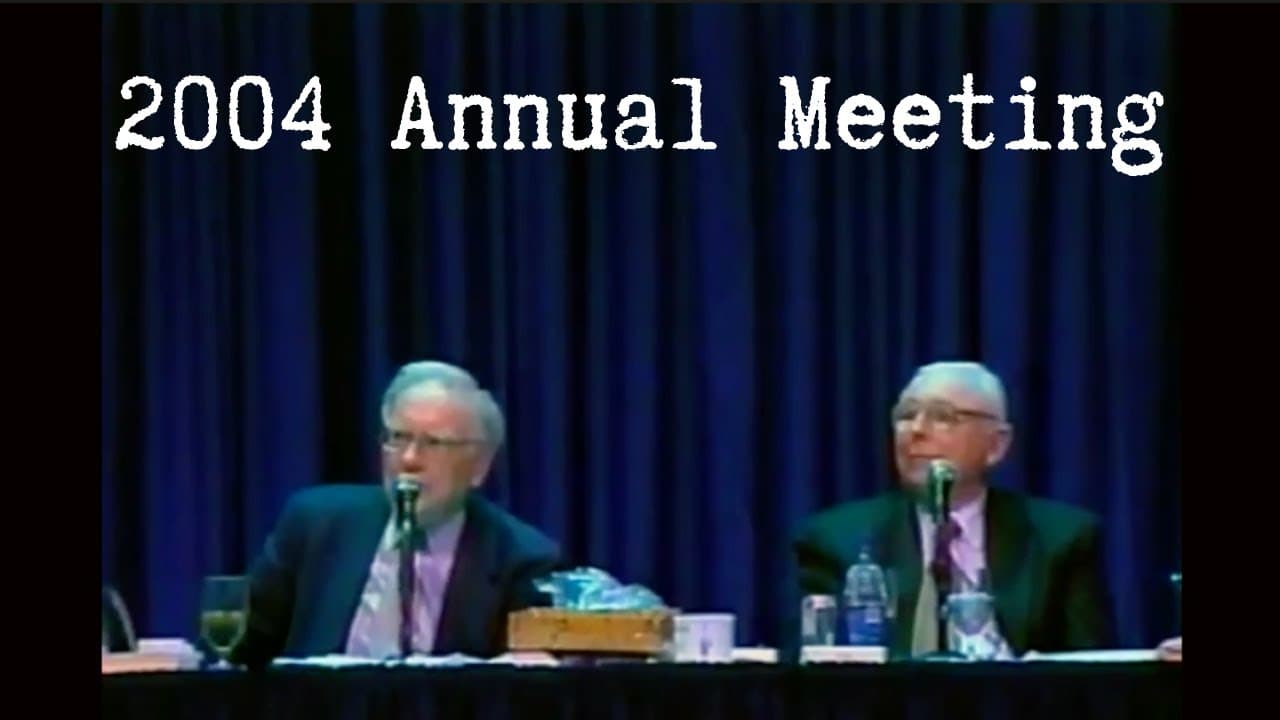
2004 Berkshire Hathaway Annual Meeting (Full Version)
TL;DR
Berkshire reinsures viatical settlements, buying elderly people's life insurance policies for more than their cash surrender value because the actuarial value is higher. GAAP rules force an immediate write-down to cash surrender value, so Berkshire charged $73 million from last year plus about $30 million in Q1 2004 against realized capital gains, even though Buffett thinks the rule is wrong.
Transcript
thank you good morning some of you may have noticed a stuntman was used in that arnold just couldn't handle some of those scenes before we get started i'd i'd especially like to thank andy hayward who's here today and if we can no way we can find him out in the crowd it's a little hard to see from up here but andy runs deke productions he he does t... Read More
Key Insights
- A viatical settlement is a transaction where someone, usually elderly, sells their life insurance policy for cash now rather than leaving the payout to their heirs, and Berkshire reinsures these transactions as a growing line of business.
- The cash surrender value of a life insurance policy can be far below its actuarial value; Buffett cites a 79-year-old woman whose $75 million policy carried a cash surrender value of only $2 million.
- GAAP accounting requires a purchased policy to be written down immediately to its cash surrender value, so a policy Berkshire paid $10 million for gets written down to a $2 million surrender value on the books.
- Berkshire adopted the GAAP method despite disagreeing with it, taking a charge of $73 million from last year plus roughly $30 million in the first quarter of 2004, booked against realized capital gains.
- The key to good auditing, per Buffett, is making auditors more worried about the audit committee than about management, since management hires them and sees them regularly while the committee is seen infrequently.
- Berkshire's audit committee asked Deloitte & Touche four standard questions at its March 2, 2004 meeting and put the answers on the record, a practice Buffett argues all auditors should face at least annually.
- Putting auditor answers on the record changes behavior because it puts the auditors on the line; Buffett believes such procedures would have prevented much of the corporate trouble seen in the 1990s.
- Berkshire's meeting format limits shareholders to one question at a time, running Q&A until noon, breaking for lunch, and resuming until 3:30, answering anything except what the company may be buying or selling.
Install to Summarize YouTube Videos and Get Transcripts
Explore YouTube Video Summarizer or Get YouTube Transcript Extractor
Questions & Answers
Q: What is a viatical settlement and why does Berkshire reinsure them?
A viatical settlement is where someone, typically elderly, who owns a life insurance policy would rather have the cash themselves than have their heirs receive the payout later, so they sell the policy early. Berkshire reinsures companies that buy these policies, taking a share such as 50 percent of each transaction. Buffett describes it as a business of sorts that is likely to become larger in the future.
Q: Why can a life insurance policy be worth far more than its cash surrender value?
A life insurance policy typically has a cash surrender value that can be quite low relative to the policy's actuarial value. Buffett cites a 79-year-old woman with a policy amounting to some $75 million whose cash surrender value was only $2 million. Even for a 79-year-old in the best of health, that surrender value was an inadequate sum, which is why sellers prefer to sell the policy for more.
Q: How does GAAP accounting require Berkshire to record a purchased life insurance policy?
Under GAAP accounting rules, which Buffett says have become more clear, a purchased policy is recommended to be written down immediately to its cash surrender value. In his example, Berkshire reinsured a policy bought for $10 million, but the rules require writing it down at once to the $2 million cash surrender value, even though Berkshire believes it is worth the $10 million it paid, or it would not have paid that amount.
Q: How much did Berkshire charge for viatical policies and where was it booked?
At the end of last year there had been a total of $73 million applicable to such policies, reflecting the difference between purchase price and cash surrender value. In the first quarter of 2004 activity stepped up, adding about $30 million on Berkshire's 50 percent share. Berkshire adopted the GAAP method despite thinking it incorrect, and the combined charge is booked, believe it or not, against realized capital gains.
Q: Why does Buffett believe auditors should answer questions at the audit committee?
Buffett argues the trick is to have auditors more worried about the audit committee than about management. Since auditors are essentially hired by management and see it regularly while seeing the committee infrequently, it is tempting to listen more to management. Asking a set of questions and putting the answers on the record puts auditors on the line, which Buffett believes has a helpful effect on behavior.
Q: What four questions did Berkshire's audit committee ask Deloitte & Touche?
At Berkshire's audit committee meeting held on March 2, 2004, Deloitte & Touche responded to four questions Buffett suggests all audit committees ask their independent accountants, with the questions and responses shown on slides at the meeting. Buffett recommends these be asked at least annually and perhaps quarterly, and credits a shareholder's suggestion to present them at the meeting itself as a good idea more companies should adopt.
Q: What are the rules for asking questions at the Berkshire annual meeting?
After complaints that people asked six or seven part questions, Buffett asks shareholders to ask only one question at a time and not to work three or four into a single question, so more people get a chance. He half-jokes the bigger reason is that Charlie cannot remember the first part by the fifth. Questioners rotate microphone to microphone, and the meeting will answer almost anything except what Berkshire may be buying or selling.
Q: What did Buffett say about Andy Hayward and the 'Liberty's Kids' series?
Buffett thanks Andy Hayward, who runs Deke Productions and produces the company's cartoon. Hayward produced a series called 'Liberty's Kids' telling the story of the beginning of the country, which had been on public broadcasting the last couple of years. Buffett says it is great for kids and adults, that he has watched a number of sessions himself, and that it goes on sale at Walmart in July as a good pick for children or grandchildren.
Summary
Warren Buffett begins the meeting by thanking Andy Hayward and Kelly Muchmore for their contributions. He discusses the cartoon "Liberty's Kids" and encourages shareholders to watch it. Buffett introduces himself and Charlie Munger, the vice chairman of Berkshire Hathaway. He then explains the structure of the meeting and addresses the issue of shareholders asking multiple questions. Buffett also discusses the rules against audio or video recording of the meeting and introduces the Berkshire Hathaway directors and auditors. The meeting proceeds to discuss the election of directors and a proposal by Human Life International, which ultimately fails. The meeting concludes with a discussion on shareholder suggestions for improvement and a motion to adjourn.
Questions & Answers
Q: What did Warren Buffett thank Andy Hayward for?
Warren Buffett thanked Andy Hayward for producing the cartoon series "Liberty's Kids" about the beginning of the country.
Q: What is the name of the company that produces the cartoon series "Liberty's Kids"?
The cartoon series "Liberty's Kids" is produced by Deke Productions, run by Andy Hayward.
Q: When will the series "Liberty's Kids" go on sale?
The series "Liberty's Kids" will go on sale in July at Walmart.
Q: Who is responsible for putting up the exhibition arrangement at the meeting?
Kelly Muchmore is responsible for putting up the exhibition arrangement at the meeting.
Q: Who is the chairman of Berkshire Hathaway?
Warren Buffett is the chairman of Berkshire Hathaway.
Q: Who is the vice chairman of Berkshire Hathaway?
Charlie Munger is the vice chairman of Berkshire Hathaway.
Q: What did Warren Buffett say about Charlie Munger's and his relationship?
Warren Buffett mentioned that Charlie Munger and he have a lot of fun together, despite occasional memory lapses.
Q: Where should shareholders go if they want to speak about matters related to the meeting?
Shareholders who want to speak about matters related to the meeting should go to one of the designated microphones in the audience.
Q: What topics should shareholders avoid when asking questions after the meeting?
Shareholders should avoid asking questions about what Berkshire Hathaway may be buying or selling.
Q: What did Warren Buffett suggest about shareholders asking questions at the meeting?
Warren Buffett suggested that shareholders should ask only one question at a time and avoid asking multiple part questions.
Q: What will happen during the lunch break at the meeting?
The meeting will take a lunch break at noon and resume at 1 pm.
Takeaways
Warren Buffett expresses his appreciation for the cartoon series "Liberty's Kids" and encourages shareholders to watch it with their children or grandchildren. He provides updates on the upcoming sale of the series and acknowledges Andy Hayward and Kelly Muchmore for their contributions. Buffett discusses the structure of the meeting, including the rules around questions and the prohibition of audio and video recording. He introduces the Berkshire Hathaway directors and auditors present at the meeting. The meeting proceeds with the election of directors and a discussion on a shareholder proposal that ultimately fails. Buffett addresses the idea of shareholder suggestions for improvement and the motion to adjourn concludes the meeting.
Summary & Key Takeaways
-
Warren Buffett opens the 2004 Berkshire Hathaway annual meeting alongside vice chairman Charlie Munger, thanking Andy Hayward of Deke Productions for the 'Liberty's Kids' cartoon airing on public broadcasting and going on sale at Walmart in July, and Kelly Muchmore, who runs the production with the dog Dudley.
-
Buffett explains the meeting rules: shareholders address business matters at designated microphones first, then ask one question at a time during Q&A, which runs until noon and resumes after lunch until 3:30, with no audio or video recording permitted due to copyrighted material.
-
The main accounting topic is viatical settlements, where Berkshire reinsures purchases of elderly people's life insurance policies. GAAP forces writing policies down to cash surrender value, producing charges of $73 million from last year and about $30 million in Q1 2004 against realized capital gains.
Read in Other Languages (beta)
Share This Summary 📚
Summarize YouTube Videos and Get Video Transcripts with 1-Click
Try YouTube Summary with ChatGPT & Claude or YouTube Transcript Generator
Explore More Summaries from Investor Archive 📚
Summarize YouTube Videos and Get Video Transcripts with 1-Click
Try YouTube Summary with ChatGPT & Claude or YouTube Transcript Generator