What Is OpenAI Sora and How Does It Work?
TL;DR
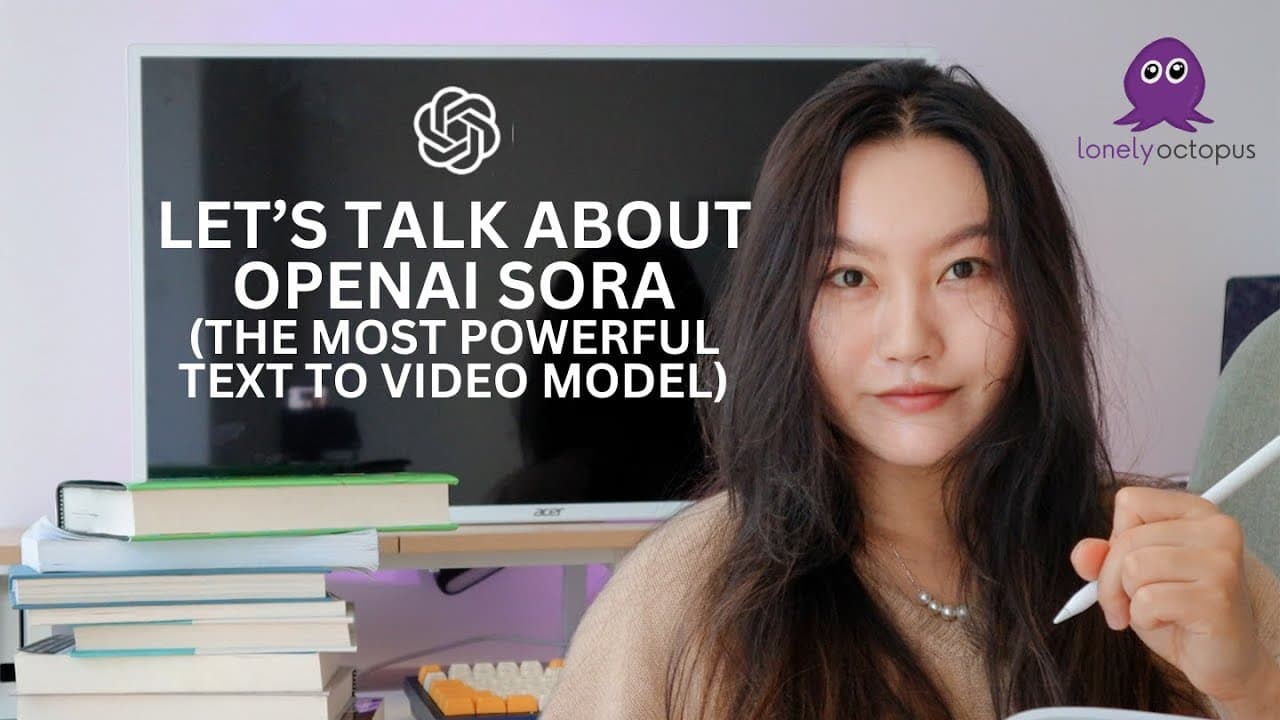
OpenAI Sora is a groundbreaking model that creates realistic and imaginative videos from text descriptions. It generates high-quality, cinematic videos by converting text prompts into visual patches, allowing for detailed scene creation. Though still in private testing, Sora showcases the potential for AI-generated content to revolutionize film and media production.
Transcript
Hello friends how's it going good morning I just woke up Don't Judge Me While I chug some water okay this water is allegedly advertised by the Chinese badon team how's everyone doing hello Quantum illusion right when I started learning blender Sam drops 3D killer I'm freaking out for what open I has just shown s is incredible still work in progress... Read More
Key Insights
- OpenAI Sora is a model that generates videos from text instructions.
- Sora can produce high-quality, cinematic videos with natural movement.
- The model uses visual patches similar to text tokens in language models.
- Sora's training involves detailed text prompts to enhance video fidelity.
- It can generate videos of varying aspect ratios and resolutions.
- Sora's output can include realistic physics interactions and object permanence.
- The model is still in private testing and not available for public use.
- Sora's development raises questions about the future of content creation and authenticity.
Install to Summarize YouTube Videos and Get Transcripts
Explore YouTube Video Summarizer or Get YouTube Transcript Extractor
Questions & Answers
Q: How does OpenAI Sora generate videos from text?
OpenAI Sora generates videos by using a process where text prompts are converted into visual patches, akin to text tokens in language models. These patches represent different aspects of a scene, allowing the model to predict and create subsequent video frames. The detailed text prompts guide the model in filling in scene details, resulting in high-quality, realistic videos.
Q: What makes Sora's video generation unique?
Sora's video generation is unique due to its ability to create high-quality, cinematic videos that include natural movement and realistic physics interactions. It can generate videos in various aspect ratios and resolutions, maintaining consistency and object permanence throughout the video. This versatility and attention to detail set Sora apart from previous video generation models.
Q: What are the potential implications of Sora on content creation?
Sora's development could significantly impact content creation by enabling the production of high-quality videos without traditional filming. This technology could reduce production costs and time, allowing creators to generate content more efficiently. However, it also raises concerns about the authenticity of media and the potential for misuse in creating misleading content.
Q: Is OpenAI Sora available for public use?
As of now, OpenAI Sora is not available for public use. It is currently in private testing, being assessed for critical areas of risk and harm. The technology is still being refined, and OpenAI is working on developing safety measures to detect and prevent misuse of AI-generated content before making it widely accessible.
Q: How does Sora handle different video resolutions and aspect ratios?
Sora can handle different video resolutions and aspect ratios by training on videos with native aspect ratios. This approach improves the model's ability to compose scenes accurately and maintain the integrity of the video's framing. Unlike models that crop training data to a standard size, Sora's method allows for greater flexibility and fidelity in video generation.
Q: What are the safety concerns associated with Sora's technology?
Safety concerns with Sora's technology include the potential for creating misleading or harmful content. OpenAI is developing tools to detect AI-generated videos and ensure they adhere to usage policies. These measures aim to prevent the misuse of Sora's capabilities, such as creating deepfakes or other deceptive media, while learning from real-world use to enhance safety.
Q: How does Sora's use of visual patches compare to text tokens in language models?
Sora uses visual patches in a manner similar to text tokens in language models. These patches decompose video data into manageable units that represent aspects of space and time within a scene. This method allows the model to predict and generate subsequent frames, enabling the creation of coherent and detailed videos from text prompts.
Q: What role does compute power play in Sora's video generation?
Compute power is crucial in Sora's video generation, as it significantly affects the quality and detail of the generated videos. Increased compute allows the model to handle more complex scenes and produce longer, coherent videos without degradation in quality. This scalability is essential for advancing the capabilities of AI-generated content and achieving cinematic-quality results.
Summary & Key Takeaways
-
OpenAI Sora is an advanced AI model that creates videos from text prompts by using visual patches, similar to how language models use text tokens. This allows for the generation of high-quality, realistic videos with natural movement and detailed scenes. The technology is currently in private testing, demonstrating the potential for AI to transform content creation.
-
Sora's ability to generate videos in different aspect ratios and resolutions, along with realistic physics interactions, showcases its versatility. The use of detailed text prompts enhances the quality and fidelity of the generated videos. This development suggests a future where AI could play a significant role in media production, raising questions about the authenticity of content.
-
Though not yet available for public use, Sora highlights the capabilities of AI in generating cinematic-quality videos. As the technology evolves, it may lead to new methods of content creation, challenging traditional media production and potentially altering how audiences perceive authenticity in visual media.
Read in Other Languages (beta)
Share This Summary 📚
Summarize YouTube Videos and Get Video Transcripts with 1-Click
Try YouTube Summary with ChatGPT & Claude or YouTube Transcript Generator
Explore More Summaries from Tina Huang 📚
Summarize YouTube Videos and Get Video Transcripts with 1-Click
Try YouTube Summary with ChatGPT & Claude or YouTube Transcript Generator