How Does a PN Junction Diode V-I Curve Work?
TL;DR
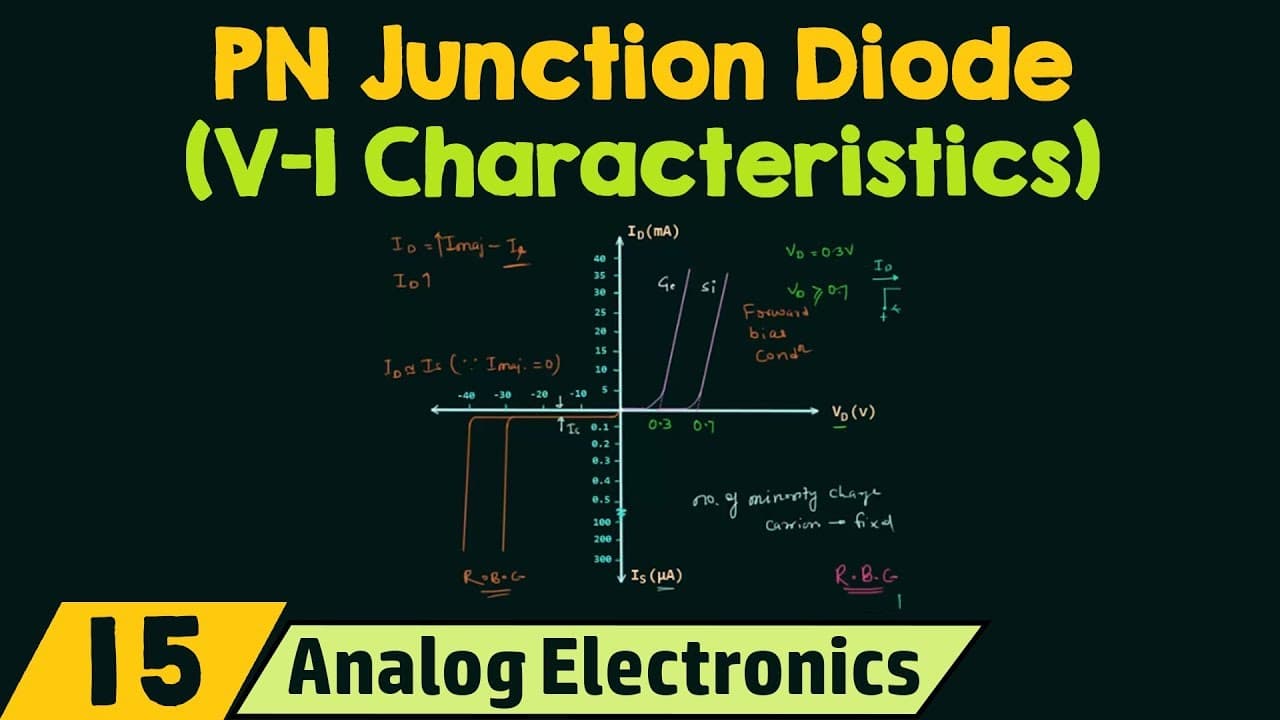
A PN junction diode conducts rapidly once forward voltage reaches its barrier potential, about 0.3 V for germanium and 0.7 V for silicon. Under reverse bias, only a small reverse saturation current flows until the breakdown voltage is reached, when carrier multiplication causes a sudden current increase. Peak inverse voltage identifies the maximum safe reverse voltage before breakdown.
Transcript
in this lecture we will study volts ampere characteristics of p and Junction diode x-axis represents voltage across the diode and Y AIS represents current through the diode in this lecture we will draw W sampure characteristics for both forward and reverse bass condition and if you remember the forward bias condition we connect positive terminal of... Read More
Key Insights
- The diode V-I characteristic is a plot of voltage across the diode on the x-axis against current through the diode on the y-axis, covering both forward-bias and reverse-bias operating conditions.
- The no-bias diode current is zero because substituting a diode voltage of zero into the stated current equation makes the exponential term equal to one, leaving the reverse saturation current multiplied by zero.
- Forward bias is established by connecting the battery's positive terminal to the P side and its negative terminal to the N side, which reduces both the depletion-layer width and the junction's barrier potential.
- The forward current rises rapidly when the applied diode voltage reaches the barrier potential. The lecture gives barrier potentials of 0.3 V for germanium and 0.7 V for silicon, followed by exponential current growth.
- Reverse bias is established by connecting the positive terminal to the N side and the negative terminal to the P side. Under this condition, the diode voltage is negative and the current approaches negative reverse saturation current.
- Reverse saturation current is a very small leakage current, stated to be in the order of microamperes. It is associated with minority charge carriers rather than the majority-carrier current that dominates forward conduction.
- Breakdown voltage is the reverse-bias voltage at which current suddenly rises. High-energy electrons break covalent bonds, free additional electrons, and initiate repeated collisions that multiply carriers through a chain reaction.
- Peak inverse voltage is the maximum reverse-bias voltage that can be applied across a diode before it enters the breakdown or Zener region. Exceeding this operating limit can subject a normal diode to power it cannot withstand.
Install to Summarize YouTube Videos and Get Transcripts
Explore YouTube Video Summarizer or Get YouTube Transcript Extractor
Questions & Answers
Q: How does a PN junction diode V-I curve work?
A PN junction diode V-I curve shows diode voltage on the x-axis and diode current on the y-axis. In forward bias, current stays small at first and then rises rapidly near the barrier potential. In reverse bias, a small reverse saturation current flows until the breakdown voltage is reached, where current increases suddenly.
Q: How is a PN junction diode connected in forward bias?
A PN junction diode is forward biased by connecting the positive terminal of the battery to the P side and the negative terminal to the N side. As the applied forward voltage increases, the depletion-layer width and barrier potential decrease. Current becomes substantial when the voltage reaches or exceeds the diode's barrier potential.
Q: What happens when no voltage is applied to a diode?
When the voltage across the diode is zero, the condition is called no applied bias. Substituting zero voltage into the stated diode-current equation makes the exponential term equal to one. The expression inside the brackets becomes one minus one, so the resulting diode current is also zero.
Q: When does forward current rise rapidly in a PN diode?
Forward current rises rapidly when the applied diode voltage becomes equal to the barrier potential, allowing a flood of electrons to cross the junction. The lecture states a barrier potential of 0.3 V for germanium and 0.7 V for silicon. Increasing the voltage further causes the current to grow exponentially.
Q: How is a PN junction diode connected in reverse bias?
A PN junction diode is reverse biased by connecting the positive battery terminal to the N side and the negative terminal to the P side. The voltage across the diode is then negative. The exponential term in the diode-current equation becomes less than one and can be neglected, leaving approximately negative reverse saturation current.
Q: What is reverse saturation current in a diode?
Reverse saturation current is the small current that flows through a reverse-biased diode, and it is also called leakage current. Its direction is opposite to the forward-current direction. The lecture associates it with minority charge carriers and states that its magnitude is very small, in the order of microamperes.
Q: Why does diode current rise suddenly at breakdown voltage?
At a sufficiently high reverse-bias voltage, electrons acquire high kinetic energy and break covalent bonds, becoming free. These electrons collide with other electrons and free them as well. The newly released electrons repeat the process, creating a chain reaction that produces the sudden rise in current identified as diode breakdown.
Q: What is peak inverse voltage in a PN junction diode?
Peak inverse voltage, or PIV, is the maximum reverse-bias voltage that can be applied across a diode before it enters the breakdown or Zener region. It defines the reverse-voltage operating limit. The lecture warns that a normal diode exposed to a large reverse potential may not withstand the resulting high power dissipation.
Summary & Key Takeaways
-
The diode V-I graph places voltage across the diode on the x-axis and current through it on the y-axis. With no applied bias, the diode voltage and current are both zero. Forward bias connects the P side to positive potential and the N side to negative potential.
-
Increasing forward voltage reduces the depletion-layer width and barrier potential. Current initially remains very small, but rises rapidly when the applied voltage reaches the barrier potential. The stated barrier values are 0.3 V for germanium and 0.7 V for silicon, after which diode current increases exponentially.
-
Reverse bias connects the P side to negative potential and the N side to positive potential. A small reverse saturation current flows until breakdown voltage is reached. Breakdown produces a sudden current rise through a chain reaction of freed electrons. Peak inverse voltage defines the maximum reverse voltage before breakdown.
Read in Other Languages (beta)
Share This Summary 📚
Summarize YouTube Videos and Get Video Transcripts with 1-Click
Try YouTube Summary with ChatGPT & Claude or YouTube Transcript Generator
Explore More Summaries from Neso Academy 📚






Summarize YouTube Videos and Get Video Transcripts with 1-Click
Try YouTube Summary with ChatGPT & Claude or YouTube Transcript Generator