How to Access Characters and Substrings in Python
TL;DR
Access a Python string character by placing its index inside square brackets, such as statement[0] for the first character or statement[-1] for the last. To extract a substring, use slicing with a start and end index, such as statement[1:4], remembering that the start is included while the end is excluded.
Transcript
foreign we will try to understand how to access characters in a string in Python programming language so without any further delay let's get started in this presentation we will discuss the following topics the first topic is accessing individual characters in a string the second topic is accessing individual characters in a string from the last an... Read More
Key Insights
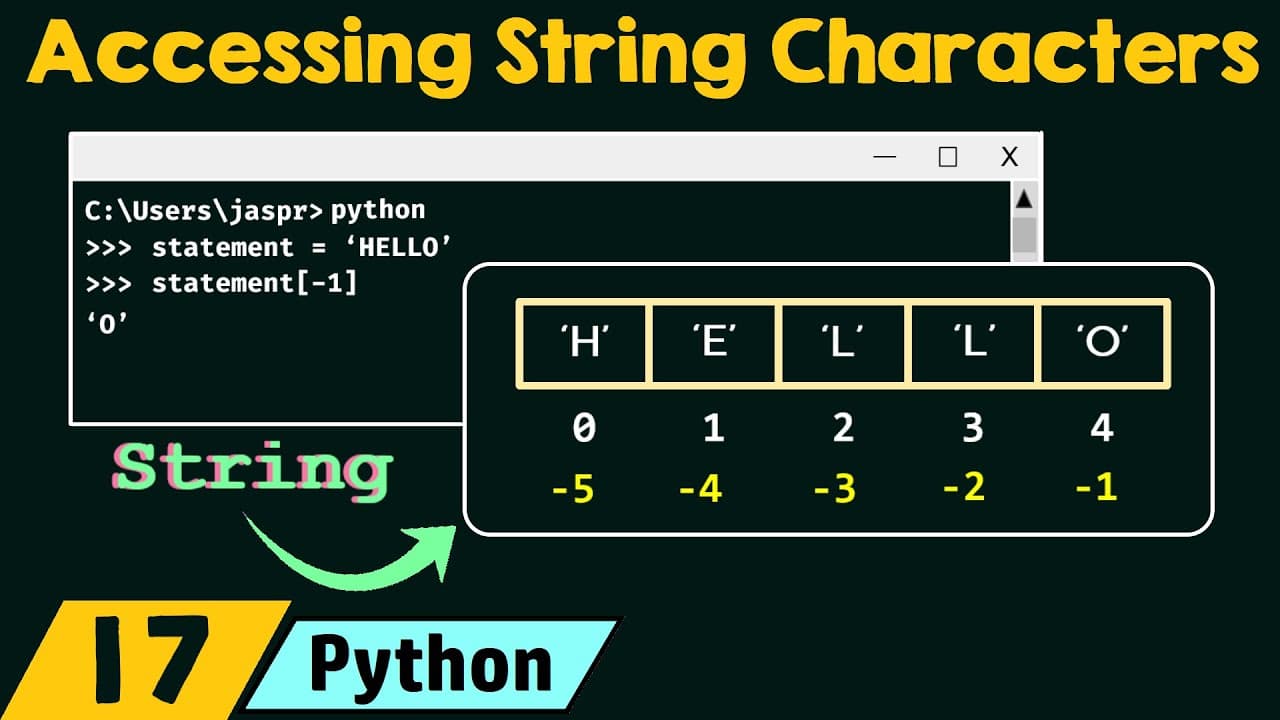
- Python string indexing assigns each character a unique position, beginning at 0 and continuing through the string length minus 1. In the five-character string "hello", the valid positive indices therefore range from 0 through 4.
- An individual character is accessed by writing a string variable followed by its index inside square brackets. After assigning "hello" to statement, statement[0] accesses the first character, while statement[2] accesses the character at index 2.
- Negative indexing counts backward from the end of a string. The final character receives index -1, the preceding character receives -2, and the sequence continues until the first character, whose negative index equals the negative length of the string.
- The main benefit of statement[-1] is that it retrieves the last character without requiring the string's length. For the value "hello", this expression returns "o" because "o" occupies the final position and therefore has negative index -1.
- A substring is a part of a string, and Python accesses a range of characters through slicing. The basic slicing syntax places a start index, a colon, and an end index inside square brackets after the string variable.
- A Python slice includes the character at its start index but excludes the character at its end index. Consequently, statement[1:4] accesses indices 1, 2, and 3 of "hello", producing the substring "ell" rather than "ello".
- An omitted slice start means that extraction begins at the first character, whose default start index is 0. For example, statement[:4] is an alternative to statement[0:4], and both expressions produce "hell" from the string "hello".
- Negative indices can define substring boundaries as well as individual character positions. With statement assigned "hello", statement[-4:-1] begins at negative index -4 and stops before negative index -1, so the resulting substring is "ell".
Install to Summarize YouTube Videos and Get Transcripts
Explore YouTube Video Summarizer or Get YouTube Transcript Extractor
Questions & Answers
Q: How do you access an individual character in a Python string?
Assign the string to a variable, then place the desired character index inside square brackets after that variable. If statement contains "hello", statement[0] accesses the first character because positive indexing begins at 0. Similarly, statement[1] accesses the character at index 1, and statement[2] accesses the character at index 2.
Q: Why does Python string indexing start at 0?
The presentation describes Python as assigning each string character a unique index that starts at 0 and ends at the string length minus 1. Therefore, a string containing five characters has positive indices from 0 through 4. These index values can then be placed inside square brackets to access the corresponding individual characters.
Q: How do you access the last character of a Python string?
Use negative index -1 inside square brackets after the string variable. If statement contains "hello", statement[-1] returns "o" because the last character of any string receives the negative index -1. This approach does not require knowing or calculating the length of the string before accessing its final character.
Q: What is negative indexing in Python strings?
Negative indexing assigns positions to characters by counting backward from the end of a string. The last character has index -1, the character before it has index -2, and counting continues toward the beginning. In the five-character string "hello", the negative indices extend from -1 at the end through -5 at the beginning.
Q: How do you extract a substring from a Python string?
Use slicing by writing the string variable followed by square brackets containing a start index, a colon, and an end index. For example, if statement contains "hello", statement[1:4] extracts "ell". The slice begins with the character at index 1 and continues through index 3, stopping before index 4.
Q: Is the end index included in a Python string slice?
No, the character at the end index is excluded from a Python string slice. A slice includes the start index and continues only through the position immediately before the end index. Thus, statement[1:4] applied to "hello" includes characters at indices 1, 2, and 3, producing "ell" without the character at index 4.
Q: What happens when the start index is omitted from a string slice?
Omitting the start index makes the slice begin at the first character because the default start index is 0. If statement contains "hello", statement[:4] produces "hell". It has the same result as statement[0:4], since both begin at index 0 and stop before the character located at index 4.
Q: How do negative indices work in Python string slicing?
Negative indices can be used as both the start and end boundaries of a slice. If statement contains "hello", statement[-4:-1] begins at the character with negative index -4 and continues through negative index -2. It stops before negative index -1, so the last character is excluded and the resulting substring is "ell".
Summary & Key Takeaways
-
Python assigns an index to every character in a string, beginning with 0 and ending at the string length minus 1. After assigning "hello" to the variable statement, expressions such as statement[0], statement[1], and statement[2] access individual characters using their corresponding positions inside square brackets in the string.
-
Negative indexing accesses string characters by counting backward from the end. The last character has index -1, the preceding character has index -2, and this continues to the negative length of the string. Therefore, statement[-1] returns the final character without requiring the programmer to determine the string's length in advance.
-
Slicing extracts a substring with the syntax variable[start:end]. The character at the start index is included, while the character at the end index is excluded. For "hello", statement[1:4] produces "ell". A missing start defaults to 0, and negative indices can also define a slice, as in statement[-4:-1].
Read in Other Languages (beta)
Share This Summary 📚
Summarize YouTube Videos and Get Video Transcripts with 1-Click
Try YouTube Summary with ChatGPT & Claude or YouTube Transcript Generator
Explore More Summaries from Neso Academy 📚





Summarize YouTube Videos and Get Video Transcripts with 1-Click
Try YouTube Summary with ChatGPT & Claude or YouTube Transcript Generator