How Did AMD Surpass Intel in the Semiconductor Market?
TL;DR
AMD surpassed Intel in market capitalization through strategic diversification into sectors like automotive and healthcare, along with strong performance metrics. Under CEO Lisa Su's leadership, AMD focused on innovative chip designs and eliminated its manufacturing concerns by partnering with TSMC, effectively navigating a changing semiconductor landscape.
Transcript
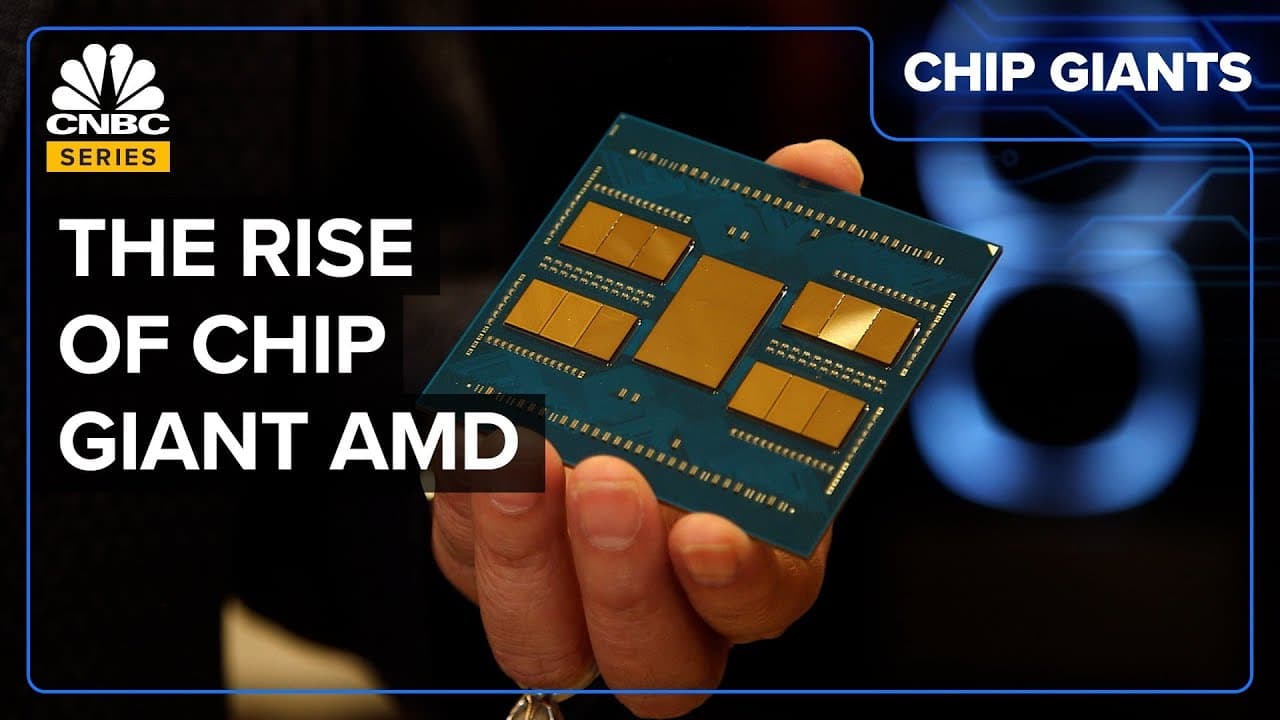
So this is Genoa, and Genoa is our latest data center server processor. It's actually 13 chips on one package. At the heart of all the most advanced computers, data centers and gaming consoles there are two kinds of processors. You know, we're in a world today where chips are everywhere. They're powering everything. And only one company in the worl... Read More
Key Insights
- 🧡 AMD's chips are powering a wide range of devices, including Teslas, Mars rovers, and the world's fastest supercomputer.
- 🕵️♀️ The leadership of CEO Lisa Su, the first female CEO of a major semiconductor company, has been instrumental in AMD's resurgence.
- #️⃣ AMD's success is partly due to its ability to excel in key metrics and surpass Intel's market cap by focusing on innovative chip designs.
- 💗 The company has diversified its offerings and entered new sectors, capitalizing on growing customization trends in the semiconductor industry.
- 🐿️ AMD has addressed concerns related to dependence on overseas manufacturing by partnering with TSMC and supporting domestic chip production efforts in the US.
- 🐿️ The pandemic has highlighted the importance of chips in enabling various aspects of daily life, increasing awareness of their significance.
- 👶 Challenges in the semiconductor industry include a slowdown in technological advancements and the emergence of new architectural trends, such as ARM.
Install to Summarize YouTube Videos and Get Transcripts
Explore YouTube Video Summarizer or Get YouTube Transcript Extractor
Questions & Answers
Q: How has AMD managed to make a remarkable comeback in the semiconductor industry?
AMD's success can be attributed to various factors, including its expansion into new sectors, such as automotive and healthcare, and excelling in key metrics that matter. CEO Lisa Su's leadership and strategic decisions have also played a crucial role in AMD's resurgence.
Q: What are the major competitors of AMD in designing advanced microprocessors?
AMD faces major competition from Intel in CPUs (central processing units) and NVIDIA in GPUs (graphics processing units). While AMD controls less market share than its competitors, it has been able to surpass Intel's market cap and gain recognition for its performance and innovation.
Q: How has AMD dealt with the challenges of dependence on overseas manufacturing and potential supply chain vulnerabilities?
AMD, along with other companies, has faced challenges due to dependence on overseas manufacturing, particularly in China and Taiwan. To address this, the US government has enacted the CHIPS Act, providing funds for domestic chip production. Additionally, AMD has partnered with Taiwan Semiconductor Manufacturing Company (TSMC), a leading chip manufacturer, and is expanding its presence in the US with the construction of a chip fab in Arizona.
Q: How has AMD diversified its offerings and entered new sectors?
Under CEO Lisa Su's leadership, AMD has expanded beyond its traditional focus on computing chips. It has entered sectors such as automotive, aerospace, defense, and healthcare applications, providing solutions in areas like smart cameras, robotics, avionics, and medical systems. AMD's acquisition of Xilinx, known for its adaptive chips, has further strengthened its presence in diverse industries.
Key Insights:
- AMD's chips are powering a wide range of devices, including Teslas, Mars rovers, and the world's fastest supercomputer.
- The leadership of CEO Lisa Su, the first female CEO of a major semiconductor company, has been instrumental in AMD's resurgence.
- AMD's success is partly due to its ability to excel in key metrics and surpass Intel's market cap by focusing on innovative chip designs.
- The company has diversified its offerings and entered new sectors, capitalizing on growing customization trends in the semiconductor industry.
- AMD has addressed concerns related to dependence on overseas manufacturing by partnering with TSMC and supporting domestic chip production efforts in the US.
- The pandemic has highlighted the importance of chips in enabling various aspects of daily life, increasing awareness of their significance.
- Challenges in the semiconductor industry include a slowdown in technological advancements and the emergence of new architectural trends, such as ARM.
- AMD continues to advance its x86 core computing chips while embracing diversification and making strategic bets on future technology trends.
Summary & Key Takeaways
-
AMD, known for its computing chips, is now branching out and its chips are being used in Teslas, Mars rovers, 5G cell towers, and supercomputers.
-
Despite facing challenges in the past, AMD has surpassed Intel's market cap and is excelling in metrics that matter.
-
Under the leadership of CEO Lisa Su, AMD has diversified its offerings and entered industrial, aerospace, defense, and healthcare applications.
Read in Other Languages (beta)
Share This Summary 📚
Summarize YouTube Videos and Get Video Transcripts with 1-Click
Try YouTube Summary with ChatGPT & Claude or YouTube Transcript Generator
Explore More Summaries from CNBC 📚





Summarize YouTube Videos and Get Video Transcripts with 1-Click
Try YouTube Summary with ChatGPT & Claude or YouTube Transcript Generator