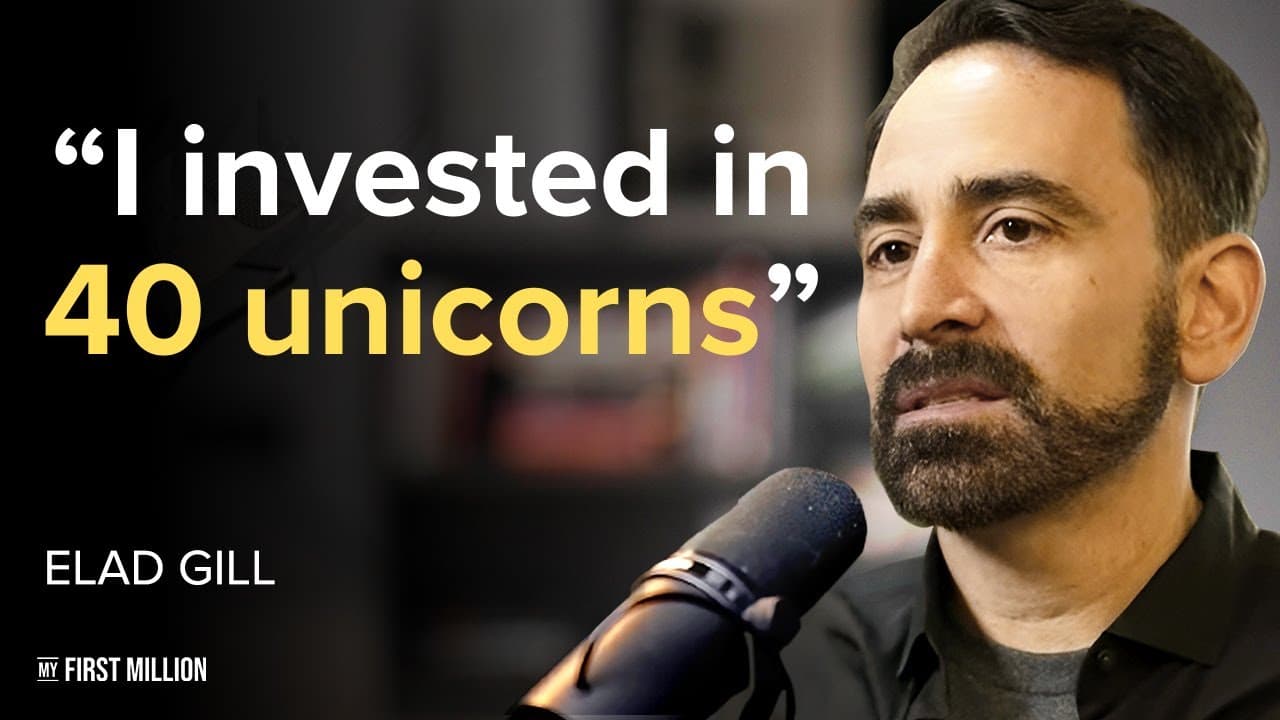
How Elad Gil Identifies High-Potential Startups
TL;DR
Elad Gil evaluates early-stage startups by prioritizing the market, the product-market relationship, and major technology shifts while still recognizing that founders matter. He develops conviction by working directly with emerging tools, identifying the small number of conditions a business must satisfy, and looking beyond fashionable investment narratives.
Transcript
all right today we were sitting down with one of the smartest people that's ever been on this podcast his name is elad Gil and he is a prolific angel investor he's a guy who has invested in something like 40 plus billion dollar companies all at very early stages like Airbnb air table and real retool ripling companies that we've all heard of down th... Read More
Key Insights
- Gil's investment approach is primarily market-first rather than founder-first. He considers founders extremely important, but he gives unusual weight to what is being built, the intended customer, and the market because even highly capable people can be overwhelmed by poor market conditions.
- Technological change is a source of early investment opportunities. Gil became involved with generative AI companies before widely discussed products made the category fashionable because he was already interested in machine learning, related technologies, and the markets those developments could transform.
- Gil's early investment bankroll came from committing his own money. He invested a large share of what he had earned, eventually encountered capital constraints, and then expanded his capacity through special-purpose vehicles, funds, and combinations of those structures for larger opportunities.
- Hands-on building is a method for developing investment intuition. Gil's translation and audiobook project requires practical comparison of AI tools, management of long-form consistency, and quality assurance, giving him deeper knowledge than he would gain from considering the technology only as an investment category.
- Societal usefulness is a longstanding motivation in Gil's career. He connects that orientation to his studies in mathematics and biology, his biology doctorate, and current projects intended to make important historical works available across languages rather than focusing exclusively on short-term financial returns.
- A business usually depends on a very small number of decisive conditions. Gil argues that founders and investors often become distracted by lists of seemingly important considerations when the central task is identifying the single belief or outcome that makes the rest of the business plausible.
- Stripe's early strategic focus was developer adoption among important young technology companies. Gil presents this as an example of concentrating on the decisive objective while postponing concerns about broader customer segments and other possible priorities until the foundational position was established.
- Complex businesses can require several essential capabilities rather than one. Gil says his analysis of a next-generation defense technology company involved a defined set of requirements for becoming a major prime contractor, showing that simplification should reflect the business rather than become a rigid rule.
Install to Summarize YouTube Videos and Get Transcripts
Explore YouTube Video Summarizer or Get YouTube Transcript Extractor
Questions & Answers
Q: How does Elad Gil evaluate early-stage startups?
Elad Gil begins with the market, the product-market relationship, and the technological changes shaping the opportunity. He still regards founders as extremely important, drawing on his own experience starting companies, but he does not treat founder quality as sufficient. He asks what the company is building, whom it serves, and whether the market can support a meaningful outcome.
Q: Why does market selection matter in startup investing?
Market selection matters because strong founders can still be crushed by poor market conditions, while less exceptional operators can perform well when the environment is favorable. Gil therefore examines the underlying market alongside the product and customer. His approach treats founder assessment as only one part of the decision instead of allowing personal admiration for a team to outweigh the opportunity itself.
Q: How can investors identify important technology waves early?
Investors can identify technology waves early by following technical change before it becomes a popular investment narrative. Gil describes becoming interested in generative AI and machine-learning-related companies before prominent consumer products made the category widely discussed. Sustained curiosity about the technology and its market implications helped him find companies such as Perplexity and Harvey at an early stage.
Q: How did Elad Gil expand his startup investment bankroll?
Gil initially invested his own money and committed a substantial share of it to private companies. When his personal capital became constrained, he began raising small special-purpose vehicles, which later developed into funds. His current structure includes personal investments, fund investments, and combinations of funds with special-purpose vehicles when an opportunity requires more capital.
Q: Why does Elad Gil work on projects alongside investing?
Gil wants to remain a builder who also invests. Practical projects force him to use technologies directly, compare competing tools, confront operational problems, and develop informed intuition. His work translating public-domain books and producing audiobooks, for example, requires solving consistency and quality-assurance problems that would remain abstract if he only evaluated AI companies from a distance.
Q: What is the most important question for understanding a business?
The most important question is which single condition, belief, or outcome makes the business work. Gil says many people focus on several considerations even though most businesses depend primarily on one decisive factor, or occasionally a small group of factors. Finding that core requirement helps separate foundational strategy from routine tasks, secondary concerns, and distracting noise.
Q: What does Stripe illustrate about strategic focus?
Stripe illustrates how a company can organize its early strategy around one clear objective. Gil says its central insight was to get developers, particularly those at important early-stage technology companies, using the product. That focus allowed the company to avoid being distracted initially by broader customer segments and other concerns that were less important than establishing developer adoption.
Q: How does hands-on work improve investment judgment?
Hands-on work improves judgment by revealing which technical and operational problems actually determine whether a product succeeds. Gil argues that direct use can push someone beyond a superficial view of an investment category. Comparing AI tools, maintaining consistency across long-form translations, and designing quality assurance can expose the capabilities and limitations that matter most in real applications.
Summary & Key Takeaways
-
Gil attributes his investment record to a combination of luck, favorable timing, market-focused analysis, and sustained attention to technological change. Rather than evaluating startups mainly through founder quality, he studies what they are building, whom it serves, and whether the chosen market can support an important company.
-
His path from personal angel investing to larger deals began with committing a substantial share of his own money. After his available capital became constrained, he raised special-purpose vehicles and later funds, eventually developing several ways to participate through personal investments, fund investments, and combined fund and special-purpose structures.
-
Gil treats building and investing as complementary activities. Hands-on projects force him to compare tools, solve practical problems, and discover which variables truly determine success. His central analytical habit is reducing a business to its decisive belief or requirement while treating many secondary concerns as noise or routine execution.
Read in Other Languages (beta)
Share This Summary 📚
Summarize YouTube Videos and Get Video Transcripts with 1-Click
Try YouTube Summary with ChatGPT & Claude or YouTube Transcript Generator
Explore More Summaries from My First Million 📚




Summarize YouTube Videos and Get Video Transcripts with 1-Click
Try YouTube Summary with ChatGPT & Claude or YouTube Transcript Generator