How to Build Effective AI Agents Using Code and No-Code Tools
TL;DR
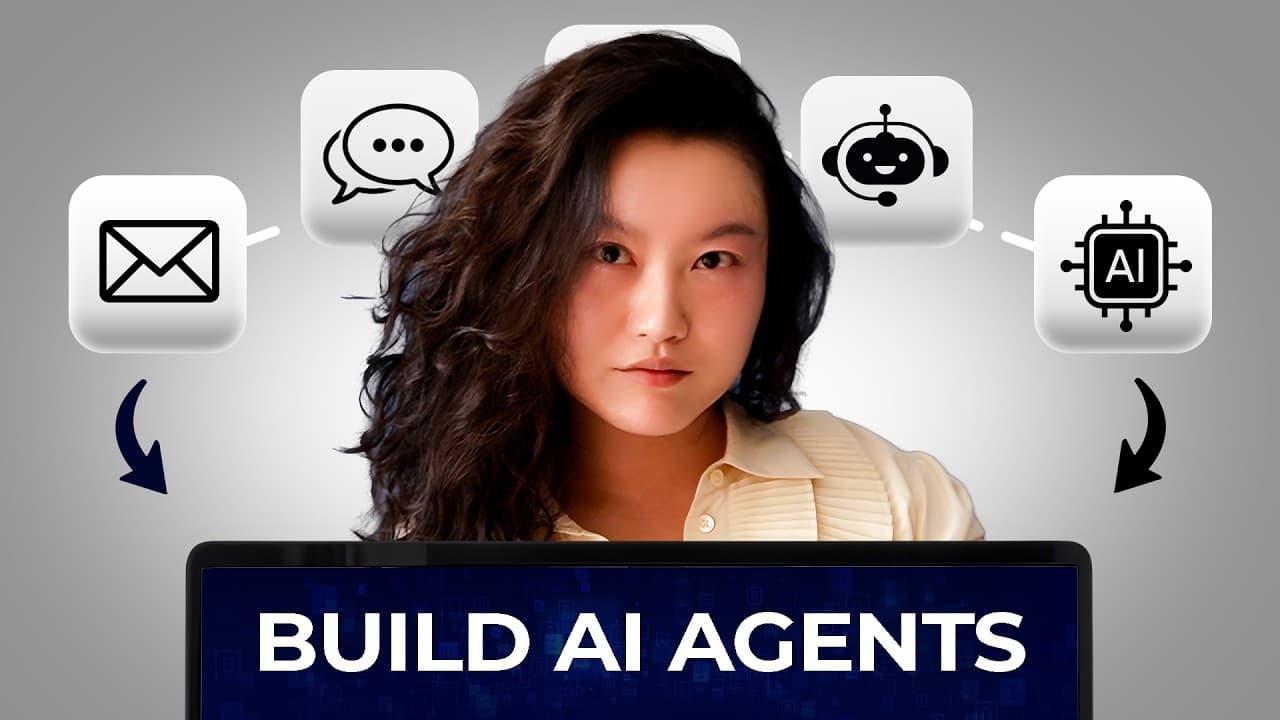
To build effective AI agents, understand key components such as models, tools, and workflows like prompt chaining and routing. The video covers practical examples using both coding and no-code solutions like n8n, emphasizing the importance of prompt engineering for optimal agent performance. It also highlights identifying business opportunities for AI agent development.
Transcript
i learned how to build ai agents for you i have spent hundreds of hours building ai agents and i actually run a program called lonely octopus where we teach people ai skills and give them the opportunity to build ai agents for companies as well so in this video i'm going to attempt to distill down everything that i've learned to give you that compr... Read More
Key Insights
- AI agents are systems that perceive their environment, process information, and autonomously take actions to achieve specific goals.
- The video provides a comprehensive guide to building AI agents using both code and no-code tools, catering to different skill levels.
- AI agents can be implemented using various workflows such as prompt chaining, routing, parallelization, and more, depending on the complexity of the task.
- Prompt engineering is crucial for AI agents, with specific components needed in the prompt to ensure effective task execution.
- Different components like models, tools, knowledge and memory, audio and speech, guardrails, and orchestration are essential in building AI agents.
- The video includes practical examples of AI agents implemented using tools like n8n and OpenAI's agents SDK.
- The presenter emphasizes the importance of understanding foundational concepts to avoid common mistakes in AI agent development.
- The video suggests leveraging existing SaaS models to inspire AI agent development, indicating potential business opportunities.
Install to Summarize YouTube Videos and Get Transcripts
Explore YouTube Video Summarizer or Get YouTube Transcript Extractor
Questions & Answers
Q: What are the foundational components of an AI agent?
The foundational components of an AI agent include models, tools, knowledge and memory, audio and speech, guardrails, and orchestration. Models provide the core intelligence, tools enable interaction with the world, knowledge and memory offer static and dynamic information, audio and speech facilitate natural language interaction, guardrails prevent undesirable behavior, and orchestration manages the deployment and monitoring of agents.
Q: How does prompt engineering impact AI agent performance?
Prompt engineering is critical for AI agent performance as it defines the agent's role, task, input, output, constraints, and capabilities. A well-crafted prompt ensures the agent understands its objectives and limitations, leading to more accurate and efficient task execution. The video emphasizes the need for a comprehensive prompt to guide the agent's actions effectively.
Q: What are some common workflows for implementing AI agents?
Common workflows for implementing AI agents include prompt chaining, routing, parallelization, orchestrator-worker, evaluator-optimizer, and fully autonomous agents. Each workflow is suited to different task complexities, from simple sequential tasks to complex, dynamic problem-solving scenarios. The choice of workflow depends on the specific requirements and goals of the AI agent.
Q: What is the role of models in AI agents?
Models are the core intelligence of AI agents, capable of reasoning, decision-making, and processing various modalities. They determine the agent's ability to understand and act upon the information it receives. Different models offer varying capabilities, such as advanced reasoning, coding proficiency, or multi-step problem-solving, and the choice of model depends on the agent's specific use case.
Q: How can AI agents be used in customer service?
AI agents can be used in customer service to handle inquiries, communicate with customers, and resolve issues autonomously. They can be implemented using workflows like routing, where a sub-agent directs queries to specialized agents based on the nature of the inquiry. This enables efficient handling of diverse customer service tasks, improving response times and customer satisfaction.
Q: What tools are available for building AI agents without coding?
No-code or low-code platforms like n8n allow users to build AI agents without extensive coding knowledge. These platforms offer drag-and-drop interfaces and pre-built integrations with various tools, enabling users to create and deploy AI agents for different tasks. Such tools democratize AI development, making it accessible to a broader audience.
Q: How can businesses identify opportunities for AI agent development?
Businesses can identify opportunities for AI agent development by analyzing their current processes and identifying tasks that can be automated or improved with AI. By understanding the pain points and inefficiencies in existing workflows, businesses can design AI agents that enhance productivity and drive value. Additionally, observing industry trends and leveraging existing SaaS models can inspire innovative AI solutions.
Q: What are the potential future developments in AI agent technology?
Future developments in AI agent technology are likely to focus on advancements in voice and audio capabilities, image and video processing, and more sophisticated autonomous agents. These innovations will enable new use cases and improve the effectiveness and versatility of AI agents. Staying informed about these trends and understanding foundational concepts will be crucial for leveraging future opportunities in AI development.
Summary & Key Takeaways
-
The video is a practical guide to building AI agents, covering everything from foundational concepts to advanced implementations. It provides a detailed overview of the components and workflows involved in creating AI agents, with examples using both code and no-code tools.
-
Key components of AI agents include models, tools, knowledge and memory, audio and speech, guardrails, and orchestration. The video explains how these components work together to create effective AI agents and provides insights into prompt engineering for optimal performance.
-
The presenter offers practical demonstrations of AI agents built with n8n and OpenAI's agents SDK, showcasing various workflows like prompt chaining and routing. The video also provides advice on identifying opportunities for AI agent development in business settings.
Read in Other Languages (beta)
Share This Summary 📚
Summarize YouTube Videos and Get Video Transcripts with 1-Click
Try YouTube Summary with ChatGPT & Claude or YouTube Transcript Generator
Explore More Summaries from Tina Huang 📚



Summarize YouTube Videos and Get Video Transcripts with 1-Click
Try YouTube Summary with ChatGPT & Claude or YouTube Transcript Generator