Tail Recursion Explained - Computerphile
TL;DR
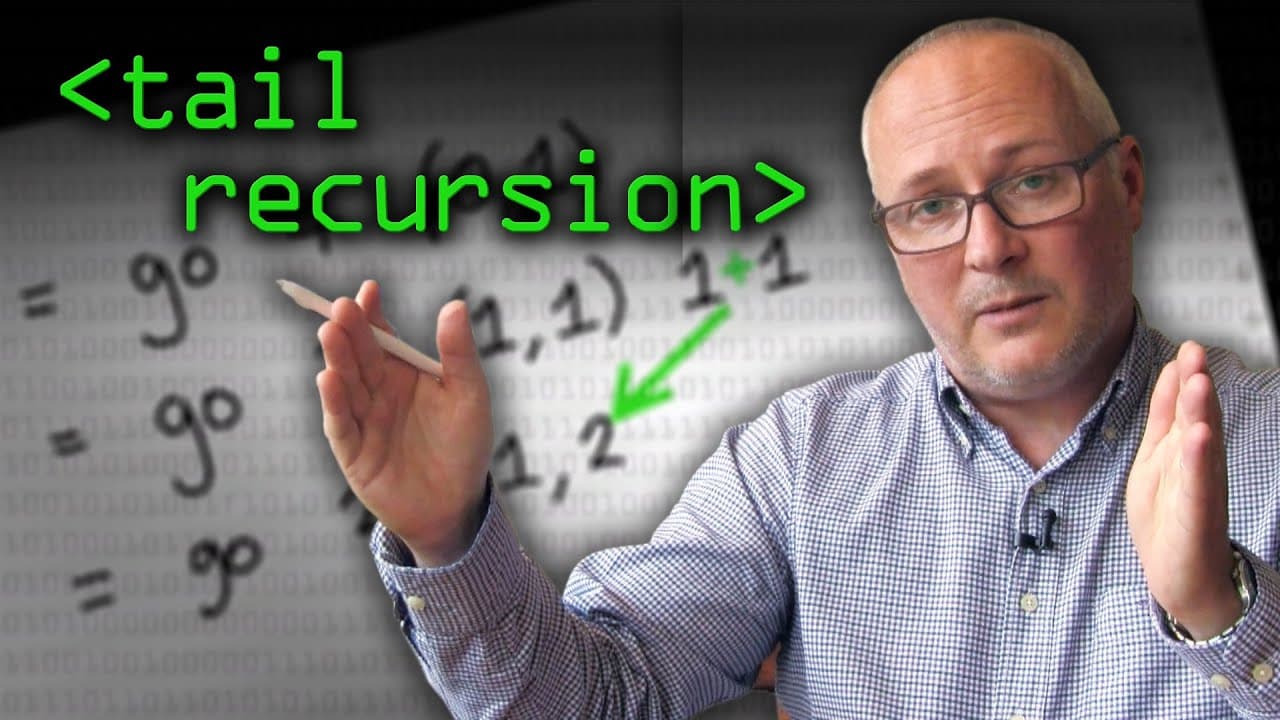
Tail recursion is a technique used to make recursive programs more efficient by making the recursive call the last operation, reducing memory usage.
Transcript
so computer files done quite a bit on recursion but so far we haven't talked about the idea of tail recursion which is a simple trick for making recursive programs more efficient and really it's something that every programmer should know about so that's what we're going to look at today tail recursion so as we often do with these things we're goin... Read More
Key Insights
- 🍸 Tail recursion is a technique to make recursive programs more efficient by making the recursive call the last operation.
- ❓ Recursion can be inefficient due to excessive memory usage and recomputation of the same values.
- 🍸 Tail recursion improves efficiency by reducing memory usage and eliminating the need for recomputation.
- 🍸 It is important for programmers to understand and utilize tail recursion to optimize their recursive programs.
Install to Summarize YouTube Videos and Get Transcripts
Explore YouTube Video Summarizer or Get YouTube Transcript Extractor
Questions & Answers
Q: What is tail recursion?
Tail recursion is a technique where the recursive call is the last operation in a function. This optimization reduces memory usage and improves efficiency.
Q: Why is recursion inefficient?
Recursion can be inefficient because it often requires building up large intermediate expressions before performing calculations, resulting in high memory usage.
Q: How does tail recursion improve efficiency?
Tail recursion improves efficiency by eliminating the need for remembering intermediate operations and reducing memory usage. The recursive call is the last operation, allowing calculations to be performed immediately.
Q: Can compilers automatically optimize for tail recursion?
Some compilers can automatically optimize tail recursion by transforming the recursive function into an iterative equivalent. However, it is not always guaranteed, and manual tail recursion optimization may still be necessary.
Summary & Key Takeaways
-
Tail recursion is a method to optimize recursive programs by making the recursive call the last operation.
-
Recursion can be inefficient due to the need to build up large intermediate expressions before performing calculations.
-
The factorial function and the Fibonacci sequence are used as examples to demonstrate the concepts of tail recursion.
-
Tail recursion improves efficiency by minimizing memory usage and eliminating the need for recomputation.
Read in Other Languages (beta)
Share This Summary 📚
Summarize YouTube Videos and Get Video Transcripts with 1-Click
Try YouTube Summary with ChatGPT & Claude or YouTube Transcript Generator
Explore More Summaries from Computerphile 📚





Summarize YouTube Videos and Get Video Transcripts with 1-Click
Try YouTube Summary with ChatGPT & Claude or YouTube Transcript Generator