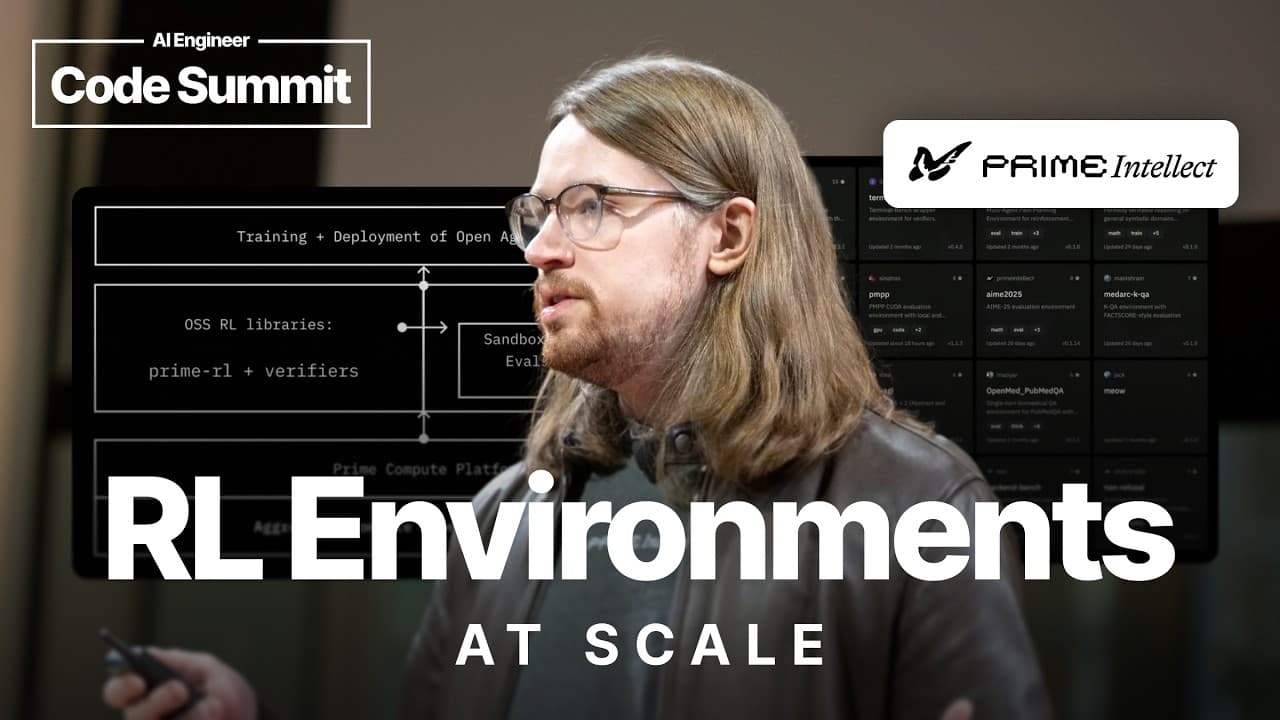
How Can RL Environments Scale AI Research?, Will Brown, Prime Intellect
TL;DR
RL environments can scale AI research by packaging a product-like harness with defined tasks and rewards into a reusable experimental system. Will Brown of Prime Intellect explains how this structure supports evaluation, synthetic data generation, supervised fine-tuning, distillation, reinforcement learning, and deployed agents, not merely thousands of parallel rollouts across hundreds of GPUs. Read on to see how environments and shared tools lower barriers to meaningful model experimentation.
Transcript
Today we're talking about RL environments and how to scale them. But the title is a little bit of a red herring. We'll talk a bit about the engineering pieces and like running these with thousands of parallel rollouts and sandboxes on hundreds of GPUs, but I'm mostly going to focus on a different notion of scale. Uh, and what I mean by scaling here... Read More
Key Insights
- Scaling AI research is partly a community problem, because ideas, applications, shared tools, and reusable abstractions allow researchers to build on previous work. Increasing compute, data, parameters, or inference time is only one form of progress discussed in the talk.
- The talent bottleneck can be addressed by increasing the pool of capable AI researchers. Prime Intellect aims to make research accessible to engineers and organizations that lack massive clusters, laboratory membership, extensive spending, or the need to complete a PhD.
- Open AI research is broader than releasing fixed model checkpoints. The talk compares a healthy research ecosystem with successful software ecosystems, emphasizing compounded abstractions, shared best practices, improved tooling, faster iteration, and lower barriers to building increasingly complex systems.
- The open super intelligence stack combines multiple layers needed for research. These include compute, orchestration, training and evaluation libraries, code execution, evaluation inference, and fine-tuning platforms, with the overall purpose of giving more people the ability to train and improve models.
- An RL environment is a harness paired with tasks and rewards. Training a model inside a harness that represents its intended product can align the model with the actual experience, making model behavior and product behavior closely connected.
- Environments are reusable across several research workflows. The same abstraction can function as an evaluation, generate synthetic data for supervised fine-tuning or distillation, support reinforcement learning directly, and represent deployed agents receiving a continuing stream of user tasks.
- A proper environment requires predefined tasks and rewards, which encourages scientific experimentation. Instead of relying on an informal impression of quality, builders can compare models, adjust hyperparameters, measure outcomes, and progress toward reinforcement learning, distillation, or fine-tuning.
- The Environments Hub and verifiers library lower the entry barrier to environment research. The hub enables open community sharing, while verifiers provides composable components for evaluations, games, question answering, tool use, sandboxes, agent frameworks, coding agents, and mathematics.
Install to Summarize YouTube Videos and Get Transcripts
Explore YouTube Video Summarizer or Get YouTube Transcript Extractor
Questions & Answers
Q: What is an RL environment for AI models?
An RL environment combines a harness with defined tasks and rewards. The harness represents the setting where a model or agent operates, while tasks establish its objectives and rewards provide measurable feedback.
Q: How do RL environments help scale AI research?
They turn a harness, tasks, and rewards into a reusable abstraction that researchers can share and build upon. This reduces repeated reinvention and lets more engineers and organizations conduct systematic experiments without belonging to a large research lab, operating massive clusters, or completing a PhD.
Q: Why is scaling AI research about more than compute?
The talk distinguishes resource scaling, adding data, compute, parameters, or inference time, from scaling research capacity. Communities also accelerate innovation by sharing ideas, testing techniques in applications, and creating reusable tools, abstractions, and best practices.
Q: How can RL environments be used beyond reinforcement learning?
The same environment can serve as an evaluation, generate synthetic data, and support supervised fine-tuning or distillation. It can also represent deployed agents that receive an ongoing stream of user tasks, connecting research workflows with product operation and monitoring.
Q: Why must an agent environment define tasks and rewards?
Tasks and rewards make model behavior measurable instead of leaving teams to rely on an informal impression of quality. With explicit criteria, builders can compare models, adjust hyperparameters, evaluate outcomes, and establish a foundation for reinforcement learning, fine-tuning, distillation, or synthetic-data generation.
Q: How can an RL environment align a model with its product?
A team can construct a harness that represents the intended product and train the model inside it. This makes the experience of using the model closely match the experience of using the product, giving builders more flexibility to customize models around the desired user experience.
Q: What is Prime Intellect’s Environments Hub?
The Environments Hub is an open-source community platform for creating, discovering, and sharing RL environments and evaluations. Builders can use it to develop original ideas, recreate research papers, adapt benchmarks for reinforcement learning, construct games, and explore other tasks.
Q: What does Prime Intellect’s verifiers library provide?
Verifiers provides composable components for constructing environments. It supports evaluations, question answering, games, tool use, sandboxes, agent frameworks, command-line coding agents, and mathematics, allowing researchers to mix and match components for different experiments.
Summary & Key Takeaways
-
Scaling RL environments involves more than running thousands of parallel rollouts across hundreds of GPUs. The broader goal is to increase research capacity by helping communities share ideas, tools, abstractions, applications, and best practices, allowing more people to conduct meaningful AI experiments without rebuilding every component or joining a large research laboratory.
-
Prime Intellect presents environments as a practical entry point into AI research. An environment combines a product-like harness with defined tasks and rewards, enabling systematic evaluation instead of informal judgment. The same structure can generate synthetic data, support supervised fine-tuning and distillation, enable reinforcement learning, and represent agents operating in deployed products.
-
The Environments Hub and the verifiers library are designed to make environment development easier. The hub supports community creation, discovery, and sharing, while verifiers supplies composable components for evaluations, question answering, games, tool use, sandboxes, agent frameworks, command-line coding agents, and mathematics. Together, they reduce barriers to experimentation and model customization.
Read in Other Languages (beta)
Share This Summary 📚
Summarize YouTube Videos and Get Video Transcripts with 1-Click
Try YouTube Summary with ChatGPT & Claude or YouTube Transcript Generator
Explore More Summaries from AI Engineer 📚






Summarize YouTube Videos and Get Video Transcripts with 1-Click
Try YouTube Summary with ChatGPT & Claude or YouTube Transcript Generator