GPT3: An Even Bigger Language Model - Computerphile
TL;DR
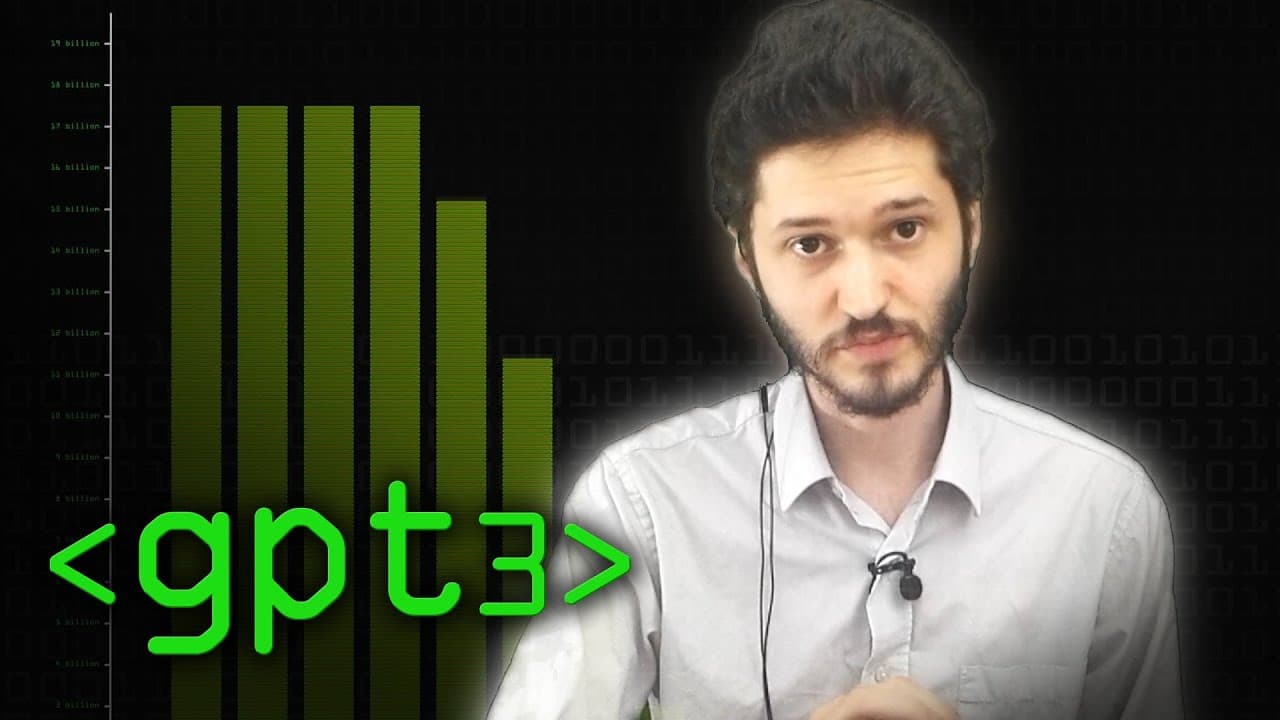
GPT-3, the latest language model developed by OpenAI, is 10 times bigger than its predecessor (GPT-2) and continues to show improved performance, pushing the limits of language modeling.
Transcript
rob welcome back to computer file in these strange times that we find ourselves recording in you've got the green screen up there we're having a few laggy problems with the communications what are you going to talk about today then uh yeah i thought uh today it would make sense to talk about gbt3 because before we had those videos about language mo... Read More
Key Insights
- 🥺 Scaling up language models like GPT-3 leads to improved performance, challenging the notion of diminishing returns.
- 🚂 GPT-3 demonstrates the ability to perform well in tasks like arithmetic, even though it is not explicitly trained for them.
- 🛀 The model exhibits few-shot learning capabilities, where it can learn from only a few examples, showing potential for efficient learning with limited data.
- 🛰️ While GPT-3's performance is impressive, it still has limitations and does not reach the level of general artificial intelligence.
Install to Summarize YouTube Videos and Get Transcripts
Explore YouTube Video Summarizer or Get YouTube Transcript Extractor
Questions & Answers
Q: How does GPT-3 compare to its predecessor GPT-2?
GPT-3 is 10 times bigger than GPT-2, with 175 billion parameters compared to GPT-2's 1.5 billion parameters. It continues to show improved performance, indicating that scaling up language models can still yield better results.
Q: Can GPT-3 generate human-like poetry?
Yes, GPT-3 can generate poems that are similar to those of renowned poets. However, it is difficult to determine whether a generated poem is written by a human or GPT-3, as humans familiar with poetry might recognize the originals.
Q: Can GPT-3 learn new knowledge or synthesize new concepts?
While GPT-3 is primarily a language model and not designed for abstract synthesis, there is a possibility that it can learn new knowledge by predicting the next word or token based on the context it has seen. However, it is uncertain if it can truly synthesize completely new concepts.
Q: How does GPT-3 perform in arithmetic tasks?
GPT-3 exhibits significant improvement in arithmetic tasks over GPT-2. While it cannot add 10-digit numbers, it can excel in addition and subtraction tasks involving two-digit or three-digit numbers. GPT-3 shows the ability to adapt and learn from context, leading to better performance.
Summary & Key Takeaways
-
GPT-3 is a larger and more advanced language model compared to GPT-2, with 175 billion parameters.
-
It builds upon the success of GPT-2 by demonstrating that scaling up language models can still lead to better performance.
-
GPT-3 shows impressive results in tasks like arithmetic, where it can accurately perform calculations, even though it is not specifically designed for such tasks.
Read in Other Languages (beta)
Share This Summary 📚
Summarize YouTube Videos and Get Video Transcripts with 1-Click
Try YouTube Summary with ChatGPT & Claude or YouTube Transcript Generator
Explore More Summaries from Computerphile 📚


Summarize YouTube Videos and Get Video Transcripts with 1-Click
Try YouTube Summary with ChatGPT & Claude or YouTube Transcript Generator